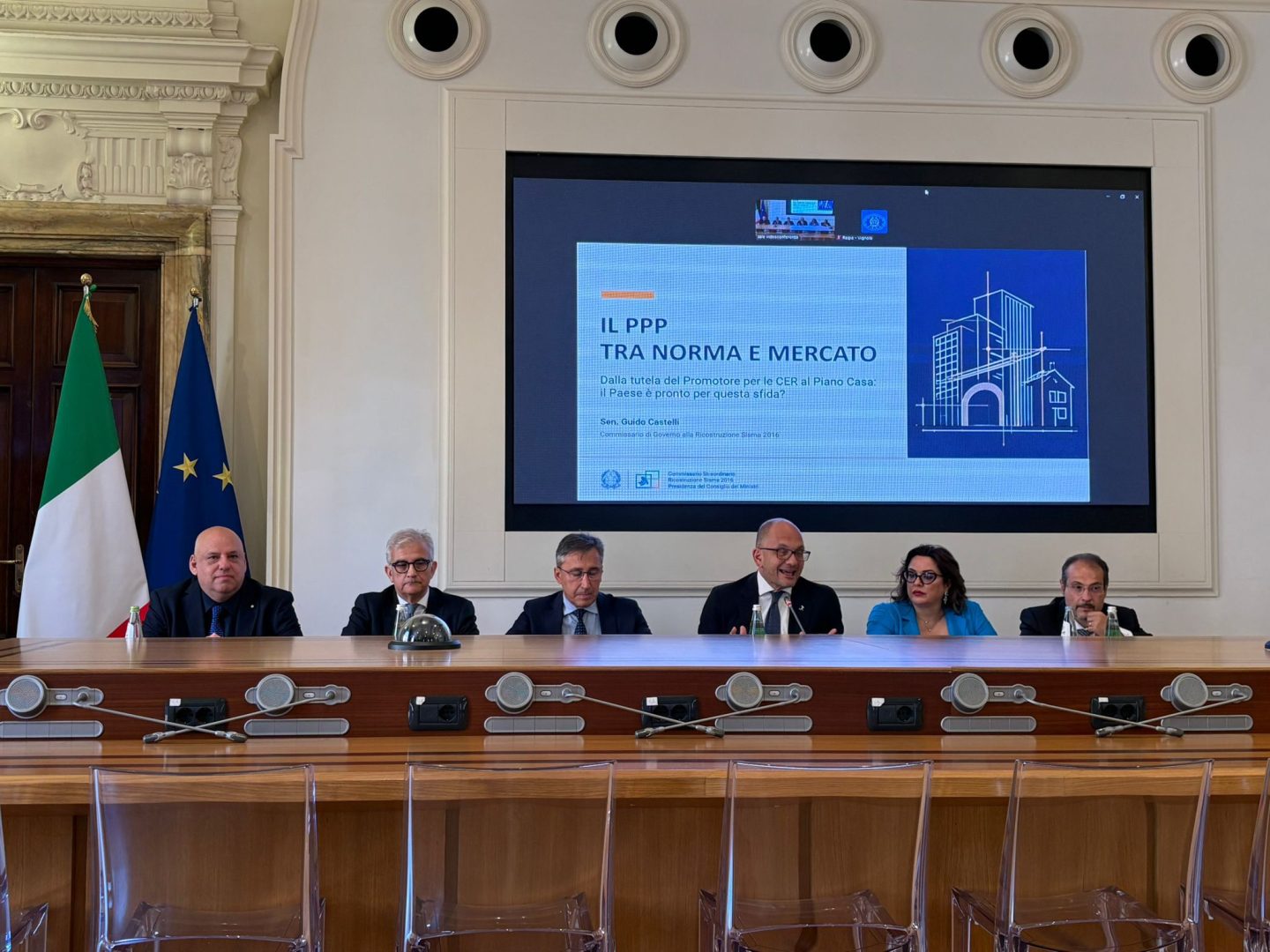
ROMA (ITALPRESS) – A comparison between institutions, experts, public companies and operators in the field on the role of the Private Public Partnership as a strategic tool to support investments, valorisation of public heritage, Renewable Energy Community and housing policies, with particular reference to the Home Plan: today, at the Monumental Hall of the Presidency of the Council of Ministers, the institutional conference “The Private Public Partnership between norms and market”.
The debate has started with the experience gained over the last three years by the Commission, which has seen 45 projects funded, of which 39 are being developed through private Public Partnership procedures. An operational laboratory that has highlighted the need to strengthen the competences of actuators, especially in the most fragile territories, where often lack the skills necessary to structure in autonomy complex operations of partnership.
The focus of the work is also the proposal of a National Competence Centre for the Private Public Partnership, operating and not only advisory, able to accompany concretely local administrations and territorial authorities in the construction of sustainable, bankable and coherent projects with the public interest.
The work was opened by Extraordinary Commissioner Sisma 2016, Guido Castelli. During the morning, among others, Renato Loiero, Council of Ministers, Federica Fabi, Aldo Areddu, Francesco Saverio E. Profiti, David Vicario, Marco Giustiniani, Laura Martiniello, Antonino Turicchi, Stefano Scalera and Paolo Crisafi, attended the round table.
The final session was dedicated to the political and institutional response, with the interventions of Lucia Albano, State Secretary to the Ministry of Economy and Finance, and Extraordinary Commissioner Guido Castelli. “The experience of the earthquake crater 2016 demonstrates that the PPP is not an abstract formula, nor a simple contractual technique, but a concrete lever to bring together public interest, private skills, economic sustainability and manufacturing capacity,” said Extraordinary Commissioner Guido Castelli. “In recent years we have verified how important it is not to leave actuators alone. To build a collaborative ecosystem on increasingly complex themes, skills in some transversal and multidisciplinary dimensions are needed, an approach that will allow public administration to do what is more likely to do, i.e. to put innovation in its strategic actions. The PPP also serves to benefit from an innovative approach that inevitably publishes the part to internalize.”.
For undersecretary Albano “no public administration can today face alone the challenge of urban redevelopment and the valorisation of public real estate. The size of the investments required and the complexity of the interventions make the involvement of private operators indispensable. However, private capital is active when it finds a credible vision, a stable regulatory framework. The role of the Cabin of Regia is precisely to reduce uncertainty, promote coordination and build a shared vision. We have promoted new investment models, enhancing the complementarity between Invimit and CDP Real Asset. The recent financial reinforcement measures that affected Invimit will allow more than one billion euros to be mobilized in the next three years,” he concluded.
The conference confirmed the centrality of the PPP as a possible paradigm of the relationship between the State and the market: not a replacement of the public, but a structured cooperation to achieve objectives of general interest. From the earthquake crater 2016 to the Piano Casa, the message emerged from the works is the need to move from experimental experiences to a stable national model, able to support local authorities, accelerate investments and give concrete answers to citizens.
-Photo Remind-
(ITALPRESS).