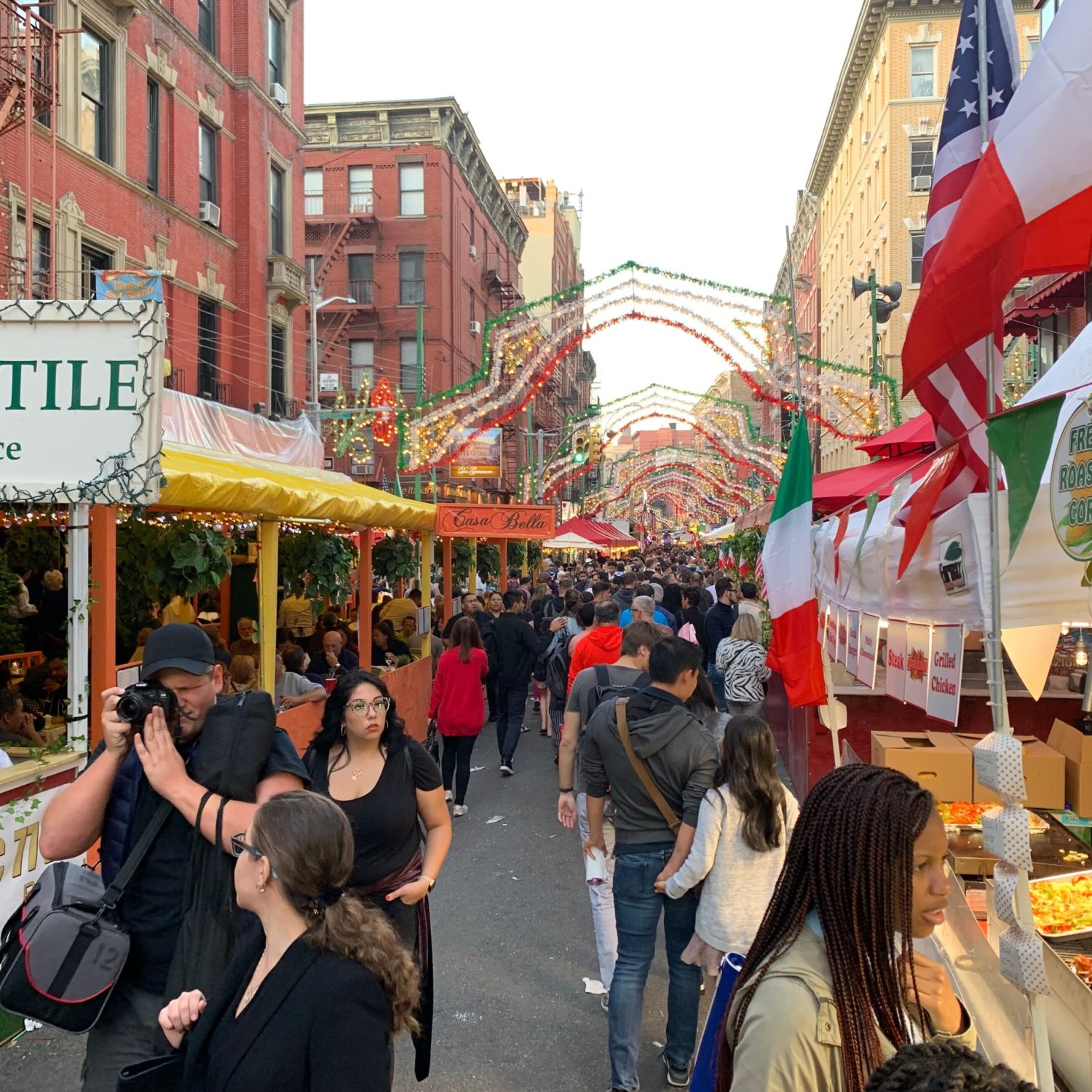
When the first San Gennaro Festival was held in New York, in 1926, Little Italy was still mainly what the name suggested: a neighborhood inhabited by Italian immigrants. Those who arrived from Naples had concentrated around Mulberry Street and on 19 September of that year decided to take on the street an event they knew from home, the feast of the patron of their city.
It was a one-day celebration. Hundred years later he occupied a substantial part of Little Italy for eleven days, recalls visitors from all over New York and abroad and has become one of the most famous Italian festivals in the United States. The centenary edition, begun yesterday, 17 September, will continue until 27.
To understand how it happened you must start from New York in the early 20th century. Between the end of the nineteenth century and the first decades of the century millions of Italians arrived in the United States, and a substantial part stood in New York. According to the Library of Congress, about a third of the Italian immigrants who crossed the city eventually settled.
However, there was no one Italian community. In Lower Manhattan immigrants tended to rebuild on a very small scale the communities from which they came. People of the same country, and sometimes of the same village, ended in the same block or even in the same building. The Library of Congress describes this mechanism through the concept of campanilism: belonging to the community that lived within the radius of the bells of the same country.
In Little Italy this geography was particularly evident. Immigrants from different Italian regions concentrated on different roads; those of Neapolitan origin settled mainly on Mulberry Street. With them came habits, dialects, food and even religious holidays that in the countries of origin marked the calendar.
Among these was the one of San Gennaro.
Gennaro was bishop of Benevento and, according to the Catholic tradition, died a martyr in 305 during the persecutions of the Emperor Diocletian. His cult developed mainly in Naples, where he is the patron of the city and where even today the most famous moment of the celebrations concerns the liquefaction of blood preserved in the Cathedral.
In New York there was no blood of San Gennaro, but there was a community that had brought with it his devotion.
The official reconstruction of the Festival dates back to 1926, when Neapolitan immigrants from Mulberry Street organized a one-day neighborhood party. The Italian American Museum indicates a precise date: on September 19, the religious feast of San Gennaro.
The festival was also linked to the Church of the Most Precious Blood, the Baxter Street church built at the beginning of the 20th century to serve the growing Italian Catholic community and today National Shrine Church of San Gennaro. The statue of the saint preserved in the church is still taken on the streets during the procession.
That procession was one of the elements that immigrants had transferred almost directly from Italy. The patronal feasts served not only as religious manifestations, but as opportunities to rediscover, recognize and maintain community relations in a new city.
The Feast of San Gennaro grew very quickly. What was a one-day event in 1926 became a longer celebration in the following years, accompanied by stalls, food and entertainment. The religious dimension remained, but around the procession gradually developed the great street party that today occupies Mulberry Street and some of the surrounding streets.
In the meantime, he changed Little Italy.
Since the 1950s many Italian residents left Lower Manhattan to move to other New York neighborhoods and suburbs. At the same time Chinatown began to expand. The National Park Service reconstructs how the Italian population of the district declined drastically in the second half of the 20th century, while the Chinese population grew up to erase in many places the old border between the two communities.
Today’s Little Italy is much smaller than the party. Its core remained around Mulberry Street, between restaurants, cafes, shops and an Italian identity that is now more cultural and commercial than demographics.
San Gennaro, paradoxically, followed the opposite path: while the Italian district narrowed, its feast became bigger and better known.
Since 1996, the organization has passed to the Children of San Gennaro, a non-profit association that still manages the event. In 1998 the Giuliani administration described the passage as a substantial transformation compared to a few years earlier, with proceeds intended for beneficial activities. Today the organization supports over thirty associations and bodies.
Over the decades, the festival has also become something different from the religious occasion from which it had left. The processions coexist with cannoli competitions, stalls, concerts and an amount of italoamericanity symbols that belong more to New York than in Naples. It is the result of a century in which the community that had created it became progressively American without losing all the connection with the place from which it came.
The centenary arrives just as New York is returning to formally recognize this piece of its history. On September 10, the City Council approved a resolution celebrating the Feast of San Gennaro and the Ferragosto Festival of the Bronx for the contribution of Italian and Italian immigrants to the city. In the document the Council recalls that, according to the data of the Department of City Planning, in New York still live more than 500 thousand people who identify themselves as Italians.
The Italian American Museum of Little Italy also dedicated to the centenary the exhibition Cent’Anni!, built through photographs and objects of its collection to reconstruct the evolution of the festival from 1926 to today.
The most significant thing about the hundred years of San Gennaro, however, has probably remained on the road.
Mulberry Street is no longer the path of Neapolitan immigrants who was in 1926, and Little Italy is no longer the great Italian neighbourhood of that time. And yet every September the statue still comes out of the church of Most Precious Blood and returns in procession to the place where that community had decided to settle.
It is one of the few moments of the year when the Little Italy that exists today and what existed a century ago end up occupying, at least for a few hours, the same roads.
L’articolo San Gennaro celebrates a hundred years in New York: the story of the feast born by Neapolitan immigrants comes from IlNewyorkese.