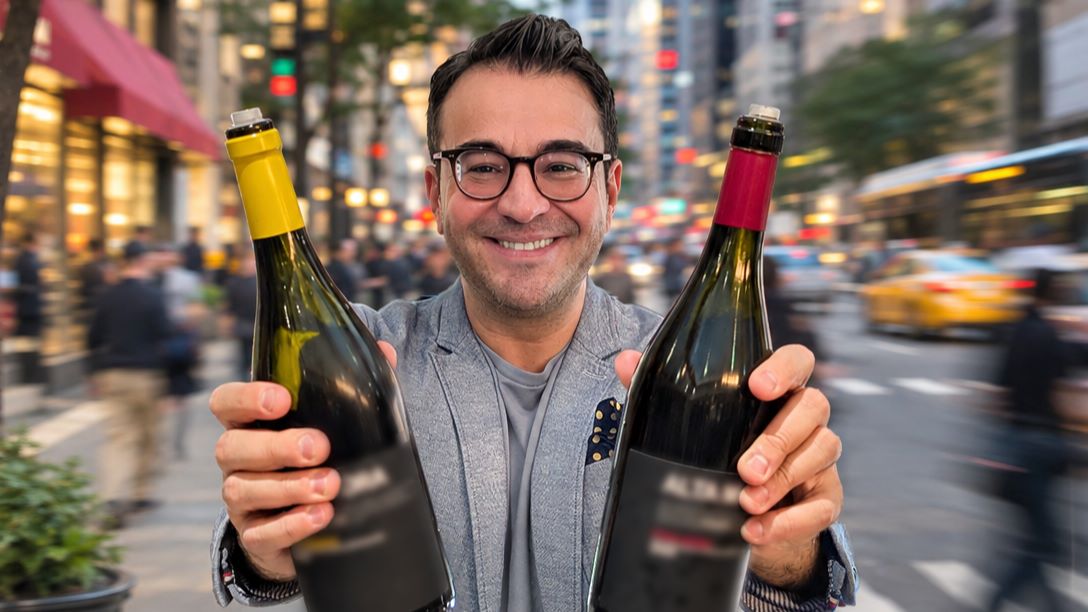
Salvatore Napolitano arrived in New York in 2009, after studying and working in several European universities. He was a young Neapolitan academic, specialized in classical studies, and he did not imagine that in the United States he would end up building a career in the wine industry. After teaching at Caltech and New York University, he began working in wine distribution, from university classrooms to wine shops and restaurants in the city, to become executive and entrepreneur.
From this experience was born Parallel 41, published by Edizioni Ampelos – Kleos Press, a book that combines the autobiographical account with an analysis of the American wine market. The title recalls the latitude shared by Naples and New York, two cities that Napolitano considers more similar than it might seem.
In the second part of the volume, the author focuses on the difficulties facing Italian producers in the United States: the decline in consumption, the new habits of younger generations, the concentration of distribution and the effects of duties. According to Napolitano, the sector will have to rethink the way it reaches American consumers, investing more in online sales, market knowledge and direct relationships with customers.
We interviewed him to talk about his path, about the changes he observed in almost twenty years in the United States and the perspectives of Italian wine in a market where, as he claims, relying on the reputation of Made in Italy could not be enough.
The title of his book, Parallel 41, recalls the geographical line that ideally unites Naples and New York. You came to the United States as a young academic, before building a career in the wine industry. What did he find in America that he probably wouldn’t find in Italy, and how much changed his way of looking at the country from which he came from?
Thank you for this question, Francis: as interesting as complex. I would start from here: by natural inclination, and perhaps also by my southern origins, I have always cultivated the idea of the other. Going, knowing, exploring – and possibly understanding – realities other than what life had offered me was a natural condition for me, from which I have memory.
Before the USA, at the end of 2009, I had experienced equally important study and work experiences in France, Germany, Greece. Yet no one had become a long-term choice: they were elsewhere too tight to contain a momentum that I always nurtured, but that I also had to hold a brake, not to end up in a ‘never-ending spinning’.
The first important impact with the workplace, and life, Americans date back to the time of teaching at CALTECH in Pasadena: a crucial experience in vocational training, yet not translated into a more radical change of life.
The desire of elsewhere remained, and a few years later found a magnetic force in New York that I had never known. So NYC became – almost my despite, because I immediately understood how many changes I would have imposed – the very personal “my” America.
It is no coincidence, I think, that a Neapolitan – in the deep spirit, before even in tastes – found the way along the same parallel to recompose the heterogeneous pieces of life lived until then, and to find those who lacked the puzzle of the one to come.
Naples and New York are in mind the same city. City-world: market, public, theatrical, aesthetic, sound more than noisy, like no other.
Neapolis welcomed, in a crucial snout of ancient history, the Greek sons of the long exodus following the collapse of the Mycenaean civilization; New York welcomed armed exiles of the same resilience and determination centuries later.
This is the common, underground, deep soul of the cities. Coming to today’s America, however, what I found is a society widely accustomed to rethinking, reinventing, flexibility of attitudes and skills, self-renegotiation.
In Italy, probably, that shadowy historical-identity burden – which also has religious roots, and in which history becomes, often implicitly, collective identity – would have seduced with the morphine of habit my desire to elsewhere. In America, those slanci have instead become propulsive gasoline to look for other, different and complementary, and for this reason more dynamic and interesting, if I can say.
If I had to say it in a phrase: I look like myself much more today than at the time of the Academy. And I look to Italy with the eyes of those who recognize its immense beauty, the unrepeatable charm of craftsmanship and the most sophisticated inventions; but also of those who would like to see it again in the center, thanks to voices capable of interpreting the opportunities beyond borders – not geographical, but cultural. That centrality belonged to her at least until the industrial age, when the center of gravity moved from the Mediterranean to the Atlantic.
In summary, America gave me what in Italy I would have struggled to find: the permission to reinvent myself, to draw for myself a new trajectory, to reason as an entrepreneur even when I work for others.
My gaze on Italy has changed a lot. From afar you love her more and forgive her less. See more clearly the delays, the bureaucracy, the tendency to tell more than to organize; but you also see a beauty and a cultural depth that those who live in it, sometimes, stopped to notice. I think the distance has made me an Italian more aware, and perhaps even more useful to my country for what I do today – even with this interview – and for what I will do tomorrow.
In the book tells the passage from university classrooms to the sale of wine on the streets of New York, an experience that defines a real school. What was the most important lesson he learned by directly comparing with American consumers? And how much of that experience continues to affect his work?
I call it, with a bit of self-harm, the “New York University of Sidewalks”: fifty thousand steps a day, tastings in every corner of the city and at every social and economic level, from Howard Beach to Westchester, from “Goodfellas” to Clinton. It was the most severe school I attended, and the most educational.
The most important lesson was this: the American consumer always buys a clear message (not necessarily the deepest, but the clearest: the brightest marketing, moreover, is always American), or an experience. The intellectualistic excesses, if they are not accompanied by real communication and synthesis skills, never affect. In the specific world of wine, then, Americans buy without doubt “one person”: a story told with force and authority, but also with immediacy. I renamed it my personal “seven seconds rule”: you could write a sales treaty – and maybe I will.
From that school of life I had to learn how to unlearn too much, instead chasing the exposition clarity and synthesis of the messages, as well as the ability to narrate and capture – even teatrally – the listener.
In the classroom you have fifty minutes and an audience that must listen to you; in front of a buyer – little counts of what extraction or typology – you have a few seconds and a person who owes you nothing.
There I realized that simplifying does not mean trivializing, and that competence has value only if it becomes accessible. I also learned respect: the American does not want to be educated, wants to be accompanied.
That experience is still my main filter today. Even when I work on national strategies, on budgets and on portfolios of several million cases, I always wonder if an idea exceeds the “road test”, always keeping a clear and precise ‘distribution mindset’: it works in front of buyers of an enoteca in Oakland, California, as before the sommelier of a Manhattan star – perhaps in different forms, but consistent?
If the answer is no, then I – or my collaborators – will have produced only a beautiful slide, not a strategy.
One of the central themes of the book is the transformation of the American wine market. Consummation decreases, new generations have different habits and attention grows to health. Are we facing a temporary crisis or is wine losing that cultural and social centrality it has had for decades?
I don’t think it’s a temporary crisis, and it would be dangerous to tell us that. It is a structural transformation, which concerns the way people live, socialize and think about their own health. Be careful, however: being greetings does not mean having a clear idea of what is really healthy. Greetings are often the fruit of communication and marketing, before a real education.
It’s a bit like the sun: we know that UVA rays hurt the skin, yet no one stops going to the sea, because the sun also does us well, in the mood and the body. The key is the measure.
With wine is the same: consumption has real physical implications, which must be respected; but, lived in moderation, remains part of an equation of happiness that only the truest conviviviality can return. And we need more than ever, in an epoch of economic and cultural changes burrascose and of cyclic geopolitical crises, to which my generation seems exposed like no before – and, I hope, no later.
If we go to the most numerical reading of the data, as an analysis in the book, the Gallup polls in recent years have recorded historical minimums in the share of Americans who declare drinking alcohol, and the younger ones increasingly associate moderate consumption at a risk. To this you add the competition of cannabis, ready cocktails, non-alcoholic, and a relationship with the free time that passes for the screen more than for the table.
That said, I don’t think wine is losing its cultural centrality: it’s redefining it. You drink less, but you drink more intentionally. Less opportunities, more meaning. For Baby Boomers wine was a daily status; for Millennial and Gen Z it is a choice, an experience, sometimes an identity gesture linked to sustainability, authenticity, discovery.
The problem is that the sector has continued to talk to a consumer who is growing old, with an intimidating and authoritative language. A often repetitive language, entrusted to professional figures who struggle to renew themselves on the cultural and economic level, and to commercial actions that, in my opinion, were already tired in the decade before COVID.
The wine must regain its place, not take it for granted: less liturgy, more conviviality; less scores, more stories; formats, prices and channels designed for those who are twenty-five years today, not for those who had them in 1985. More listening and strategic intelligence; less static and banality.
What we are living, and not only in the USA, is not a tracollo, but rather a decisive – and decisive – reset of the entire sector, which for Italy could become the trampoline to return in front of every other producer country in the world. It is an exceptional occasion, to be gathered with courage, competence, strategy and with a system logic between all parties involved.
She describes an increasingly concentrated American distribution system in the hands of a few large operators and proposes sales models that allow manufacturers to reach consumers directly. How realistically accessible is this road to a small Italian winery that wants to enter the American market, considering the costs and complexity of the regulations?
One must be honest: for an Italian winery the pure “direct to the consumer”, in the sense that a California winery means it, does not exist. The three-level system imposes an importer and, in most cases, a distributor. To this are added recordings, label approval, rules that change from state to state. Those who think they open a site and ship from Montalcino to Chicago are destined to a bad surprise.
At the same time, the concentration of distribution is a fact: the great mergers and acquisitions, up to the crisis of a giant such as RNDC, have reduced the space for small brands, which are likely to end at the bottom of exterminated catalogs, and subsequently in complete oblivion. Even medium-sized brands, if they do not have their own voice on the market – that joins the distributor or, more realistically, operate in full autonomy, with a real and sustainable impact for the winery that finances it – will meet severe cuts in wallets, and simplifications that are not yet ready to digest.
For this reason, in the book I talk about omnichannelity more than DtC in a strict sense: to use in an integrated way importer, distribution, specialized retailers, online platforms that comply with regulations, clubs, events and hospitality in the cellar, to create a question that then the traditional system is forced to follow.
The road is accessible, but it is neither economic nor fast. My advice to a small winery is: to choose a few markets, two or three at most, instead of chasing “America”, which does not exist as a single market; to find an importer of his own size, who believes in the project; to put to budget at least three years of investment; and above all there, physically and digitally. Once a solid foundation is built, the road that in the book I dedicate as privileged is to work with seriousness and transparency together with the national importer, on targeted offers that optimize every passage of cost, logistics and tax included. And if a winery is new to the market, or does not have the resources for such an articulated path, it can team up: with its own Consortium, or with a group of similar producers, linked by commercial relationships or friendship. Together it is more easily accessed to the new DtC solutions that are being created, to be used with intelligence in a first commercial and communication phase on the world’s most important market. It is the theme of the second part of Parallel 41.
The book also deals with the effects of duties and the growing American economic polarization. Is the risk that quality Italian wine becomes a product accessible to an increasingly restricted range of consumers? And what consequences could this transformation have for independent Italian restaurants in the United States?
Risk exists. The duty on European wines, in force since August 2025, does not stop at 15%: it enters a chain of embroidery, importer, distributor, retailers or restaurant, and the shelf or paper amplifies. At the same time the American economy is increasingly polarized: the high band holds, the entry line as well, while the middle class, which was the heart of average quality Italian wine consumption, is under pressure.
The segment that suffers most is the middle one, the bottle between 20 and 50 dollars, which for decades has been the force of Italy. It is the territory of ‘value’, of the value-price ratio: our main strength, along with the cultural charm that our country exercises and that, here in the USA and I would say in the world, has no equal.
On the most specific level of wine production and craft spirits, Italy has an advantage that other countries do not have: an extraordinary variety of territories (and prices), of unrepeatable knowledge and flavors, of pure beauty, of autochthonous vines still little known that offer true quality at sustainable prices; with fascinating, credible and engaging stories.
This is where Italy can play, better than anyone else, the game of accessibility and attraction.
For independent Italian restaurants the situation is delicate. Rentals, labour costs and raw materials have already eroded the margins, and wine is often the voice that keeps the economic account standing. If the price in paper goes too far, the customer orders a glass instead of a bottle, or changes direction; and in some cases completely renounce.
The danger, as I said, is the simplification along the entire supply chain: the importer restricts the focus, the distributor struggles to bring the message to the customer, and in the end the consumer finds shelves and cards of the most homologated and less courageous wines.
The answer, in my opinion, remains at the moment of education and contact with the final consumer. With retailers means offering a true partnership: a service made of events and tastings well organized, passionate and impactful, able to propose less obvious but quality choices, thinking first of all to the final consumer. Retailers are pure merchants, in the noblest sense of the term: what we can give them, by consultants and educators, is service, and ideas that we put into practice in person.
In catering, each room should be read for what is – geography, typology, clientele – and not with the simplifications that apply to chains, which follow other business models. The key remains the engagement: to form sommeliers and room staff in a dynamic and never discounted way, with a much greater rigor than in the past, but without becoming rigid or pedant.
Finally, it also serves an institutional effort of the Italian System, entrusted to people who can hold together investments and concrete, commercial and communication results. Never as today, with the simplifications I mentioned, our centrality is likely to be reduced.
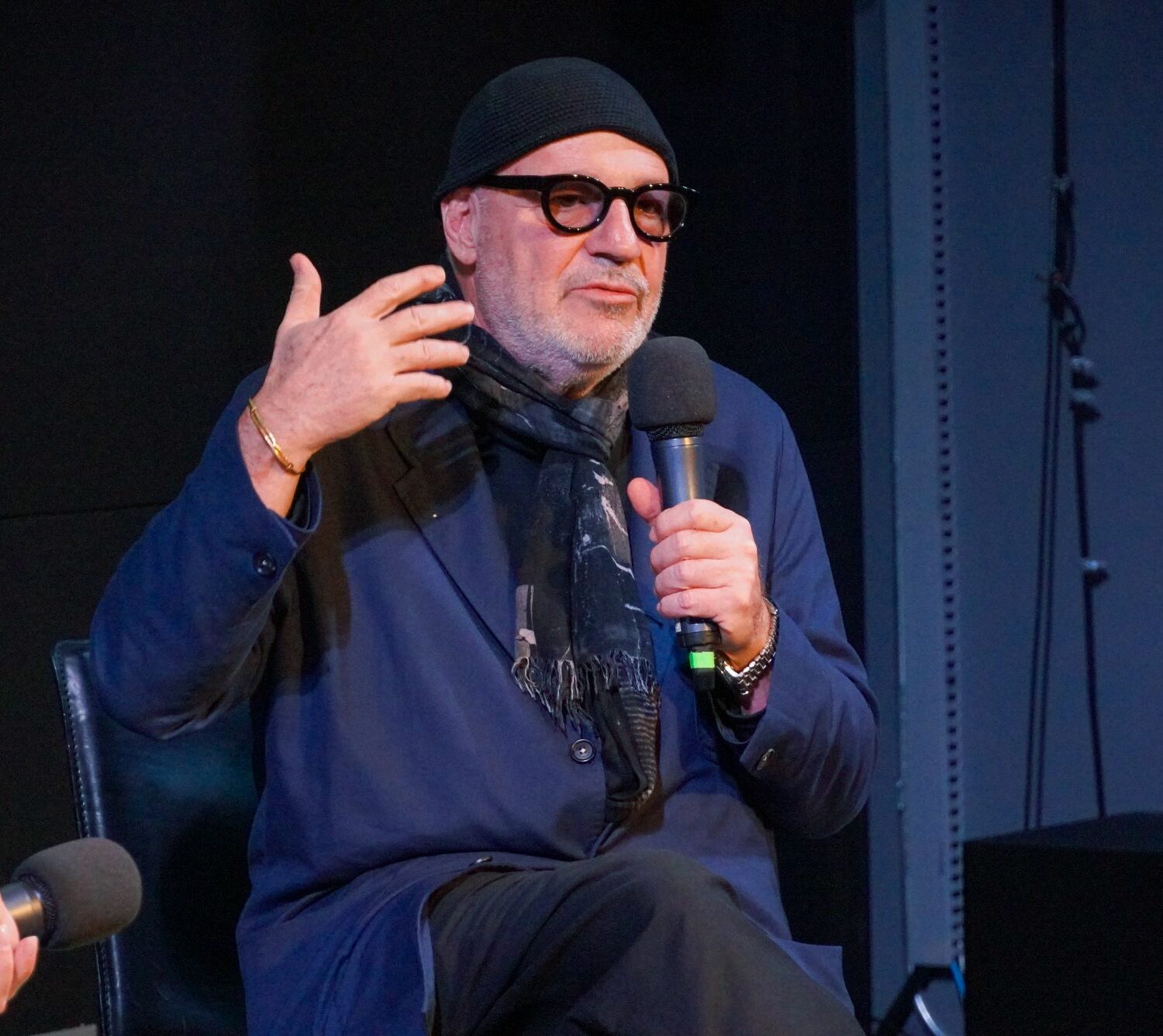
Salvatore Napolitano e Martin Scorsese
The UNESCO recognition of Italian cuisine comes at a particularly complex time for Italian companies operating in the United States. She argues that the sector must overcome a certain rhetoric of excellence and tradition. What are we wrong today in telling Made in Italy to Americans, and what should Italian companies do to continue to be competitive?
UNESCO recognition is a great satisfaction and deserved recognition. But it’s not a business plan. We risk turning it into a gagliardetto, the umpteenth medal to hang on the wall, rather than in a value to capitalize – even commercially – at best.
The main mistake is to tell the past instead of the value. “Excellence”, “one-year tradition”, “the recipe of grandmother”: these are words that Americans have already heard a thousand times, and that now they use all, even those who Italian is not. When everyone says the same thing, that thing stops differentiating. The American consumer does not want another lesson in history; he wants to know why that wine, that product, that experience deserve its time and its money today.
As a classicist, I think of Ulysses: he does not come home by reciting his genealogy, but thanks to metis, practical intelligence, the ability to adapt to each interlocutor.
Italian companies should do the same: knowing the market data, segmenting for generations and states, ensuring product continuity and price consistency, investing in service and trade relations, being present in a constant and not only at Vinitaly or at trade fairs.
We also need renewed professional profiles, more articulated than ever. Because, as I write in the closing of the book, the future of the great Italian wine will not be built on the rhetoric of the ancestors, but on the intelligence, on the service and on the long, generous conversations that only a large bottle can still arouse.
L’articolo Salvatore Napolitano and what the wine tells of America proviene da IlNewyorkese.