Sixty years of career, 80 million albums sold and a repertoire that accompanied several generations of Italians. The Poohs are preparing to return to the United States, with a long-awaited tour in North America, after finishing the Italian one dedicated to the six decades of their history. In the backstage of the Palaflorio in Bari, on the occasion of the last Italian date, the band told us exclusively the emotions of these months, the relationship with the public and the expectations for the next American transfer. A return that also reminds me of the first trip to the United States in 1973, when a concert at Madison Square Garden suggested to the Pooh some innovations that they would then introduce in their shows in Italy.
The Italian tour ends today for your sixty years of career, before a new adventure in the United States. What is the budget of these dates and what feelings accompany the conclusion of such an important project?
Riccardo Fogli: They were really given beyond our expectations, for the amount of audience, the sold out, the enthusiasm and love we received for our music and for our history. Much, much more than other concerts, and this has made us understand how much it would be to listen to the Poohs, to find us on stage and to listen to our repertoire. It’s about three hours of concert that really represent a journey through the love and enthusiasm of the public.
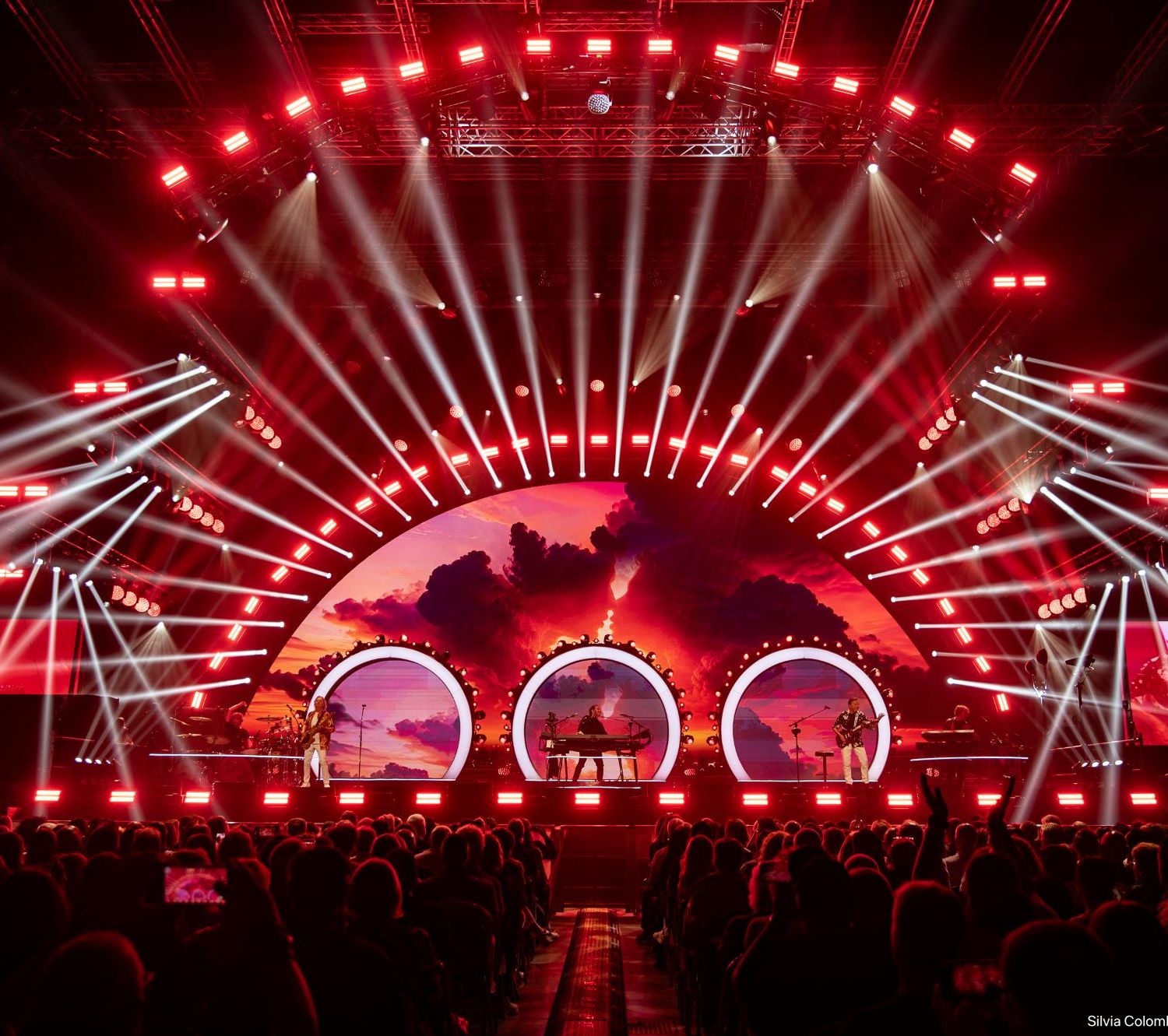
Rethinking also the shows of the past, without taking anything from what we did before, because we always had the chance to make important concerts, this tour had something special. We were even the first to bring in Italy certain innovations in live shows, such as the effects of smoking, lasers and really impressive scenic structures.
Spectacular solutions that, at the time, were mainly characteristic of the great American and Anglo-Saxon concerts.
Riccardo Fogli: In fact, we were in America for the first time in 1973. On that occasion we saw some concerts at the Madison Square Garden in New York and it was there that we first discovered the smoke machine. We didn’t understand how it worked, but we had seen that smoke greatly improved the effect of the lights. So, once we returned to Italy, we really built our first smoke machine.
Returning to the budget of this tour, I must say that it was something unique even from the point of view of the show, the lights and the staging. We are very, very happy and happy. This evening is the last concert and, as always happens when we come to the conclusion of an important project, that we managed to bring in port and that has given us so much, a little sadness inevitably there is. But we’ll go back to America, where we’ll definitely have fun.
Then we return to the United States. At this point in your career, American travel no longer represents a promotional operation, but above all a celebration of your history. What did it mean to climb on a stage thousands of kilometers from home, with a repertoire that accompanied three generations of Italians? And what do you expect to find in America, over fifty years after your first visit?
Roby Facchinetti: The effect that puts on the stage, for a band like ours, is definitely particular. We are lucky to have a very successful repertoire, because 80 million records sold are figures that really tell so much. And when you have the chance to get on stage with such a well-known repertoire, you are already halfway through the work, because in front of you you you find an audience singing everything.
In fact, sometimes when we do not remember a few words of a text, we just look at the labiale of the people we have in front and so we do not miss a word!
There is definitely a great tranquility, but above all the pleasure of getting on the stage knowing to have in front of an audience who knows perfectly your history and your repertoire. I think for an artist this is the most important thing. Absolutely.
In 1980, Hurricane was released, a record sung in English and produced by Teddy Randazzo, with whom you tried to conquer the Anglo-Saxon market. Looking back today at that chapter of your career, how do you evaluate that experience? And what changes in returning to singing in the United States today, when the Italian language identity has become a value, compared to a time when it did not enjoy the same consideration?
Roby Facchinetti: Look, that research was quite naive, even because Teddy Randazzo was far from an international producer. He was a typical American producer, but linked to a music school like Frank Sinatra. Even when he tried to give the record a more dance direction, to move a little our music, in the end they worked much more our songs sung in English.
That record, however, went very well in Italy, while being sung in English, and I also believe in Japan. But that’s not how you do certain operations. We, for the heart we put in the writing of our songs, should have looked at the Latin American market. We should have left there, as Eros Ramazzotti and Laura Pausini later did.
If I have to find a regret, after four hundred songs written and sixty years of history, this is precisely what we could have done more abroad, devote more to international markets. There is also to say, however, that you cannot have everything. We have dedicated a lot to Italy and Italy has rewarded us. The very fact that we are still here celebrating sixty years of career is the demonstration.
And anyway going to America now is beautiful, also because the audience has changed. We’re talking about a third, a fourth generation. There are Canadians married with Italians, Italians married with Americans and vice versa. It is a much more varied audience, with which we can get a live, current match.
It is no longer like when I happened to sing for Italian immigrants, those arrived with the cardboard suitcase, who wanted to listen only Claudio Villa and Gino Latilla. Today is a completely different reality.
The strength of the Poohs has always been in the balance between the different souls that made up the band. Stefano D’Orazio was one of the architects of this balance, not only for the lyrics of the songs, but also for his contribution to the organization and communication of the group. How will Stephen’s memory accompany you overseas? And in what moments of the concert do you feel his presence?
Roby Facchinetti: Stefano, with his smile and his positivity, is still present. When we sing a song with a text written by him, inevitably the thought goes to Stefano. But it also happens when we perform songs in which he sang a stanza with us.
I think, for example, to Men alone. Now Stefano’s stanza sings Richard, but I still expect to hear his voice every night. It is a spontaneous thing, because when you shared so many years of life and music with a person, you get used to his presence, in his voice, in his way of interpreting a song. And that habit remains even after many years.
But the beautiful thing is that there is no sadness. When we remember Valerio, as well as when we remember Stefano, sadness does not prevail. Both have brought in our lives a world of positivity much greater than the pain they inevitably left going, unfortunately, prematurely.
This is why the budget, even from an emotional point of view, is still serene. And then, who knows, it could also be that sometimes they give us some protection from up there. Because we are always moving, constantly engaged, and I have to say that everything is going so well that sometimes it comes also to think it.
Beyond the numbers and great successes that inevitably have to find space in the ladders, on this tour you still propose three hours of music. Are there tracks that you consider particularly significant, capable of enclosing your story, but that perhaps are not among those that the audience necessarily expects to listen in concert?
Dodi Battaglia: No, look, I have to say that sincerely our personal tastes, fortunately, coincide very often with those of the public. It is true that, when we chose the songs to compose the ladder of this tour, we focused on the tastes of the audience, but we realized that they were also ours. And every night, when we play them, we really enjoy playing them, because I think that then the essence of a song, its spirit, comes to those who listen both through the record and, above all, live.
Consider that our repertoire is extremely varied. We can have more traditional songs, such as Tanta’s desire, which we can also perform with a symphonic orchestra, or progressive pieces like Parsifal, or even acoustic songs like Men alone and many others. There is therefore no musical typology that prevails over others in the pleasure of the public. We are a set of different ways to play and interpret music, and people have perfectly understood this characteristic of ours.
For those who follow us there is no contradiction between songs like Viva or The last night of hunting, which are absolutely rock and that could have realized, or could still realize today, a contemporary band, and songs like Tanta want of her or Piccola Katy, which, if we want, are musically less profound.
I think that the Poohs represent the essence of these different souls, which then, I am told, are also those of the Italians. The Italians are smart, they are also a little crazy, they are willing, romantic, they are people who want to get to the goal. A bit like the repertoire of the Poohs, which contains all these characteristics. And I think that’s our winning formula.
Let’s go back to America. The concerts in the United States will inevitably bring together a very heterogeneous audience: the second, third and fourth generation Italian communities, who today live and work in the USA, but also American listeners fascinated by Italian music and melody. How do you plan to relate to such a different audience, in which nostalgic expectations live, a link with their origins and perhaps even the curiosity to discover an Italian band of great success? Have you thought about a special set-up for this trip?
Dodi Battaglia: Your question is very intelligent and pertinent, but the answer is actually quite simple. We could follow the advice of those who consider the Poohs a romantic and melodic group, or of those who consider us a rock band, or of those who see in us a progressive rock group. They are all definitions that, somehow, belong to us.
That’s why, when we found ourselves having to prepare a ladder for the United States, which really represented the Poohs and our way of playing, we looked at each other’s face and said to each other: let’s go do what we enjoy doing.
Because in the end, both in the records but especially in the direct relationship with the public, when people hear you play with some energy, with conviction and, above all, with participation, is inevitably involved. People sense what you’re doing, they feel you believe, you like to play those songs, and they end up participating together.
So we chose a repertoire that mirrored ourselves first. We made a choice thinking mainly of our personal gratification, the possibility of getting on stage and then getting out with the awareness of having given the maximum of what we could give.
Although, for example, the concerts we will do in the United States will be a little shorter than those we propose here in Italy, the principle remains exactly the same. I think the priority is to have fun, because when you really have fun on stage you can convey that fun to people too. And that’s exactly what makes a concert work.
The tours in the United States impose very different rhythms and distances than the Italian ones: time zones, long transfers, a daily life that inevitably requires a certain organization. At this point in your career, what still enjoys your life on tour and what aspects require more discipline than before?
Red Canzian: The Poohs are very disciplined, but always with sympathy and joy. There are those who tell jokes, who pulls out anecdotes, and I in this am an expert! But when it comes to working, they are all extremely serious.
I’ll give you an example. You are in the lobby of a hotel and the appointment is at five and a half, regardless of the time zone in which you are. At five and twenty-eight there is no one yet, but at five and a half the Poohs arrive. Punctuals, all together. It’s their way of being.
I have a chance to watch them both from inside and out, and I can tell you that the Poohs are a school. A school of life, of thought, but also a musical school. Because they had the courage to change so many times in their career, to question, and they even had the courage to start self-producing after being followed by a great producer.
Their strength has always been this ability to confront each other. They gather, discuss and decide together. It’s always been like this and I think it’ll always be like this. And this is certainly one of the many reasons that explain the strength of the Poohs.
From Men alone onwards, your writing has been able to combine a more dramatic and narrative dimension to the Italian melodic tradition and the breath of the arena pop rock. In the United States, however, the classic rock band model responds to pretty precise stylistic codes. Do you think that the musical identity of the Poohs has so particular characteristics that it is difficult to replicate by an American band?
Red Canzian: I think the Poohs don’t have to compete with American groups. The Poohs are the Poohs, they sold millions of records and built a relationship with the public that goes well beyond a single city, a region or a certain territory. Their music has rooted everywhere, has reached an infinity of people and has created very deep ties.
That’s why I think the Poohs should just keep being the Poohs. And I’m sure they’ll do it in America without trying to look like anyone else.
I also tell you a little bit by ex Pooh, but especially as a person who continues to love this band deeply: they will probably be the others to copy the Poohs or to take inspiration from them, rather than the Poohs, once arrived in America, to have to seek inspiration in American groups.
L’articolo I Pooh, after 60 years of music and before a tour in the USA proviene da IlNewyorkese.