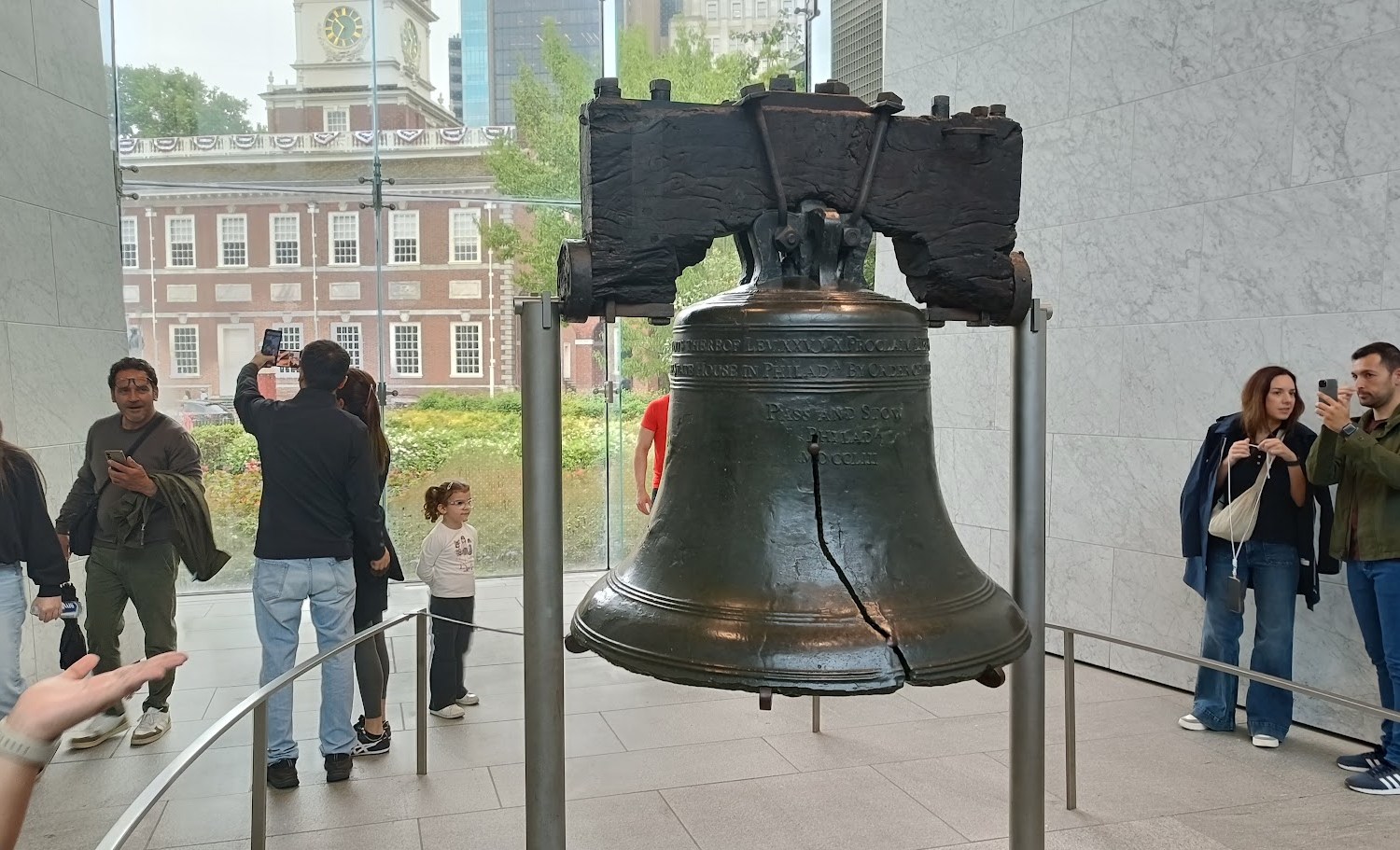
There is a transparent darkness inside the glass pavilion in the heart of the Independence National Historical Park in Philadelphia. Tourists queue quietly, moving slowly under the watchful look of federal rangers. Then, suddenly, here it is: a bronze block of over nine hundred kilos, suspended at a fossil wood yoke. The Liberty Bell. It is not the largest bell in the world, nor the oldest, but it is undoubtedly the one that bears the most famous scar in the history of the West.
Looking closely at it, on a day when the sky of Pennsylvania flirts with the 18th-century brick grey of the nearby Independence Hall, means facing a geometric paradox: the symbol of American freedom is a structurally broken object. An almost too perfect metaphor for multitasking, hyper-connected and deeply polarized America of 2026.
The story of the bell began in 1751, when the Pennsylvania State House (now Independence Hall) decided to order a large bronze to celebrate the 50th anniversary of the Privileges Charter of William Penn. The commission flew overseas, landing in London, in the famous foundry of Lester and Pack (later known as Whitechapel Bell Foundry, the same one that would give birth to Big Ben). The English craftsmen fused it using a traditional alloy of copper, tin, zinc and lead, affecting a verse of Leviticus destined to become prophecy: “You will proclaim freedom throughout the earth, for all its inhabitants.”.
But the fate of the bell was linked to a manufacturing defect. In 1752, just landed in Philadelphia, it was weighed down for a preliminary test: at the first touch of the battacchio, the edge fell. The metal was too fragile, perhaps for an excess of tin or for too fast cooling in London workshops. Two local craftsmen, John Pass and John Stow, offered to refrail, adding more copper to the alloy to make it less flexible. It is the bell that we see today, that which he played to call the citizens of Philadelphia to the public reading of the Declaration of Independence on 8 July 1776.
The famous crack that today tears it, however, is not the original one. The current fracture line was formed progressively in the first half of the nineteenth century, due to intensive use. The definitive damage occurred, according to tradition, in 1846, during the celebrations for George Washington’s birthday: a deeper remodel of the others extended the crack to the crown, making the bell forever mutated. The attempts to repair – visible in the small holes practiced to stop the propagation of the split – served only to isolate the vibration, but the brass had decided not to play anymore.
If in the first part of his life the Liberty Bell was a simple civic appeal tool, since the 1930s it became a universal icon. It was the activists of the abolitionist movement who renamed it “Liberty Bell” (until then it was simply the bell of the State House), adopting it as a symbol of the struggle against slavery. How could a country celebrate freedom if millions of black men were still in chains? The crack became the visual emblem of an unfinished democracy.
Since then, the Philadelphia Pavilion has become the obligatory stage of the great pilgrimages of history. Under his yoke, women’s suffrage leaders, civil rights activists from the 1960s and, more recently, giants such as Nelson Mandela and Dalai Lama. For anyone who has struggled against oppression, that cracked bronze was proof that freedom is a noble but vulnerable material, requiring constant maintenance and which can break if subjected to the tensions of social injustice.
Today, the meeting with the Liberty Bell raises questions that burn political relevance. We live in America of identity populism, the era marked by Donald Trump’s divisive rhetoric and “Make America Great Again” movements, where the public debate is reduced to a tribal clash and civil rights – from immigration managed with the strong manors of the ICE to the tensions never struck on police violence towards minorities – seem to be creaking under the weight of polarization.
In this context, Liberty Bell is not a piece of antiques. It’s the mirror of the country. Contemporary populism is often appropriated by the symbols of 1776 to raise walls, exclude the other and claim an excluded patriotism. But the bell of Philadelphia tells an opposite story: it tells that America was born of an imperfect league, which had to be remade, and that it bears in itself a structural wound that expands whenever the promise of equality is betrayed. The crack of the bell is the exact representation of the festive line that today divides the United States into two ideological blocks unable to speak.
The last time the Liberty Bell was touched for ceremonial purposes was on June 6, 1944, when the rhinos (recorded and broadcast via radio) announced the landing in Normandy. Since then, it is only gently struck three times every 4 July, on the occasion of the Independence Day, by a delegation of descendants of the signatories of the Declaration.
In front of the tide of tourists and young people taking photos in its oblique profile, here is the epiphany of a deep suggestion. Would it be the case to make her play again today? If technology allows us to weld that bronze without destroying its aesthetics, a new real touch of Liberty Bell would have a disruptive meaning. But it should not play to celebrate the triumphs of a faction or nationalist rhetoric of populists.
It should sound like an alarm. A remodelling to wake up the consciences of a tired and multitasking West, to remind America and global democracies that freedom is not an inheritance acquired once and for all, but an open yard.
Until that bronze remains silent, its crack will continue to remind us that the only possible merger for the future does not do with the steel of arms or the export of conflicts, but with the democratic patience of inclusion and a peace that must still be fully conquered.
L’articolo The Filadelfia Mute Intouchs: Liberty Bell and the crack that breaks America proviene da IlNewyorkese.