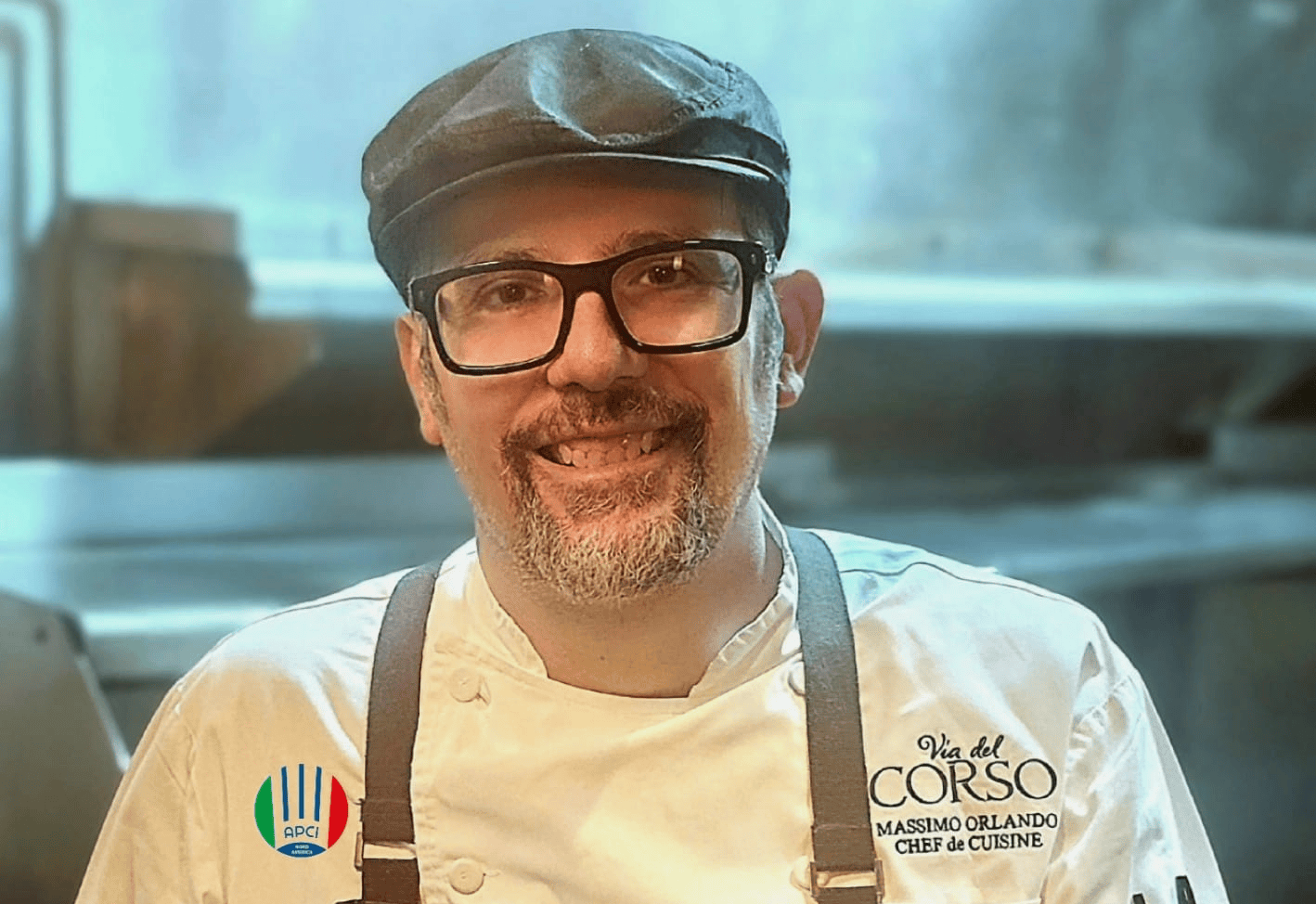
Massimo Orlando arrived in the United States at 22, thinking of living a professional experience before returning to Italy. Twenty-six years later he still lives in California, where he built his career as chef and today he is engaged in the promotion of authentic Italian cuisine also through the Professional Association Cuochi Italiani (APCI). A work that combines catering, training and valorisation of Italian products and which led him to organize a charity event in Berkeley, destined to finance scholarships for young Americans interested in getting to know Italian cuisine directly in the places where he was born.
Let’s start with his story. How did you get to the United States? Was she looking for the American dream?
I was born in Varese and attended the hotel school in Casargo. I started my apprenticeship on Lake Como, working in several hotels and rather renowned restaurants. After a few years of experience in Italy, I was given the opportunity to come to the United States. I was only 22 years old and, more than the search for the American dream, it was mainly an adventure, a new experience to face.
An adventure that then became a choice of life. You thought you were staying in the United States for so long?
Absolutely not. When I got here, I never thought I’d finally settle in the United States. I had taken that opportunity as a professional adventure, but then I met my wife, we got married and decided to stay. I’ve been living here in California for 26 years.
His wife is American, so can we say that the head brought you to the United States and the heart made her stay?
Yes, it is so: my heart has made me stay. But I must say that in the United States I have also had so many job opportunities, perhaps more easily than it would have been possible in Italy. Today we know that even in the Italian hospitality and catering sector there are many difficulties and a crisis situation. For this reason, after so many years spent here, I consider myself lucky enough for the path I managed to build.
Alongside his chef’s activities at the Via del Corso Restaurant in Berkeley, there is also an important commitment in the Italian Cuochi Professional Association. How was this relationship born and what role does it play today?
After many years of work in the United States, I became a member of the ACI, the Italian Cuochi Professional Association, which is also present in North America. Our delegation has existed for almost two years, while in Italy the association is a real institution, engaged for over thirty years in the promotion of true Made in Italy and Italian cuisine. Last year I became vice president of the delegation here in the United States. Since then we have begun to collaborate with the Italian Consulate and with several Italian companies to promote our cuisine and our products. We participated in the celebrations for the Feast of the Republic, the Week of Italian Cuisine in the World and several other international events. It is an activity to which I care a lot, because I think it is important to make known not only our dishes, but also the culture and products that represent the true Italian cuisine.
In these 26 years how much has Italian cuisine changed in the United States? And how did American tastes and demands evolve?
I have to say, I think, she’s changed better. Personally I have always tried to propose a kitchen as authentic and traditional as possible, without changing the recipes to adapt them to the American palates. I think that especially in the last decade there has been an important evolution: today people understand much more the authenticity of Italian food than when I arrived in the United States. There is a greater knowledge of our kitchen and a greater ability to appreciate the original recipes. I think it’s very important to us chefs and restaurateurs. We must not be afraid to make known the true Italian cuisine, without compromise. I’m convinced that Americans are perfectly able to understand and appreciate it. But it must also be presented from a cultural point of view, not only as something to eat. It is necessary to explain how you really eat in Italy, because you use certain ingredients and why some recipes belong to our tradition. This has always been a bit of my battle: do not be afraid to propose traditional Italian cuisine as it is, without changing recipes only to meet American tastes. With the UNESCO recognition of Italian cuisine, this route takes on an even greater meaning.
His commitment to the promotion of Italian cuisine is also taking place in the organization of a charity event in Berkeley. How was this initiative born?
It is an event that is particularly close to me, especially for my personal experience. I had the opportunity to come to the United States, work and bring Italian cuisine here. I would also like other young people to have similar opportunities for vocational training and growth. As the Italian Cuochi Professional Association we have started a partnership with the Culinary Institute of America in Napa Valley and with the De Filippi Hotel Institute in Varese. The goal of the charity event is to raise funds that will be destined to finance the possibility, for some American students, to go to Italy and live an experience linked to our cuisine. It will not only be a school education, but also a work and cultural experience. We want to allow these children to know directly the Italian cuisine and its products of excellence, coming into contact with the people and with the realities they produce.
So not only cooking courses, but a direct experience in Italian territories. How will this training course be organized?
Exactly. We also want to take them to visit some consortia, such as that of Parmigiano Reggiano and that of balsamic vinegar, to allow them to know the products closely, understand how they are realized and understand what really means authenticity. It is a very important aspect, especially if we think about the problem of Italian Sounding. Here in the United States there are many products that, through the name or packaging, recall Italy. People often think of buying something Italian simply because the name sounds Italian. In fact many of these products have nothing to do with the original ones, because they are not made following the same methods of production and the specifications that characterize our authentic products. For this reason we want students to see directly how our excellences are produced, what their characteristics are and why they are different from imitations. I think it’s the best way to convey the value of Italian cuisine.
Can this initiative also help solve a problem of Italian catering in the United States, the difficulty of finding qualified personnel?
Of course, and it is just another reason why we decided to organize this event. In the United States there is a shortage of specialized staff who truly know Italian cuisine. At the same time it became difficult to find Italian chefs willing to move here from Italy, even for a series of bureaucratic problems. That’s why we thought it might be a good opportunity to invest in the training of hotel schools students who already live in the United States. The idea is to let them know the true Italian cuisine through an experience in Italy, hoping that they can become passionate and find inspiration to continue studying and deepening it. Our hope is that, once they return to the United States, they can put to fruit what they have learned, working in the many Italian restaurants of good level that already exist here. It would be a concrete way to contribute to the growth of Italian catering in the United States, forming professionals who really know our tradition.
We come to the event you are organizing. How will the day take place and what will the participants find?
The event will take place in Berkeley and we have already collected the membership of a dozen Italian activities, including restaurants, pizzerias, ice cream shops and pastries. All these realities will participate by offering tastes of their own specialties, in order to allow guests to know different aspects of Italian cuisine. There will also be distributors and importers of Italian wines, so there will be the possibility to make wine tastings. In addition, other importers of Italian products and several companies that have decided to support the project. Among these are the Consorzio del Parmigiano Reggiano, Levoni, Galbani and other companies that have joined the initiative and will provide us with products to use during the event. We want to create an opportunity where people can taste authentic products, learn more about our cuisine and, at the same time, contribute to an important cause such as the formation of young people.
How is Berkeley responding to the initiative? Do you already have expectations about public participation?
Of course, we hope to be exhausted. We have set a maximum participation of 200 people and have already started selling tickets. I think it’s a very important cause, because it’s not just about organizing a gastronomic event, but raising funds to offer young people an opportunity for training. At the same time we want to make known the true Italian cuisine to those people who have not yet had the opportunity to discover it in its authentic form. It is important for us to achieve both these goals and we hope that the public will respond positively.
For those who want to participate and secure a place without waiting for the last days, how does the booking work?
We started a campaign to sell tickets through Zeffy, an online platform we use to manage reservations. Those who want to participate can then buy their ticket directly through this platform, booking the place in advance at the event. One important thing is that even those who do not participate in the event can donate the same through Zeffy.
In addition to tastings and fundraising, will there be other special moments during the event?
Yes, we have planned several other initiatives. First of all, some representatives of the Italian Consulate will be present, and for us it is an important element because it confirms the attention to this project and towards the promotion of our cuisine. In addition to food there will also be live music, to make the event a pleasant opportunity to meet. We are also organizing a silent auction, a silent auction, through which participants will be able to contribute further to the fundraising. We are thinking, for example, of preparing baskets containing exclusively Italian products, which can be auctioned. We would also like to propose some gift vouchers offered by restaurants and other commercial activities that will participate in the event. In this way those who have not yet had the opportunity to know some of these restaurants will then go to visit and try their cuisine. I think it is also a good opportunity to give visibility to Italian activities that have decided to support our project.
He also mentioned a special moment dedicated to Parmigiano Reggiano. What is it?
There will be a real opening ceremony of a form of Parmigiano Reggiano. The Consorzio del Parmigiano Reggiano has been so kind to give us a whole shape and we thought to open it during the event, in front of the participants. Once opened, the cheese will be distributed to all the people present, who can taste it. I think it is an interesting experience, because it will allow to appreciate the difference between a newly opened Parmigiano Reggiano and one that has already been cut for a long time. The taste and characteristics of the freshly opened product are very different. It is a simple and direct way to make people understand the quality of the product and the importance of knowing it in its authenticity.
Will the students of the Culinary Institute of America also be directly involved in the organization and conduct of the event?
Yes, there will also be some students from the Culinary Institute of America, who will be accompanied by refreshments during the event. We wanted to involve them just to give more value and concreteness to the project. We do not want students to be just the future beneficiaries of this initiative, but that they can already start contacting Italian catering professionals and participate directly in such an experience. Their presence is important because the formation of young people is the reason why we decided to organize all this.
L’articolo Massimo Orlando: «I do not change recipes for American palates. The real Italian cuisine must be known” comes from IlNewyorkese.
L’articolo Massimo Orlando: «Non cambio le ricette per i palati americani. La vera cucina italiana va fatta conoscere» proviene da IlNewyorkese.