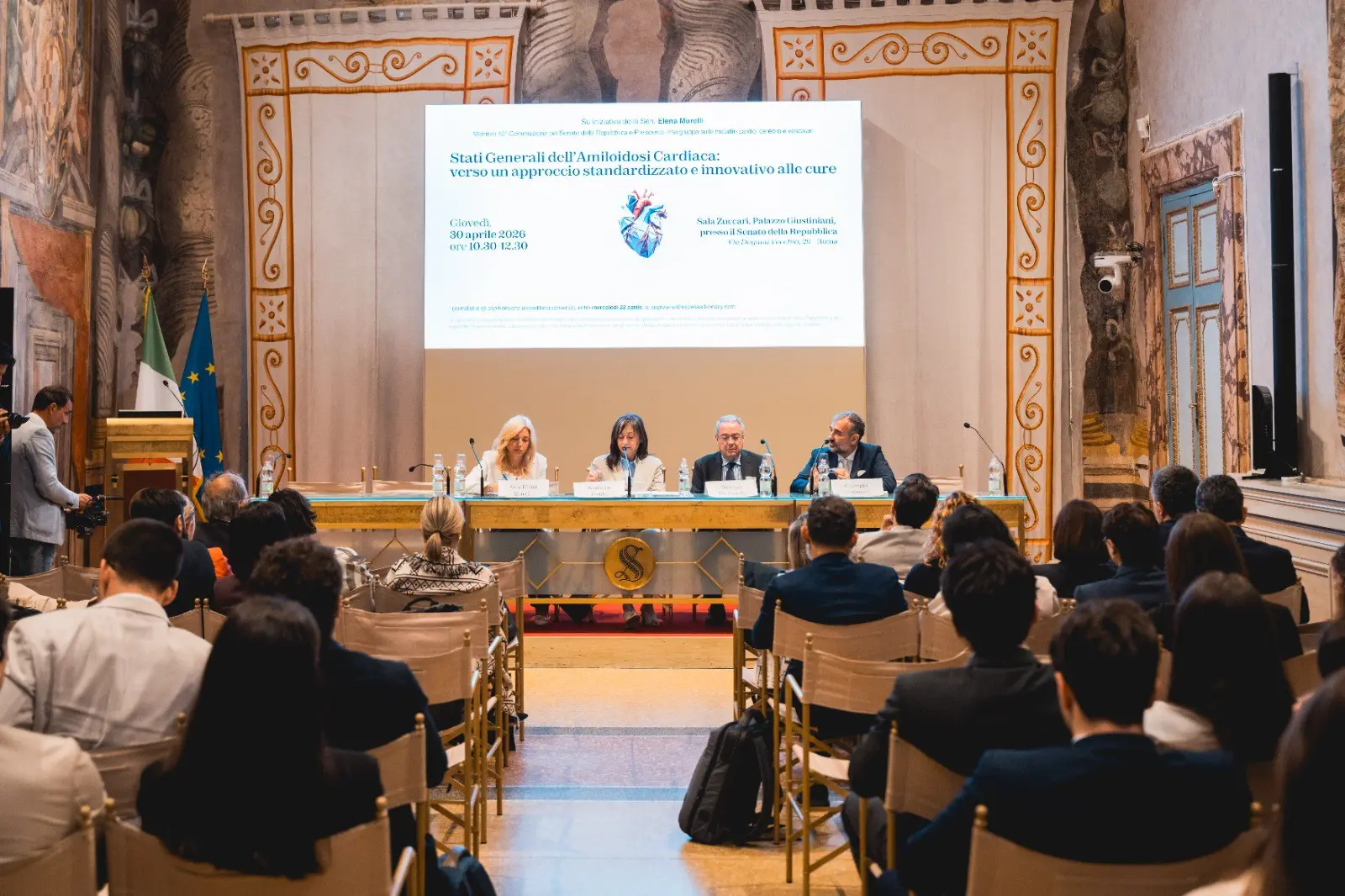
ROMA (ITALPRESS) – The General States of Cardiaca Amiloidosis were held today in Rome at the Sala Zuccari of the Senate of the Republic, an event promoted at the initiative of Senator Elena Murelli, Member of 10th Commission and President of the Intergroup Speaking on Cardio, Cerebro and Vascolari Diseases, which brought together institutions, clinical, scientific societies and patient associations, in order to launch the diagnosis In the course of the initiative, realized with the non-conditional contribution of Bayer Italy, the urgency of strengthening the ability of the health system to early intercept patients was reaffirmed. In this context, Senator Elena Murelli stressed that “the cardiac amyloidosis today requires institutional attention proportional to the complexity of the pathology and the impact it produces on patients and their families. It is necessary to valorise addresses and policies that make the diagnosis more timely and more effective the models of taking into account, strengthening the paths of care and integration between territory and reference centers. It is also essential to promote governance tools capable of reducing territorial unhomogeneity and guarantee welfare continuity throughout the entire patient journey”. Marco Salvatore, Director of the Interdepartmental Structure Rare Diseases Without Diagnosis of the National Rare Disease Center of the Higher Institute of Health, during his intervention on the role of clinical data availability, highlighted that “the dedicated national register is an essential infrastructure to produce evidence useful to health programming. The collaboration between Istituto Superiore di Sanità, ANMCO and SIC, through which the dedicated register has been promoted, allows to build a shared database that can be used to monitor the impact of welfare strategies”. The comparison recalled the centrality of the network and the definition of shared rules to make the Hub & Spoke model – of connection between reference centers and peripheral ones – actually operational. Fabrizio Oliva, Past President ANMCO, recalled that “the implementation of the PDTA promoted by ANMCO and SIC represents a tool to make homogeneous the flow of sending and counter- sending of patients between reference centers and territorial medicine and clearly define the roles of the multidisciplinary team. Consolidating a functional connection between centres means reducing territorial unhomogeneity and making patient access more timely to the treatment path”. “Premature diagnosis requires operational rules applicable in territorial clinical practice, capable of transforming suspicion into a structured pathway – said Giuseppe Limongelli, Director of the Rare Disease Coordination Center of the Campania Region and Delegate SIC – spreading the culture of suspicion implies systematic recognition of pathological red flags and also consider functional fragility as a clinical element useful to develop diagnostic insights”. The role of telemedicine has been deepened as an organizational lever to ensure greater welfare continuity. Francesco Cappelli, Referent of the Centro per lo Studio e la Cura dell’Amiloidosi A.O.U Careggi Firenze has highlighted how “the telemedicine represents a useful tool to strengthen the grip and the clinical follow-up, improving the connection between the different levels of care and reducing any discontinuity in patient management. If integrated in a structured way in clinical processes, it allows to strengthen the response, especially in center to high volume”. Another focus was on the contribution of Artificial Intelligence to strengthen clinical processes along the patient journey. “IA can support the stratification of pathological risk through a structured organization of data, but innovation produces impact only if it is governed and integrated in clinical practice – said Giovanni Palladini, Professor of Clinical Biochemistry and Clinical Molecular Biology of the University of Pavia – for this reason the formation of health professionals and the definition of models that guarantee precocious diagnosis are imprescindable conditions that improves the path”. Through the event, the importance of supporting the shared commitment to strengthen the early diagnosis and governance of pathological paths has been highlighted, providing an operational basis for the structure of care models capable of focusing the patient on the path of care and protecting the quality of life. -photo press office Esperia Advocacy – (ITALPRESS).