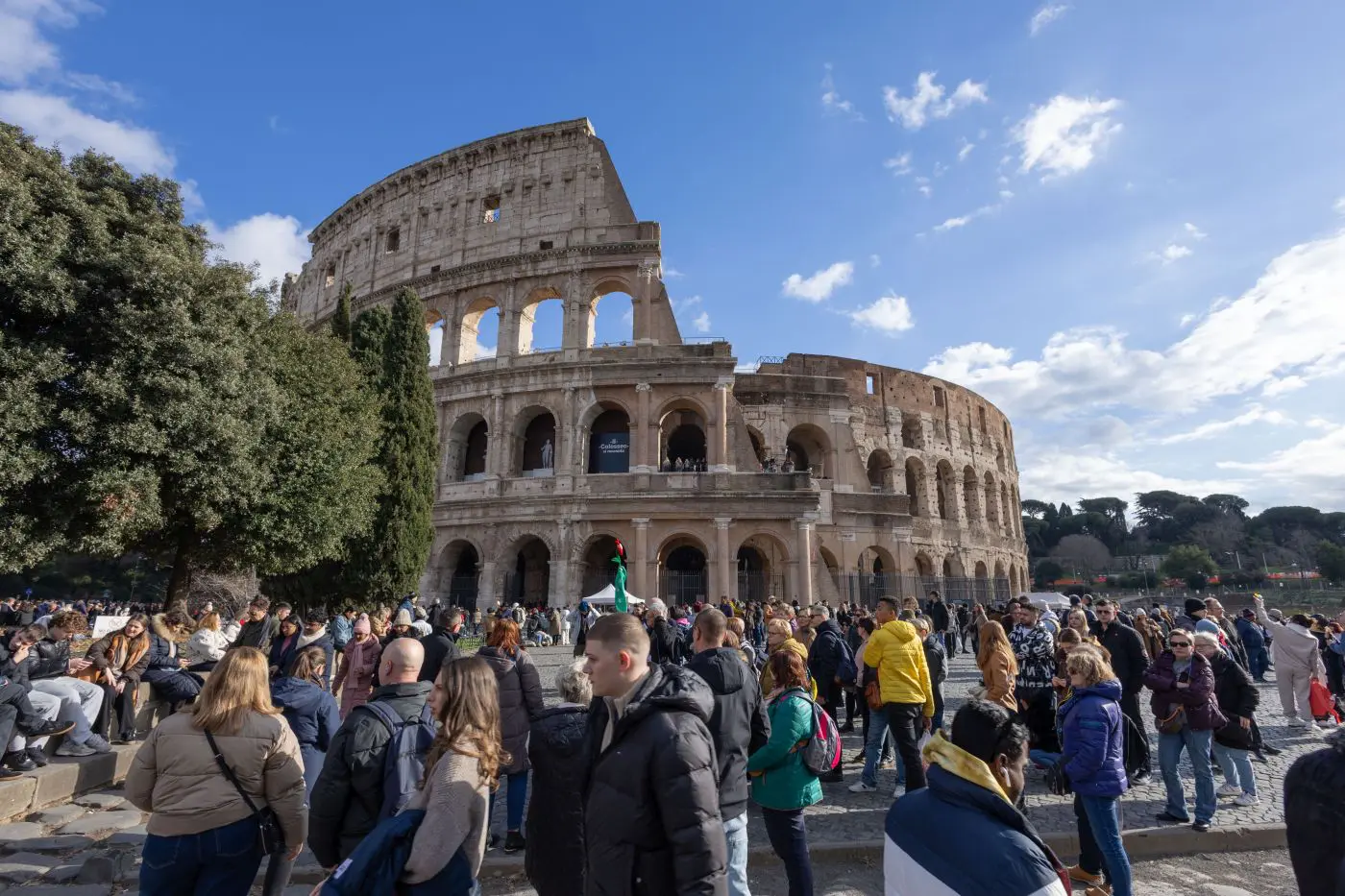
ROMA (ITALPRESS) – Foreign tourism continues to push consumption. In 2025, the total spending of foreign travellers in our country was just over 56.7 billion, 2.5 billion more than 2024 (+4.6%). A growth that should continue, with a change expected to 2026 of +3.9% on the year, reaching 58.9 billion (+2.2 billion). This is what emerges from the estimates and elaborations carried out by CST – Centro Studi Turistici di Firenze per Confesercenti on data Banca d’Italia.
The main share of foreign tourist spending was intended for hospitality (45.2%), followed by catering (23%) and shopping of goods at the commercial network (15.2%). The rest of the expenditure was intended for internal transport (9.5%) and “other services” (7.2%).
In 2025 compared to 2024 international tourism generated 2.510 million euros in more (+4.6%). However, growth has not been distributed evenly, but has been driven almost entirely by accommodation (+1.101 million euros, +4.5%) and catering (+955 million euros, +7.9%), driven by the increasing interest in the Italian gastronomic tradition. The purchases of goods in the shops have instead recorded a contained increase (+164 million euros, +1.9%), while the expenses for the internal transport, only voice in red, that loses 261 million euros (-4.6%) regarding 2024. While representing a lower share in absolute terms (+551 million euros), the category other services has recorded the highest percentage growth in absolute (+15.7%). In this voice there are guided tours, excursions, entrances to museums, concerts, personalized experiences and wellness services, demonstrating a foreign demand increasingly oriented to “experience tourism”.
The first four spending regions absorb almost 56% of the consumption of foreign visitors: Lazio (10.2 billion, 18.1%), Lombardy (9.9 billion approximately, 17.6%) and Veneto (6.3 billion, 11.1%) and Tuscany (5.3 billion, 9.4%). Among other regions are Campania with 3.390 million Ç (6.0% of total) and Trentino-Alto Adige with 3,069 million Ç (5.4% of total). The regions with the lowest cost impact of foreign travellers are Basilicata (€60 million) and Molise (€37 million). On the other hand, Friuli-Venezia Giulia shows a unique shopping facility, where foreign tourists spend more on shopping (36.5%) than for accommodation (27.2%). In Trentino-Alto Adige there is the highest percentage of Italy dedicated to accommodation, which absorbs 54.1% of the total budget of travellers in the region.
The data relating only to holidays (excluding all other reasons of travel like business) are around 38 billion euros on the total 56.7 billion, and highlight how the different tourist products start different economies and behaviors. Cultural tourism and the City of Art is the driving force of foreign demand: it generates 21.639 million euros, that is 56.8% of all spending for holidays in Italy. The holiday at the sea is in second place with 8.232 million Ç (21.6% of the total holiday). The mountain holiday generates 3.588 million Ç (9.4%).
“International tourism confirms an irreplaceable economic engine for our country, with positive results not only on housing businesses, but also catering, commerce and services – says Confesercenti President Nico Gronchi -. But it is not enough to intercept the question: you have to rule it. With almost 56% of spending concentrated in four regions, we are asking a few tries to support the weight of flows that could, and should, be distributed throughout the country. A double problem: on the one hand the risk of overcrowding and loss of viability in the most visible destinations; on the other territory with a huge tourist, food and wine potential that remain at the margins of growth”.
“For this reason we ask the institutions, starting from the Executive, to put the government of tourism on the territory at the center of the agenda: a national direction that coordinates Regions and Municipalities, instruments of seasonalization of flows, infrastructural investments towards the internal and minor areas, and incentives aimed at the enterprises that choose to invest outside the most beaten routes. Also because – he concludes – international demand is destined to grow again, with the concern of new major emerging markets, starting from the Indian one. The challenge of the future of Italian tourism will be precisely this: to intercept and manage flows on the territory, to transform these numbers into a widespread development throughout the country”.
– photo IPA Agency –
(ITALPRESS).