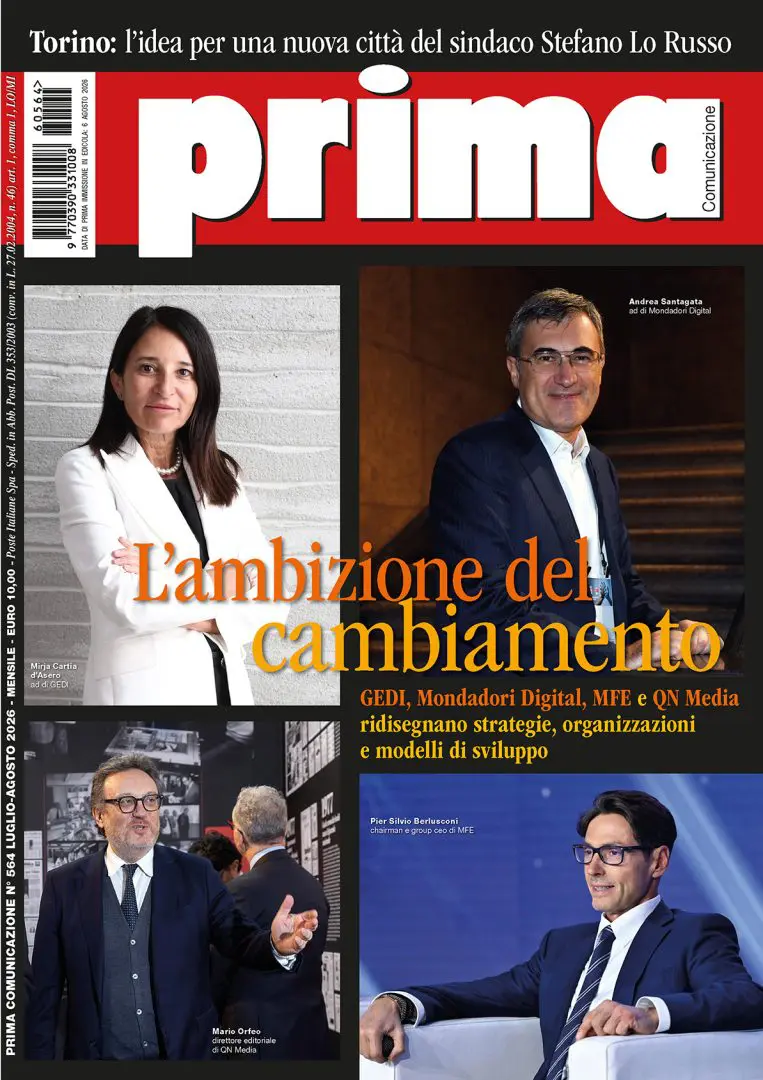
MILAN (ITALPRESS) – The July-August issue of First Communication is a sample of stories that return the feeling of a world of information and media in full boiling. The greater the crisis of advertising, sales and listening, while octs continue to grow, the more publishers react. We have been working on this sector for over fifty years and do not remember such an intense season: new editorial projects, acquisitions, reorganization and entrepreneurs, even unexpected, who choose to invest in the media. It is the case of Leonardo Maria Del Vecchio who, with the acquisition of QN Media, decided to re-launch the group also aiming on the arrival of an editorial director like Mario Orfeo. Or Theodore Kyriakou, the Greek entrepreneur, who decided to invest in Italy by purchasing GEDI. An editorial group that urgently needed to be reconsidered and on which the new shareholder is setting a deep reorganization: accounts to be restored, Republic to be relaunched, digital development, videos, events, new synergies with Antenna and a team of trusted men to preside over governance.
Pier Silvio Berlusconi, increasingly engaged in the international development of MFE, of which he redesigned the organigrams placing his managers of confidence in the most strategic places, but never lose sight of Italian television. And he has reason: Mediaset wants to dominate the national market while accelerating the project of a European platform capable of competing with the great American technological operators. An ambition that until a few years ago would seem unrealistic.
“First” then went to see how things go to the Turin Press, where the arrival of the new editor Alberto Leonardis and the director Antonio Di Rosa seems to have returned confidence in a editorial that, in recent years, had lived an unhappy season. In Genoa, however, the long and complex coexistence between Michele Brambilla and the publisher Pier Francesco Vago was closed. The Blue Media group, controlled by Msc, now has the task of building a real editorial strategy, after starting the revival with a new and ambitious digital site, focusing on the side business of the blue economy.
If there is a common trait to all these events, it is that no one, today, thinks more of being able to defend the existent. Everyone, in different ways, is trying to reinvent their future. The perhaps most significant story is that of Mondadori Digital. In a few years the Mondadori Group has built one of the main Italian digital ecosystems, able to reach altogether 137 million followers. In the long interview with Prima, managing director Andrea Santagata tells a strategy that integrates content, creator economy, advertising technologies and growth for acquisitions, remembering that the real challenge “is not pursuing technology, but putting innovation at the service of a heritage built in over a hundred years of group history”.
But digital is not only innovation and new opportunities. It also has a more disturbing side, which crosses the way the information is formed. This is the story of Marco Gregoretti, a veteran of journalism, who had chosen YouTube to continue making information. After a rapid growth of the audience and views, he decided to close his channel, denouncing a system in which algorithms tend to reward polemics, aggression and conflicts at the expense of deepening and good journalism. A choice then revised, with the reopening of the channel, but that remains a significant testimony of the tensions that today cross the platforms.
On an even more strategic plan there is an interview with Stefano Amoroso, director of Leonardo’s communication, which introduces the theme of cognitive war: in contemporary conflicts, he explains, there are not only infrastructure and networks, but also the ability of citizens to form a free and conscious opinion. A theme that opens up new questions about the relationship between technology, information and democracy.
From digital information the story then moves to the world of television, where traditional broadcasters and new operators are redesigning palinsesti, strategies and models of development in an increasingly competitive market, with octs in the background as the main factor of change. After recounting the MFE programs and the new responsibilities entrusted by Pier Silvio Berlusconi to his managers, Prima analyzes the palinsesti of the main broadcasters. Sky Italia, under the ever more recognizable guidance of Giuseppe De Bellis, strengthens its position by integrating information, sports, entertainment and cinema; Warner Bros. Discovery relaunches the Nine, doubling the presence of Fabio Fazio and consolidating the distribution alliances; La7 continues to grow by leveraging information power and looking at digital development. A journey that shows how the palinsesti are less and less a simple television offer and increasingly the result of industrial, technological and editorial strategies. Closes the television focus the analysis of the new managerial narrative with which the managing director Giampaolo Rossi tries to reposition the Rai and, together, his leadership. An ambition not recently.
Ample space also for sports and communication. Antonio Rossi’s voice, the Olympic champion and the reference point of Italian canoeing, reports the debate on the ground of people and values of sport, recalling how communication remains first of all a question of credibility, example and ability to create bonds. While the Giro d’Italia becomes the story of a brand: the experience of Banca Mediolanum shows how a great sponsorship can turn into a lever of relationship, reputation and involvement, far beyond the simple visibility.
In the Communication section, finally, we analyze the path of Ferrovie dello Stato in building a new identity of the group, and we propose the interview to the CEO and CEO of Wpp Media Italy, Massimo Beduschi, who reflects on the challenges of the new global advertising market, on the role of platforms and on the transformation of the media agencies in the era of artificial intelligence. And then the turn of Audicom, called to build new standards of audience measurement in an ecosystem where television, digital and platforms are now part of the same market.
– Press Office Photos Before Communication –
(ITALPRESS).