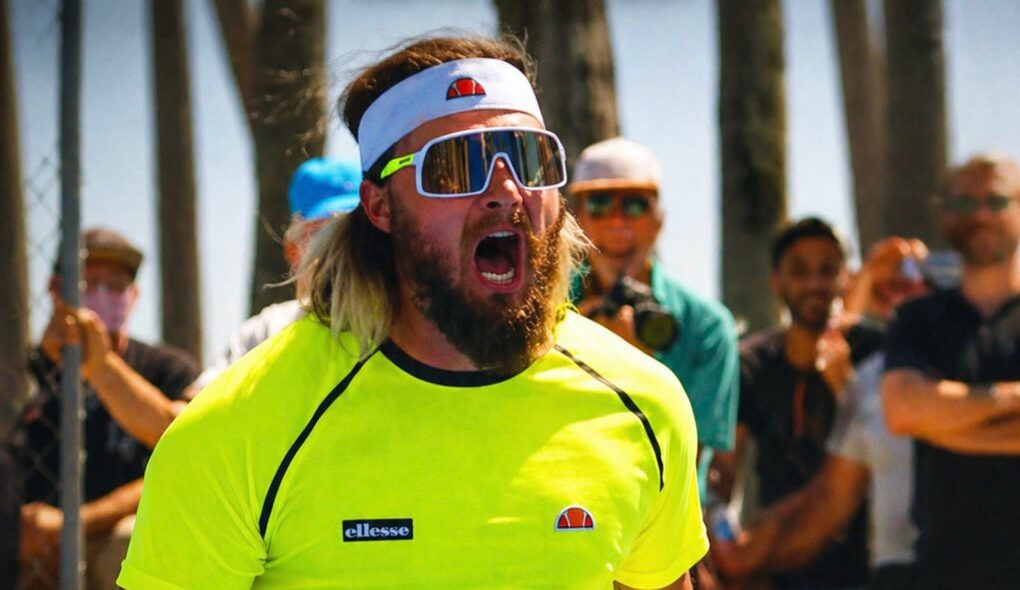
In Venice Beach, where the boundary between performance and daily life dissolves, one of the most authentic stories of contemporary urban sports is born. Here is Ernesto Russo, a hybrid figure among athlete, artist and storyteller, protagonist of the Kings of Venice project, a docufilm that has conquered audience and criticism in international festivals such as the Slamdance Film Festival and the Calgary Underground Film Festival.
Kings of Venice is a docufilm set in the legendary paddle tennis courts of Venice Beach, one of the few places in the world where this sport survives in its most authentic form. More than telling a discipline, the film enters the community: a microcosm made of outsiders, artists, athletes and borderline characters who live the field as a space of expression. The director is signed by TC Johnstone, American documentary filmmaker already known for works related to sports and urban subcultures. Among the producers, Terry Kennedy, together with an independent team that has followed the project since its origins, maintaining its raw and immersive style. The result is a visceral tale, where competition, identity and belonging intertwine, returning Venice Beach in its purest and unfiltered form.
Ernesto, your history at Venice Beach seems almost predestined. How did it all start?
My story in Venice Beach didn’t happen. It’s like this place called me. I arrived here in 2016, with a paddle tennis racket and an undefined view, but with the precise feeling of having to cross something. Venice Beach is not only a place: it is a state of mind, it is freedom, it is chaos and harmony together. Here I found a space where I could express myself without filters, as an athlete and as a human being.
From this experience was born Kings of Venice. What kind of project is it?
Kings of Venice was born of this invisible energy. It was not built, it emerged. Day after day, between the fields, people, tensions and cruel truths of this environment. We did not want to tell a sport, but a soul. A human ecosystem
.
In the film, you don’t seem to be acting, but living something much deeper.
In the film, I do not interpret a character: I manifest myself. I’m instinctive, I’m conflict, I’m research. I bring in the most visceral side of the game, what you cannot teach. It is not only about winning, but to leave a footprint, even uncomfortable, even imperfect, but real.
The film has had important awards at international level. What do you mean?
For me, Kings of Venice is an act of truth. It is Venice Beach in its purest form. A tribute to those who live out of the schemes, to those who transform every day into expression. The film was strong, authentic, internationally recognized, with victories such as the Audience Award at the Slamdance Film Festival and the Calgary Underground Film Festival. But the awards are only a reflection: what matters is the energy that the film leaves in people.
You often talk about “movement” more than project. What do you mean?
What we’re doing is a movement rather than a project. A fusion of sport, art and culture. Kings of Venice is identity, is vibration, is memory.
Your figure is hard to get incasellare. How do you define yourself today?
I move between fashion, cinema and sport as on parallel trajectories that at some point meet. I don’t recognize myself in one definition. I’m a hybrid, contemporary figure. I try to transform every field, every scene, every space, into a stage.
If I had to synthesize your philosophy in a sentence?
Because in the end it’s not about belonging to a world… but creating one of its own.
L’articolo Ernesto Russo: the visceral soul of Venice Beach between sports, cinema and identity proviene da IlNewyorkese.