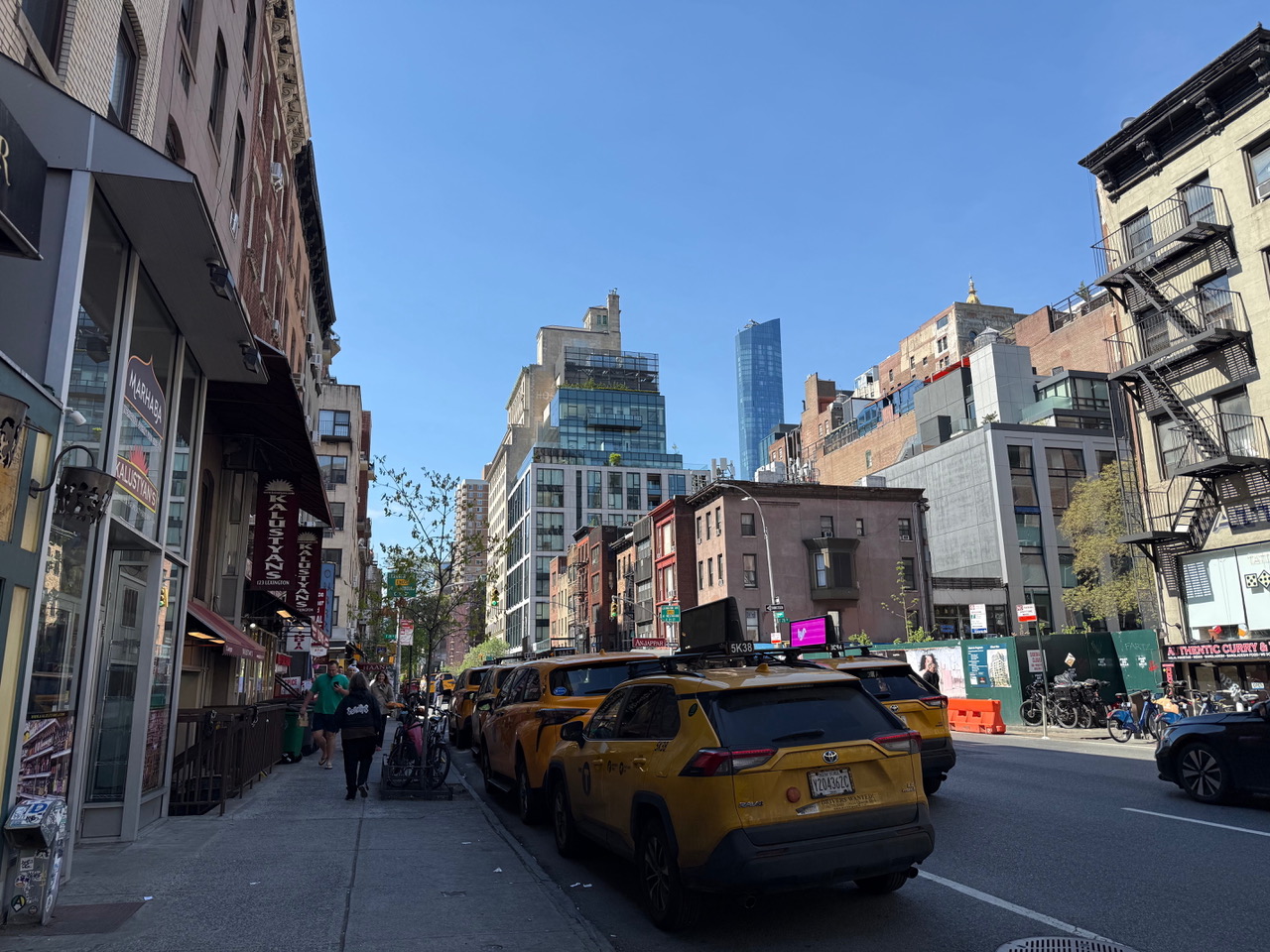
In Midtown, among the high anonymous skyscrapers of the offices, there is a short stretch of Lexington Avenue, between 26th and 28th Street, which smells of spices. We are in Curry Hill, the small Indian cultural and gastronomic enclave of Manhattan, which survives proudly with its few-storey buildings and commercial activities in family management, despite the continuous and hectic evolution of the neighborhood. Who knows New York knows that the great Indian neighborhood of the city is not here but in Jackson Heights, Queens, where Asia has rooted in the streets and markets, with a residential and commercial density that has no comparison in Manhattan. Curry Hill, however, is a reality to itself: smaller and more concentrated, but not for this less interesting to discover.
My first meeting with authentic Indian cuisine did not take place in New York but in Delhi, on the evening of the first day of a trip to Rajasthan in 2013, when still disoriented by time zone and impact with the city, I found myself sitting by Saravana Bhavan, a historical chain of vegetarian restaurants native to southern India. I didn’t know what to order, and it was someone at the table next to pointing out the dosa masala. This thin and crunchy rice flour, filled with spicy potatoes, served with coconut sambar and chutney, turned out to be one of those experiences of food that do not forget. Later I would have discovered that Saravana Bhavan also has a seat in Curry Hill, at 81 Lexington Avenue, where every time I come back to mind Delhi, the ant table, the frenzy of the restaurant in one of those short geographical circuits that only New York can generate!
But we do as always a step back and try to figure out how this neighborhood corner has developed. The South Asian community began to root in New York significantly after 1965, when the Immigration and Nationality Act dismantled the national quotas that had in fact held out of America anyone who was not European, opening the doors to a highly specialized immigration made of doctors, engineers, professors, very different from the labor wave that had characterized previous generations. Murray Hill, with its still affordable rents and its central location, becomes one of the chosen natural landing points, and the Lexington section around the 28th, already known as Little Armenia, is soon renamed Curry Hill, in a word game with the name of the neighborhood that still resists today. To make the place interesting, besides the presence of the spices name and fact, is the succession of restaurants and Indian shops, Pakistani, bangladesi and Lankesi sri, with their kitchens and their cultures that in the countries of origin bear the weight of deep historical tensions and that here, in four blocks of Midtown Manhattan, seem to have found a quiet and pragmatic truce.
The easiest way to get to Curry Hill is by metro line 6. Coming to 28th Street and turning east on Lexington, the neighborhood turns out alone. The first thing you notice is the overlap of different registers: next to a restaurant with elegant air there is a place without name with plastic chairs that bakes thali to fifteen dollars, next to a jewelry store with the sari exposed in the showcase there is a grocery store where an old man counts lentils behind the counter. It is a neighborhood that works, in the simplest and most New Yorker sense of the term, and the fact that among its most faithful frequenters there are taxi drivers of the city, mainly Indians, Pakistani and Bangladesi, is perhaps the most honest sign of its authenticity. When those who know that kitchen better than anyone else choose to stop there, you can definitely trust! The culinary choice ranges from North Indian cuisine to South India with Saravana Bhavan, which brings to Manhattan the vegetarian cuisine of Tamil Nadu with its steamed soft idles and crispy dosas that here are identical to those I first discovered in Delhi.
Before the restaurants, however, there is a place that deserves a separate speech and that in a way precedes everything else. It is Kalustyan’s, at 123 Lexington Avenue, which is not only the most supplied spice shop in the city but it is, in all effects, the place from which Curry Hill began to take shape. Founded in 1944 by Kerope Kalustyan, an Armenian arrived from Istanbul with the intention of exporting steel to Turkey, the store develops in what was then an Armenian neighborhood, selling spices and products of the Middle East. When in the 1960s and 1970s the Indian community began to reach significant numbers, Kalustyan’s expanded to serve it, introducing ingredients that were not elsewhere in New York, and thus became one of the catalysts of the very identity of the neighborhood. Today the store is owned by a bangladese family and sells products from more than eighty countries, with shelves coming to the ceiling and a ability to let anyone enter without a precise list. I go back regularly to stock up with spices and herbal teas, and every time I go out with at least three things I had not planned to buy including sweets soaked in honey, a special rice pack or some datter with surreal dimensions. It is one of those shops that remind you why it is worth living in a big city!
In Curry Hill, restaurants take place a few steps from each other, often managed by the same entrepreneurs who over time built small family groups, covering different registers of the same culinary tradition. It is the case of Bhatti Indian Grill and Desi Galli, two locals of the same owner who turn to different moments of the day and to different moods: the first is the place for a more collected dinner, with a focus on the kitchen of the tandoor, specialized in chicken tikka while Desi Galli is the realm of Indian street food where the kathi roll (rolled paratha cakes around various fillings) are unmissable. There are also vegetarian options and the aforementioned Saravana Bhavan and Kailash Parbat are the right places.
If restaurants are the most immediate way to get into Curry Hill, shops are the way to really understand it. In addition to Kalustyan’s, which we have already met, it is worth stopping also from New Foods of India, at 121 Lexington, smaller and chaotic with the typical atmosphere of neighborhood shops that New York is losing more and more often. Completing the picture are the jewelers and textile shops, overcrowded with rolls stacked up to the ceiling, which line Lexington with their illuminated windows. Here you can buy both classic sari and salwar kameez, tunics with trousers that have become the daily leader for many women in southern Asia, and prices are almost always surprising for the quality of what is found. There are also jewels and decorative ornaments that in traditional Indian families represent a transferable personal wealth of the woman, a form of savings and security independent from any other variable of family life.
Curry Hill has a precise and recognizable daily rhythm, but also knows how to fit into the great celebrations of Indian culture. During Diwali, the festival of lights that falls between October and November, the shop windows fill with mithai, the traditional desserts made of reduced milk, sugar, saffron and pistachios, the restaurants offer special menus, and the atmosphere becomes warmer and more convivial than usual. Then there is the India Day Parade, the largest celebration of Indian independence outside India, which parades every year along Madison Avenue with dozens of wagons, thousands of participants and the Empire State Building illuminated with the colors of the Indian flag. The parade does not pass on Lexington, but its path ends a few blocks away, and in those afternoons of August Curry Hill becomes the natural continuation of the party, with the restaurants that fill and the streets that animate a joy different from the usual. If you want to live it firsthand, mark on the agenda on the third Sunday of August and arrive at Curry Hill in the late afternoon, when the parade is over and the party moves to the table.
Curry Hill, like all of Manhattan’s ethnic neighborhoods, today faces a pressure that does not hint at decreasing. Rentals increase, new real estate developments transform the isolated building fabric, and the children of immigrants who built this place move elsewhere or simply embark on professional routes that do not pass through the opening of an Indian restaurant in Midtown. The neighborhood has survived many transformations, but the changes are in place and do not hint to slow down despite these few blocks are still frequented both by a clientele full of long course and by the new arrivals looking for a cultural reference point. If you haven’t been there yet, go there. And if you’ve been there, maybe go back to a party day where sharing gets deeper.
This is our monthly appointment with the World Tour in New York. If you have lost your previous numbers, you can find all the articles in the section on the site: Greenpoint Poland, the Williamsburg of the Orthodox Jews and many other corners of the world, without ever leaving the city. Next month, with a new story and a new neighborhood!
L’articolo Curry Hill: where Midtown smells of spices proviene da IlNewyorkese.