There is a question that, sooner or later, climate change will also force the world of enology to ask itself: will wine end?
The simplest and most reassuring answer is no. There is no scientific forecast that the vine will suddenly stop producing grapes or bottles will disappear from the shelves. However, it would be naive to think that wine could continue to be born everywhere, in the same way and with the same results as ever. The challenge does not concern the survival of the plant, but the preservation of the balance that for centuries has allowed a certain vine, in a certain place, to become that wine.
Italy, which has built much of its cultural and agricultural identity on the biodiversity of the vine, is today at the heart of this transformation. One of the most immediate consequences of increasing temperatures is the anticipation of maturation. The harvest comes first, sometimes much earlier. For example, this year in Franciacorta, it arrived to harvest up to a month in advance compared to the custom of a few decades ago, working at night before dawn to protect the grapes from the 38 °C day and preserve the acidity.
If the heat accelerates the times, the grapes accumulate sugars too quickly at the expense of acidity and aromatic balance. Thus the paradox of modern viticulture is born: a grape can be excessively sugary and, at the same time, still immature on the qualitative level. For the winemaker it is no longer just to understand when harvesting, but how to stop time.
Taking a look at the data of global production, the International Organization of Vine and Wine (OIV) for 2025 with about 227 million hectolitres: a figure confirming the third consecutive year of volumes contracted globally. Italy confirms itself as the world’s first producer with about 726,000 hectares of vineyard, but stopping at the current figures is misleading. The climate does not generate an ordered drop in production, but a strong volatility: dramatic vintages alternate on sudden shootings, while some areas suffer and others take temporary advantage.
A wide scientific analysis conducted on 12,931 points of detection throughout the Peninsula and based on bioclimatic projections (through the Huglin wine index) reveals the breadth of this metamorphosis. In the temporal window between 2061 and 2080, in the scenario of intermediate emissions (SSP2-4.5) the Italian territory classified as “Very Warm” will be 18%; but in the most severe climate scenario (SSP5-8.5), 52% of the national territory will fall into this range with high thermal stress, involving the totality of the vines located below 300 meters above sea level. It does not mean that over half of Italy will stop producing wine, but that the climate of historical areas will no longer be the one for which those wine systems have been thought.
Forecast from 2035 to 2080. The impact of global warming will not be sudden, but will be divided into four key phases defined by climate modelling:
Prossimi 10 anni (Fase Agronomica): L’adattamento avverrà quasi esclusivamente in vigna. Gli interventi prioritari riguarderanno vendemmie anticipate, gestione dell’irrigazione di soccorso, ombreggiamento dei grappoli e selezione di portinnesti più tolleranti alla siccità.
2035 – 2050 (Fase di Selezione Territoriale): Diventerà evidente la linea di demarcazione tra le regioni dotate di una naturale resilienza microclimatica e quelle in cui mantenere i vitigni tradizionali richiederà costi economici e ambientali sempre meno sostenibili.
2050 – 2070 (Fase della Riorganizzazione Geografica): Accelereranno i processi di migrazione altimetrica e la ricerca di versanti più freschi. Vitigni storici cominceranno a trovare nuove interpretazioni espressive in zone un tempo considerate marginali.
Verso il 2080 (La Nuova Mappa): Negli scenari più critici, l’intero assetto viticolo della Penisola apparirà radicalmente ridefinito rispetto alle mappe delle denominazioni attuali.
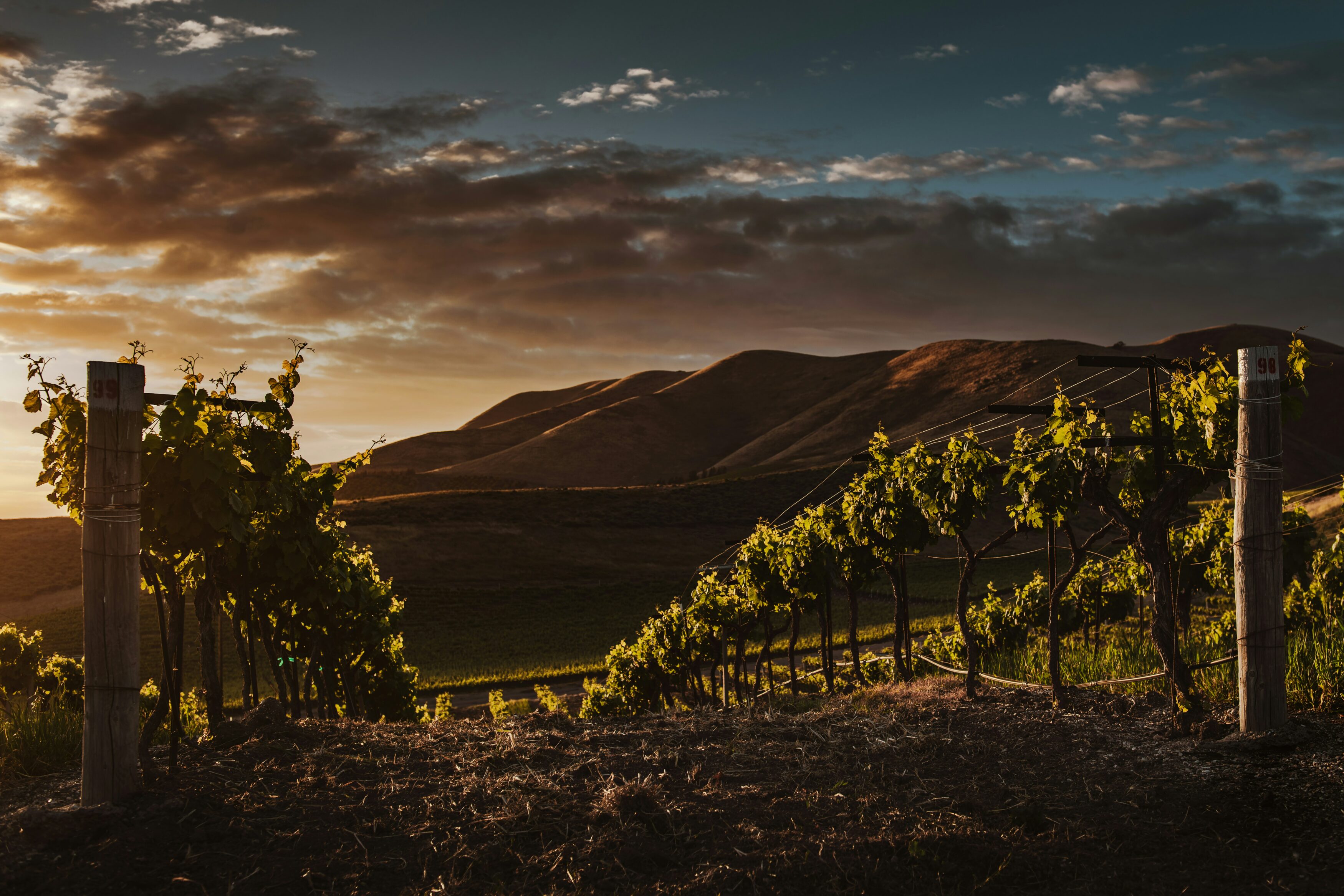
Where will wine go? The history of viticulture is turning into a history of migration. In Italy this race will not necessarily be towards other countries, but upwards: from the plain to the hill, from the hill to the mountain.
The altitude becomes the new strong currency of viticulture. A vineyard at 700 meters today offers the weather conditions that once were 400. Historically considered marginal areas or too cold slopes suddenly acquire an invaluable value.
At the same time, the global map widens towards north. In the United Kingdom, the production of sparkling wines has an unprecedented expansion, and similar dynamics touch Northern Europe. However, planting a vineyard takes a few years, while forging a terroir requires generations. A great territory is not only created with temperature: suitable soils, culture, infrastructure, knowledge and markets are needed.
However, Italy has a secret weapon: its extraordinary heritage of native vines. Having hundreds of different varieties is to have a natural genetic laboratory: some tolerate drought, others retain acidity or mature late. This biodiversity, considered for a long time only a cultural wealth, is today the main strategic reserve of survival.
When geography changes, geopolitical changes inevitably. For centuries, the Mediterranean block composed of Italy, France and Spain has represented the nerve center of world production. With the shift of ideal conditions, new territories and countries so far considered peripheral will come to the market.
In this scenario, access to water will become the true strategic resource: producing in areas subject to extreme temperatures will require constant irrigation, placing the sector in front of ethical and economic choices painful. The question of the future will not only be where one can cultivate the lives, but who can afford to do so.
Italy has a competitive advantage not available on the market: history. Being able to protect the economic and cultural value of denominations that risk not being more climatically equal to the past is the real game of the next fifty years.
The wine is not misunderstood. He’s changing his address and redesigning his own balance of power.
L’articolo Climate change and wine: Italian viticulture flees upwards proviene da IlNewyorkese.