There is a precise moment, in the late afternoon of Manhattan, in which the bureaucratic machine of justice gives rise to the last breath of the day. It happens around Centre Street, in the shadow projected by the imposing Corinthian columns of the New York County Courthouse at number 60. When employees flock to subways and lawyers close leather bags, the City’s Federal Court area sinks into a silence that has nothing bucolic. It is a mineral silence, heavy, made of stone and asphalt.
In the late afternoon, among the columnists of the Federal Court, the metropolis stops screaming. A sound asphyxia that reminds us how Gotham is an island that has forgotten the song of water.
Walking in front of the stairway of granite, where countless times we have seen parades accused and witnesses in the news around the world, gives a feeling of vertigo on the contrary. Without the buzz of the crowds, the hexagonal building designed by Guy Lowell seems to be bigger, an empty temple that holds already written judgments.
In this quadrilateral of courts, silence is a forced truce. You don’t hate the traffic of the nearby Canal Street, nor the reverb of the life of the neighborhoods. But it’s right on this break that we can see what really is missing in New York: nature.
New York is an island – or rather, a set of islands – yet it is a city that has devoured its original soundscape. This afternoon at Centre Street, it is reflected on a cruel paradox: we are surrounded by the ocean and the East River, and yet in Manhattan the noise of the sea never odes.
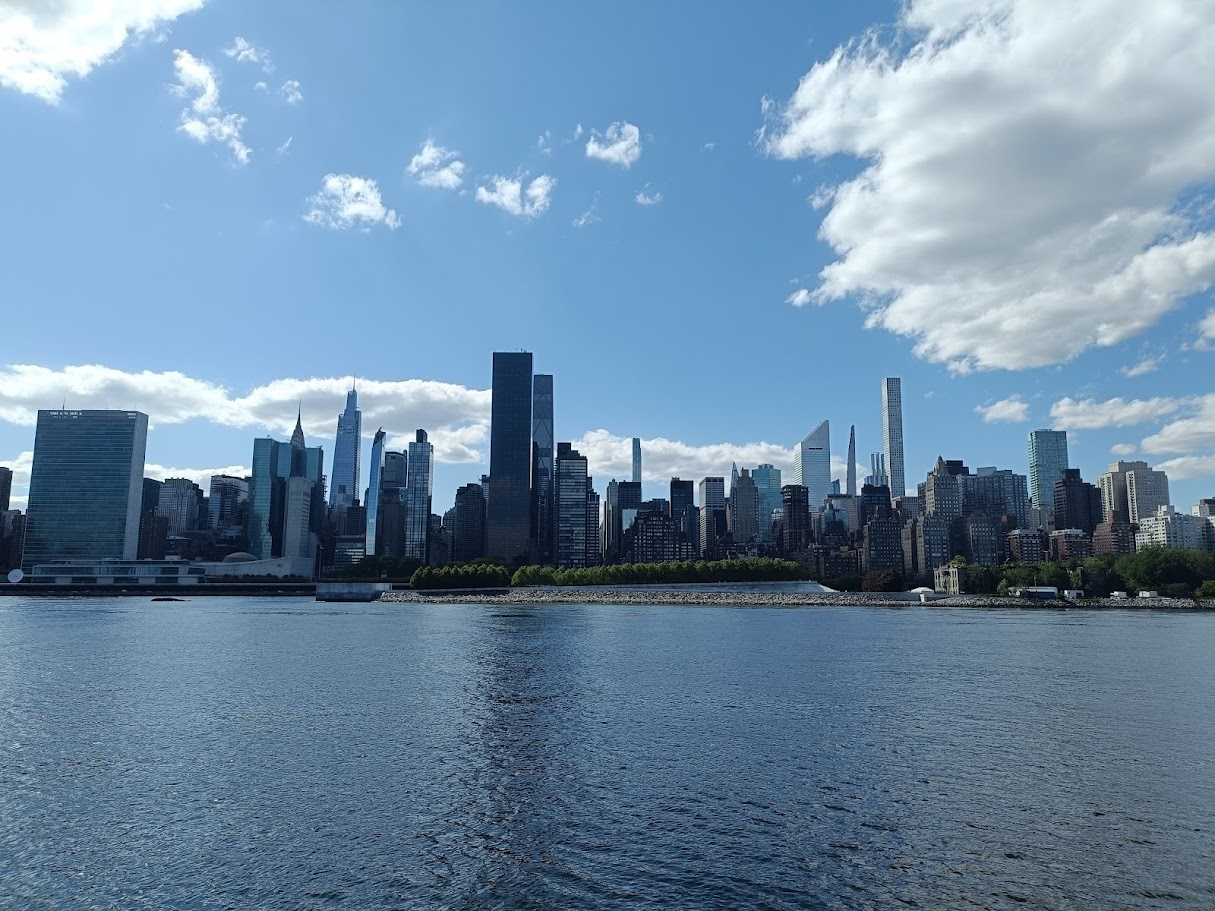
Manhattan, the pulsating heart of New York, is an island surrounded by water streams that, while being called rivers, are actually almost all estuaries subject to the oceanic tides.
In the west, the island is separated from New Jersey by the majestic Hudson River, a true river that is born in the Adirondack mountains and flows into the Atlantic Ocean, offering one of the most iconic river views in the world. East is the East River, which despite its name is a narrow brackish sea arm connecting Upper New York Bay with Long Island Sound, dividing Manhattan from Queens and Brooklyn districts. To the north, the short Harlem River, another tidal channel, separates Manhattan from the Bronx, completing the water ring around the island.
These three water bodies converge south into Upper New York Bay (the bay enclosed between Manhattan, Brooklyn, Staten Island and New Jersey), which then opens to the Atlantic Ocean through the Strait of The Narrows. This complex water system has not only shaped the geography of Manhattan, but has decreed its historical and commercial fortune, turning it into the most strategic natural port of America.
In other sea cities, the strawberries of the waves or the call of the seagulls penetrate into the urban fabric as a constant breath. Not here. Artificial noise is so dense, even when it is absent, that it has created an insurmountable barrier. Even when the city is silent, it is not the silence of the shore, but that of an acoustically isolated room. The sea in New York is a visual entity, a grey steel strip between the piers, but acoustically it was silenced by concrete.
In the hours when the courts empty, one would expect to hear the twittering of birds, that universal signal that nature takes back its spaces. But in Lower Manhattan, the flight of birds is almost always mute, suffocated by the buzz of air conditioners who never turn off or from the far-off wind between skyscrapers.
It is a silence that makes us reflect on our condition of inhabitants of Gotham: we have built a sound cathedral so perfect that, when finally silent, we only return the echo of our absence. The hollow of Centre Street is fascinating and terrible at the same time. It reminds us that we are in a magnificent stone prison that expelled the wind, the sea and the singing, leaving us alone with the majesty of our laws and the weight of our palaces.
The article Centre Street and its solemn void: where the silence of New York reveals the absence of the sea comes from IlNewyorkese.