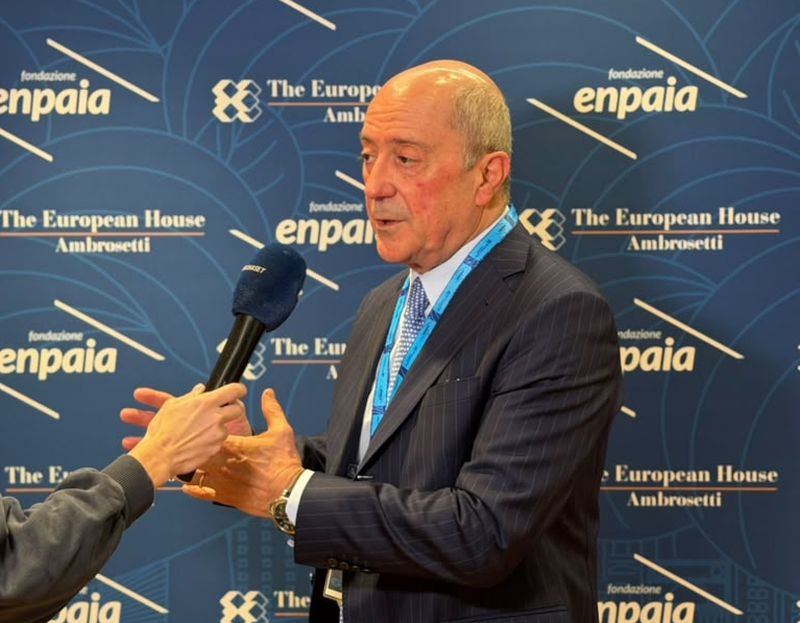
MILAN (ITALPRESS) – The Enpaia Foundation’s request by new president Massimo Gargano is that “of a detaxation of the investment of the insurance funds with a constraint to direct the resources towards the real economy that creates employment”. “The great challenges of our time – explains Gargano – are not only measured “in the financial markets, in the tables of international diplomacy or in economic indicators”, but “in the capacity of a country to guarantee water, food, energy, work and opportunities to its communities, transforming strategic resources into factors of stability, growth and cohesion”. At the opening of the Enpaia Forum 2026 “Economy and Society” at the Milan Stock Exchange on “Crescita, investments and strategic resources” Gargano (elected yesterday at the summit of the Agricultural Security Fund), emphasizes how this is the indispensable glue that a reality as the Enpaia Foundation offers to the national community at a complex historical moment, contributing to give concrete answers, dissipate uncertainties and restore confidence in the future. In this scenario – he adds – the management of water, the protection of the territory and the competitiveness of the agri-food chains are an essential part of national security. “Enpaia – continues Gargano – can offer an important contribution, alongside the social security function, a growing investment capacity in the real economy and the great transformations of the agricultural system.” In this context, the Mattei Plan is a strategic opportunity to build lasting partnerships based on the valorisation of skills, cooperation between territories and the sharing of knowledge. “Italy – Gargano concludes – can play a central role in the Mediterranean not only for the quality of its productions, but also for the ability to relate people, institutions and experiences.” For the Minister of Agriculture Francesco Lollobrigida, Italian agriculture has returned as a protagonist: for the second consecutive year it is the first agricultural economy of Europe for added value, leader in the quality of agri-food. A privileged sector in the Enpaia investment line. For Professor Omar M. Yaghi, water safety is inseparable from national security. “ When communities do not have reliable access to clean water – warns – they often have economic instability, migration and political tensions.” Water independence, according to the Nobel Prize for Chemistry who developed a system for the production of drinking water from the atmosphere already operating with Atoco, will become “one of the great technological revolutions of this century”. A revolution already begun, which could become an instrument to protect European agriculture from increasingly frequent droughts, from which no one can remain outside. Italy, says Yaghi, has “scientific skills, engineering skills and manufacturing base to become a leader in this emerging sector.” Europe should invest in partnerships between universities, industry and governments to create a new industry around decentralized clean water production. The US, Yaghi explains, supports entrepreneurship and scientific independence; China has extraordinary capacity to mobilize resources, build infrastructure and translate scientific research into large-scale productions. Europe has deep scientific traditions, solid institutions and is attentive to social responsibility. But the most effective model combines intellectual freedom, ambitious investments, rapid execution and ability to bring discoveries into society. The global competition, according to the President of Leonardo Francesco Macrì, has changed nature: “Today there are no more only companies, but whole-country systems. For Italy – he explains – it is essential to focus investments in areas where we own distinct skillsi would like to thank the rapporteur for his work. In this scenario – he emphasizes – the defence and security industry is a strategic lever for the autonomy of the country and for economic growth, thanks to the ability to generate innovation, strengthen the chains and create qualified occupation. It is from this integration between security, technology and industrial development – Macrì concludes – that can take shape a new economy of innovation, able to strengthen the competitiveness of Italy and Europa. For the Secretary General Coldiretti, Vincenzo Gesmundo, ‘we live in a conflicting world, crossed by a world war fought in pieces, as the Pope recalled, that today has already arrived in our house. We are generations who have grown up in peace, who have not known war and who are struggling to understand what a conflict with today’s military and technological power can mean. In this scenario Europe is the cog pot among the great powers that defend its strategic independence, while we are reduced to paying spectators and not protagonists. And in this context – Gesmundo continues – everyone realizes that land and food have become national security issues, like energy and defense. We cannot allow power to become a strategic dependence, as has happened in Europe for energy. We have built a Europe that does not make policies, but produces rules, often absurd, imposing ever heavier constraints on our farmers while opening the doors to products from countries that do not respect the same environmental, health and social standards. ‘It is time to change the rule of origin in the European Customs Code – Gesmundo emphasizes – deleting the deceit of the last substantial transformation that allows to pass for Italian products that are not. Without reciprocity there is no fair competition and to pay the price are our enterprises and the health of citizens. It serves a different Europe, able to defend its interests and guarantee healthy and quality food. Because – he concludes – without agriculture there is no health, there is no safety, there is no independence and there is no future. The land, today more than yesterday, was stolen. “In an increasingly unstable and conflicting world,” says Enrica Mammucari, Secretary General of the Uila, intervening at the panel on Earth and Food – clearly emerges the centrality of food and its strategic dimension that concerns not only the economy, but the social estate of communities and the stability of states. When we talk about land and food we are prompted to immediately think about agricultural production, supply chains and markets. But first of all – Mammucari emphasizes – there are the workers and workers who make our products great all over the world.” “The work – adds Mammucari – represents the first infrastructure of Italian and European agriculture and must be defended to protect food security, honest enterprises, environment and territories at the same time.” The quality of our food and its value are “inseparable from the dignity of those who produce it”. The experience of Enpaia, concludes the General Secretariat of Uila, testifies “the value of a vision in which social security and responsibility can contribute to the development of the real economy, the quality of employment and solidarity among generations”. “If I had to sum up the day in a sentence – says the General Manager of Enpaia Roberto Diacetti closing the Forum – I would say: the missing future is not a fatality; it can be built on condition of designing it with the same care with which Professor Yaghi designs his materials. Orient long-term savings towards investments that generate real value; strengthen the industrial and technological base; and protect land and water, which are the first infrastructure in the country”, sintetizza Diacetti, are the preferential courses for economic and social development. “In this design – he concludes – the Enpaia Foundation wants to do its part. Keep the present of those who work in agriculture and guarantee it tomorrow. And to be a place of open thought, as this Forum shows from seven editions.”.
– photo printing office Enpaia –(ITALPRESS).