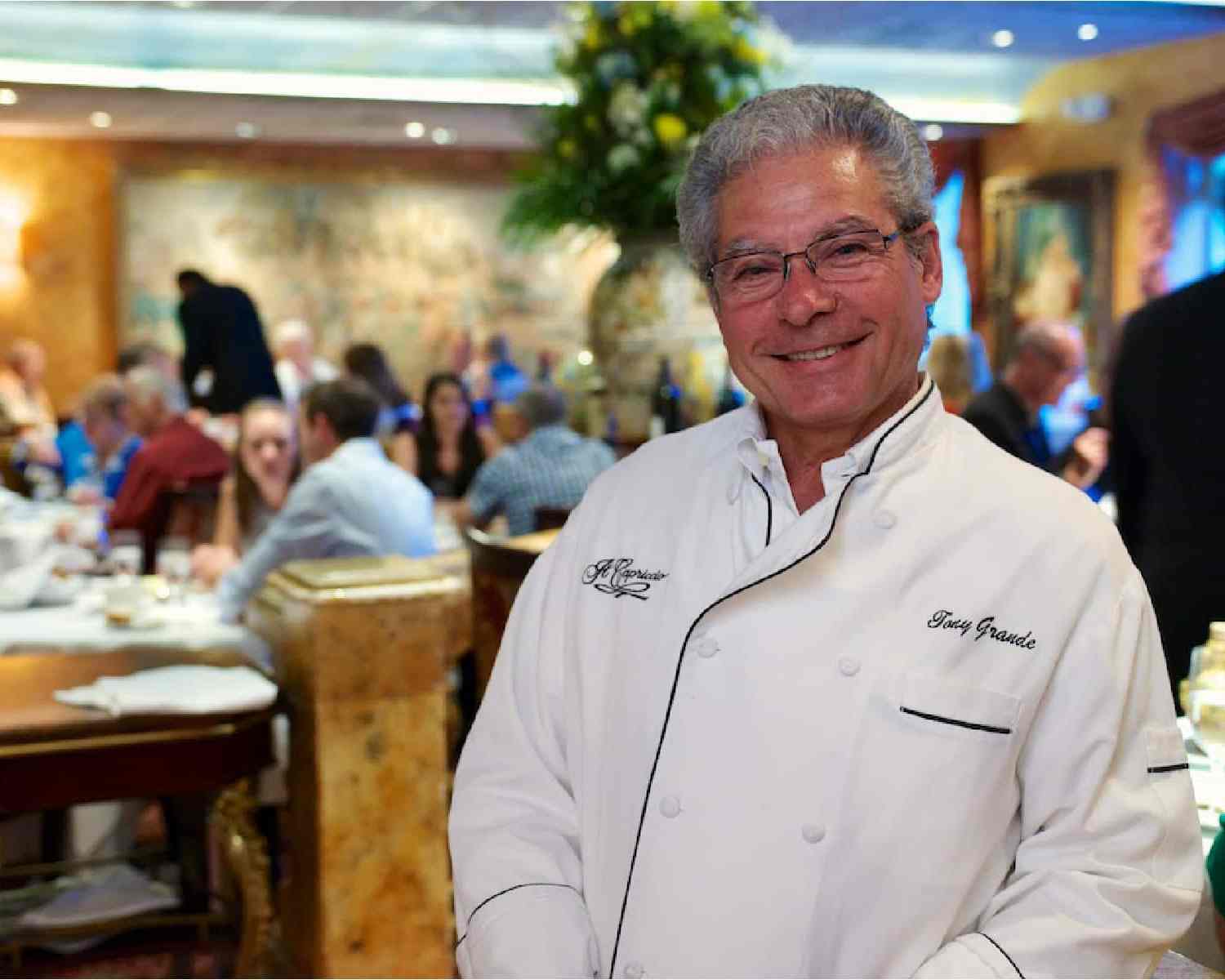
In Whippany, New Jersey, Capriccio has been one of the most recognized landmarks in Italian catering for forty-two years. Behind that name is Antonio Grande, known in the United States as Tony Grande: executive chef and entrepreneur, Calabrian of Mandatoriccio, arrived in America in 1973 with a job already in the hands (and in the head) and a precise idea of what he wanted to become. Speaking to the microphones of New York, in the podcast Portraits, Chef Grande has retraced a story made of departures, ships, kitchens and wishes that has never stopped chasing.
It all began when he was fourteen years old and he felt that the small country where he was born could not contain his curiosity. “I didn’t want to be a farmer, I didn’t want to be a builder, I didn’t want to do those jobs that offered very little. I had a great desire to discover: I wanted to touch, know, see”. Remember to have explained to the mother the need to leave with a simple and very own image: “My little head was always looking for something, but I felt like a mouse in a small hole. I told her I couldn’t stay there, I needed to escape, I had to grow up, do something of my life.”.
The first choice was the hotel school, welcomed in the family with some understandable perplexity. «My mother answered me: “Hotel school? You want to be a servant? ””. For Antonio Grande, however, that work he dreamed had a different sense: hospitality: “I told you this is one of the most beautiful things we have. Italianity begins with hospitality: we give the world hospitality, the art of life, the art of living”. After studies the seasons arrived in Italy, between Sorrento, Rapallo, the mountain and the sea, and then boarding on the ships of the Italian Society of Navigation.
That experience opened the world before America. The crossings lasted fifty-eight days and crossed the Mediterranean, the Atlantic and the Pacific to Valparaíso, Chile, passing also through the Panama Canal. “We talk from Naples, then Genoa, Barcelona, the Canary Islands, Tenerife, Haiti, Venezuela, Curaçao, Cartagena, Cristóbal; we passed the Panama Canal, we arrived in Balboa and we went down to Valparaíso”. For the Calabrian boy was the first concrete discovery of a larger world, outside its comfort zone: “I saw something new, I felt like a king, a little king. That adventure gave me the roots to fight in the world of hospitality”.
When he arrived in the United States, however, Antonio Grande found an Italian cuisine very distant from that studied and practiced in Italy. “I felt lost in front of the Italian cuisine I found. I said: “Let me see a menu, is it possible that nothing can be understood? ””.
Do not deny the work of those who had built, before him, Italian-American catering, with family recipes and with the needs and limitations of a life as immigrants: “Tanti Italians worked, they had to send the family forward, pay the expenses. Their mothers at home made meatballs and lasagna and they built an activity with what they knew.” But for him the challenge was to let the American public know the variety and uniqueness of Italian regional cuisine.
Chef Grande places the beginning of that battle, which will give rise to an epochal turn, at the end of the 1970s: “Me and many other professionals, about one hundred and twenty or one hundred and thirty Italian restaurateurs, have begun this path. There was also Tony May”. The goal was to make it clear that Italian cuisine was not a fixed formula, nor a simplified version of some famous dishes. “We convinced the best American journalists to come with us in the Italian regions: we brought ten or twelve journalists and fifty or sixty restaurateurs in Italy to see and write”. Another obstacle was the availability of raw materials. “We convinced friends and people we knew how to import products. Finally today I can say that we have everything we need to create authentic Italian menus”.
Prima de Il Capriccio was Il Belvedere, a smaller and informal restaurant. But the project that Antonio, now become for everyone Tony Grande, had in his head different and tells him as an ineluctable path, a climb imagined and wanted since a teenager: “My path is the realization of a series of steps that I begin to appear in my head since young. I want to be a cook. Then a great cook. Then a chef. Then one of the best chefs. And finally I want to have one of the best restaurants”.
The Capriccio was born from a malridotto and a land to reinvent. “I started from scratch. The name also sums up its story: Americans often ask me what Capriccio means. I answer that it is not a whim: it is the great desire of a fourteen-year-old boy who has always believed us and never abandoned him. This is not my whim, this is my dream».
In its idea of catering, the quality starts from the ingredients but does not exhaust itself in the dish: “The ingredients of a chef are like the notes of a musical instrument: it depends on the skill of the musician to create the harmony of food”. Tradition is a starting point but it is not immobility: recipes can evolve and receive a personal interpretation, provided they do not lose balance and recognisability, with only one bond: “For me harmony must always be present”.
The same harmony concerns service and relationship with those who enter the premises: “Let the customers feel comfortable, make them feel special, make them understand how important food is. Food is not a luxury: it is a necessity of our lives, which gives us joy to live and health”.
At seventy-nine years, Chef Tony Grande does not think at least about the withdrawal: “Pension is a bad word.” He continues to work with what defines an energy still intact and with a clientele become part of his history: “We have three generations of customers: we embrace, we talk, we chat”.
The most important recognition for him is not only the long list of awards received (including the Four Diamonds of the American Academy of Hospitality received for thirty-two consecutive years) but the judgement of those who attended the restaurant. “One of the greatest joys of my life is that we are not talking about us, but they are the others to do so.”.
The restaurant is also a family and a team. Next to him are his wife Clara, the daughter, engaged in the pastry shop, and Salvatore, the manager arrived at Capriccio just fifteen years and became his right arm: “The team is another important word. In my dream I always tried to put together elements, characters, people, to create a team. Without team nothing can work well”. It is a belief that Tony Grande applies both to the kitchen and to the room: “If a waiter is in the wrong place, if someone does not have the ability to understand what it means to work in a team, he immediately sees the effect”.
Now his story will also become a book, titled Ulysses in search of Ulysses. The path of my American dream. It is not an autobiography designed to celebrate a personal milestone, but a story addressed above all to those who still have to find their way. “I didn’t do it for me. It is the desire to honor my parents, my brothers and sisters, my countrymen and all the Italians who will read me. But above all it is for young people. The sense is this: he, like me, wanted to discover, struggled. I am a small Ulysses who still wants to discover, despite having seventy nine years”.
In the final message of Chef Tony Grande there are confidence in individual skills and a concern for young people who, according to him, today risk living too much through the screens: “We must tell these boys and girls that we all have a great ability. We have the ability to do anything”. Tony Grande emphasizes the responsibility of building a full life, made up of relationships and projects: “The most important part is to be happy with our lives, because we have responsibility for ourselves and others. Life is unique: it is the most beautiful gift that God has given us.” And the invitation, with the simplicity of those who continue to welcome their guests with enthusiasm every day, is already ready: «Come and see me, that we will have fun».
Article The Chef de <i>The Capriccio</i> Tony Grande: “My story will become a book” comes from IlNewyorkese.