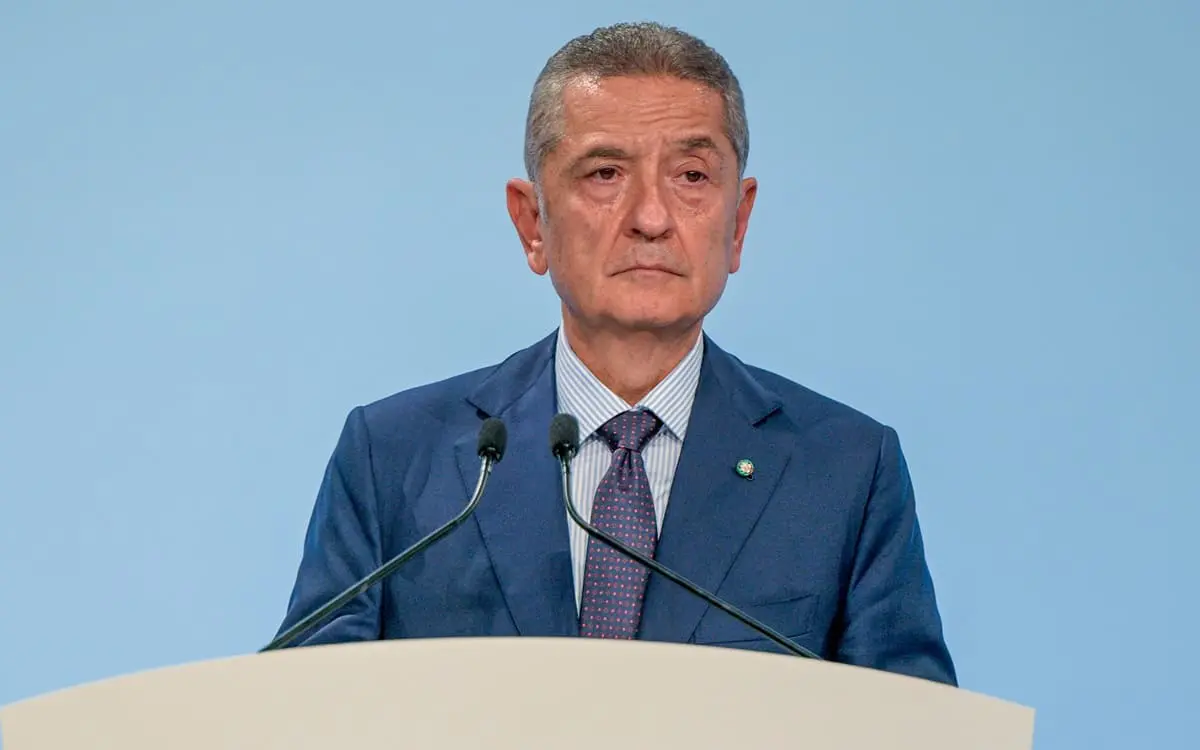
ROMA (ITALPRESS) – “The conflict in the Persian Gulf has weakened already fragile prospects. According to the projections, economic activity will remain weak in the coming months; in the most unfavorable scenarios, it could stagnate or contract. In perspective, competitiveness is likely to return central.” Thus the governor of the Bank of Italy, Fabio Panetta, in the final considerations on the occasion of the publication of the annual report on 2025.
“The presence of Italian exporters remains limited in Asian markets, destined to be the main engines of global demand, while Chinese competition increases pressure also in technologically advanced manufacturing sectors. Italy retains significant strengths in mechanics, pharmaceuticals and quality productions: only by investing and innovating will be valued. Without a strong increase in productivity, the Italian economy could remain anchored at structurally modest growth rates,” added Panetta.
“With a population at a very low working age, we will not be able to count stably on the increase in employment to support development – said Panetta – In order to raise productivity, we must face the weaknesses that for decades have curtailed the Italian economy: poor innovation, low levels of human capital, energy dependence. The investment effort in recent years must be continued and made more effective, improving the quality of public action.”.
“The resumption of investments has represented the main discontinuity of recent years – he added – The increase has concerned construction, but also machinery and intangible goods, essential components for the prospects of growth. The public contribution was relevant. Between 2021 and 2025 the interventions of the Pnrr have exceeded 100 billion, contributing 30% to the overall accumulation. The subsequent revisions have adapted the Plan to the complexity of its implementation: some works have been resized or replaced by projects already started; some reform goals have been recalibrated. They are partly physiological adjustments for a program of this magnitude.”.
“Expenditure so far has supported demand and raised the annual product level of almost 1 percentage point, on average, in the five-year period33. They have strengthened digital, railway, electrical and water infrastructure. The Plan also affected the operation of public administrations. He has introduced procedures more oriented to achieving goals, with simplified iter and pre-designed resources,” he added.
“To make the increase in accumulation lasting, the private sector cannot fail. Enterprises have significant own resources, which are oriented towards investment in innovation. They risk hindering this evolution some structural weaknesses: a fragmented production fabric in small enterprises, which adopt new technologies more slowly; the scarcity of innovative companies capable of growing; the insufficient propensity to invest in in in intangible assets – research and development, software, data and organizational capital”, he said.
“For nuclear energy, the new technologies in development deserve careful evaluation; in this direction also goes the examination of the bill of delegation in progress in Parliament. Targeted and temporary measures to support families and enterprises may be necessary in critical phases to reduce the impact of recovery. They are supported by structural interventions aimed at facing energy vulnerability. Only by accelerating the transition will we be able to permanently reduce dependence on foreign countries and prevent new shocks from returning to hit hard incomes, competitiveness and growth,” he concluded.
-Photo IPA Agency-
(ITALPRESS).