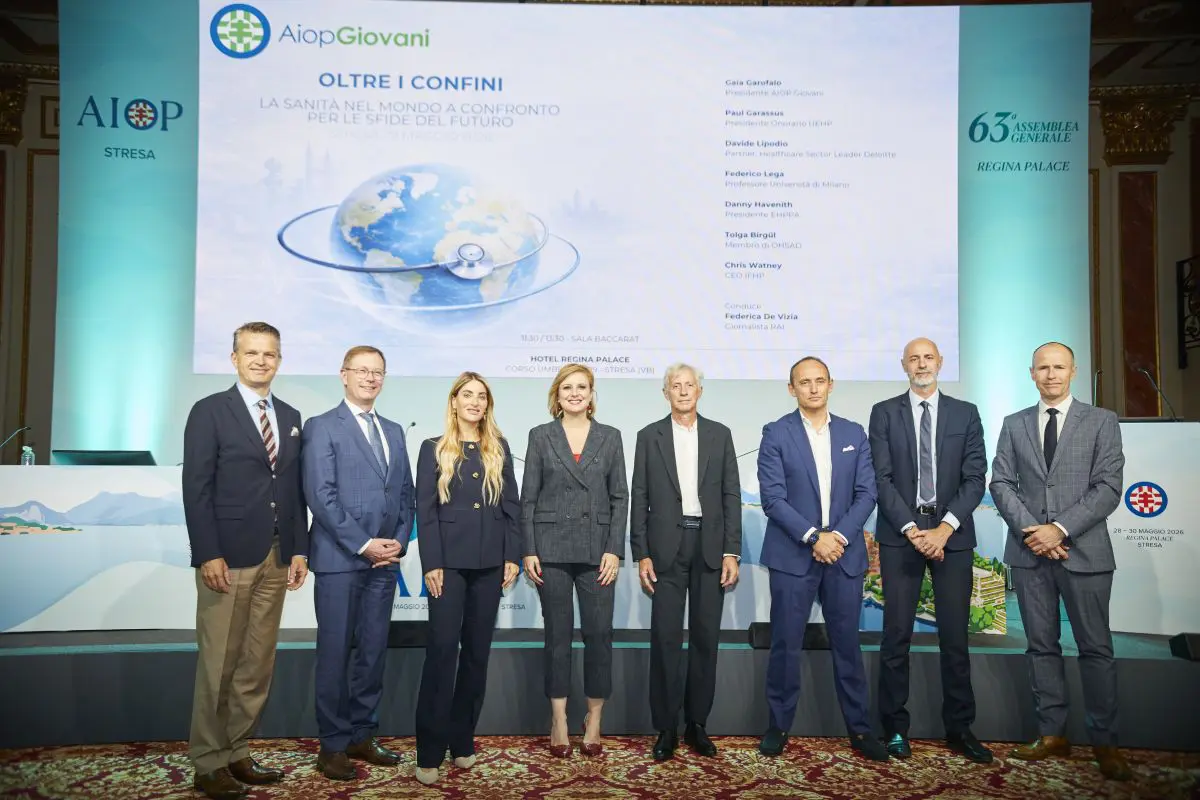
STRESA (ITALPRESS) – The conference was held at the Regina Palace Hotel in Stresa: “Beyond the borders: health in the world in comparison with the challenges of the future”, promoted within the 63rd General Assembly of AIOP (Italian Association of Hospital and Territorial Health Care Companies and Residential and Local Health Companies of Private Law). “The event – read in a note by AIOP Giovani – was an important moment of international discussion on the central issues for the future of healthcare systems and healthcare organizations, bringing together representatives from the institutional, academic and industrial world from different countries. International healthcare models and innovative organizational approaches have been analysed throughout the day, with particular attention to the strategies needed to address the profound changes affecting the sector. The focus of the debate is on sustainability, technological innovation, access to care and integration between public and private. Gaia Garofalo, National President of AIOP Giovani, opened the debate. “The message emerged from international comparison is clear: the sustainability of health systems does not defend itself with ideological contrasts, but integrating public, private and innovation around the value for the patient. Italy starts from a position of excellence, but without structural reforms it risks transforming a world primacy into a social fragility. The real risk is not to change the health system, but to leave it steady while the world accelerates,” he said. “The history of medicine is that of its tools. Its future will be technological and will depend on data deriving from the processing of information – said Paul Garassus, Honorary President of the European Union of Private Hospitals (UEHP) -. Many initiatives are already promising, but it is necessary to strengthen cooperation between all actors in the health system. The private sector is innovative and has an investment capacity; it becomes essential to establish a stable relationship of trust with the regulator to allow a long-term commitment.” For Davide Lipodio, Partner, Healthcare Sector Leader of Deloitte, “the healthcare systems around the world are under unprecedented pressure. Ensuring quality, equity and sustainability is a challenge that does not exclude any country and invests all continents. In the international context, our country presents itself a system of high production capacity, with unique but deeply fragile skills in its foundations of access to care and sustainability for the new generations in the absence of structural interventions. Raising the gaze and observing the world can help us find concrete solutions.” “The comparative analysis of the main European health systems, developed by the HEAD centre of UNIMI with the support and contribution of AIOP, highlighted how there are practices in the management of the public-private relationship that could be of great interest to Italy – explained Federico Lega Professor Ordinario di Economia, Politics e Management Sanitario, Università degli Studi di Milano -. From multiannual supply contracts to the testing of value-based financing systems”. He also highlighted that “the private accredited SSN can be a reference point in innovation and this role can be reflected and valued in the definition of the contents of institutional and contractual relations”. Danny Havenith, President of the European Health Public Procurement Alliance (EHPPA), said: “Belgium shows that only access to care is no longer enough. The increase in costs, pressure on the labour force and the persistent variability of the outcomes require us to reform the hospital systems by orienting them to value, and not to volumes. Value-Based Healthcare is nota slogan: means measuring what really matters to patients and aligning consequently procurement, financing and governance.” The case of Belgium is particularly relevant because it shows how a health system with a strong reduction in the role of private for profit is facing significant challenges in terms of sustainability and efficiency. The high health expenditure, higher than the OECD average, is accompanied by results not always proportioned to investments, making current debate on possible reforms aimed at greater attention to the outcomes, the quality of care and the overall efficiency of the system. Tolga Birgùl, a member of the Turkish Association of Private Hospitals and Health Structures (OHSAD), explained that “the healthcare system of Turkey has been through a significant transformation over the past two decades, becoming more accessible, integrated and coordinated at an institutional level. Under the guidance of the Ministry of Health and with the support of the Sanitary Transformation Programme, Turkey has expanded the availability of services, strengthened the coverage of social security through the SGK (Social Security Institution) and developed a model of provision of healthcare articulated on three levels: primary, secondary and tertiary assistance. In this context, the private health sector has become an essential complementary pillar of the national health system. Private hospitals and private health institutions contribute significantly to the ability to provide services, freedom of choice of patients, advanced medical procedures and international competitiveness.” “Australia uses the capacity of the private sector to preserve universal access to care and reduce pressure on public hospitals – said Chris Watney, CEO of the International Federation of Health Plans (IFHP) –. In this way, the public sector benefits from a reduction in pressure on programmed surgeries, increased infrastructure capacity, faster patient access to care and greater flexibility in workforce management. Private hospitals are part of the national health infrastructure and are not simply considered as independent and external suppliers. Against this, the public sector is increasing the use of the purchase of benefits from private individuals.” The Australian health system is universally considered among the most effective in terms of efficiency, accessibility and sustainability. The integration between the public and the private sector is one of the distinctive elements of this model, demonstrating that collaboration with the private accredited can help strengthen the universality of the healthcare system, improve the quality of care and ensure greater sustainability over the long term. The conference represented “a significant moment of growth, networking and sharing of international experiences, helping to strengthen dialogue between institutions, businesses and health professionals, with the aim of building a common vision on the challenges facing the industry in the coming years.”.
– Photo press office AIOP Giovani –
(ITALPRESS).