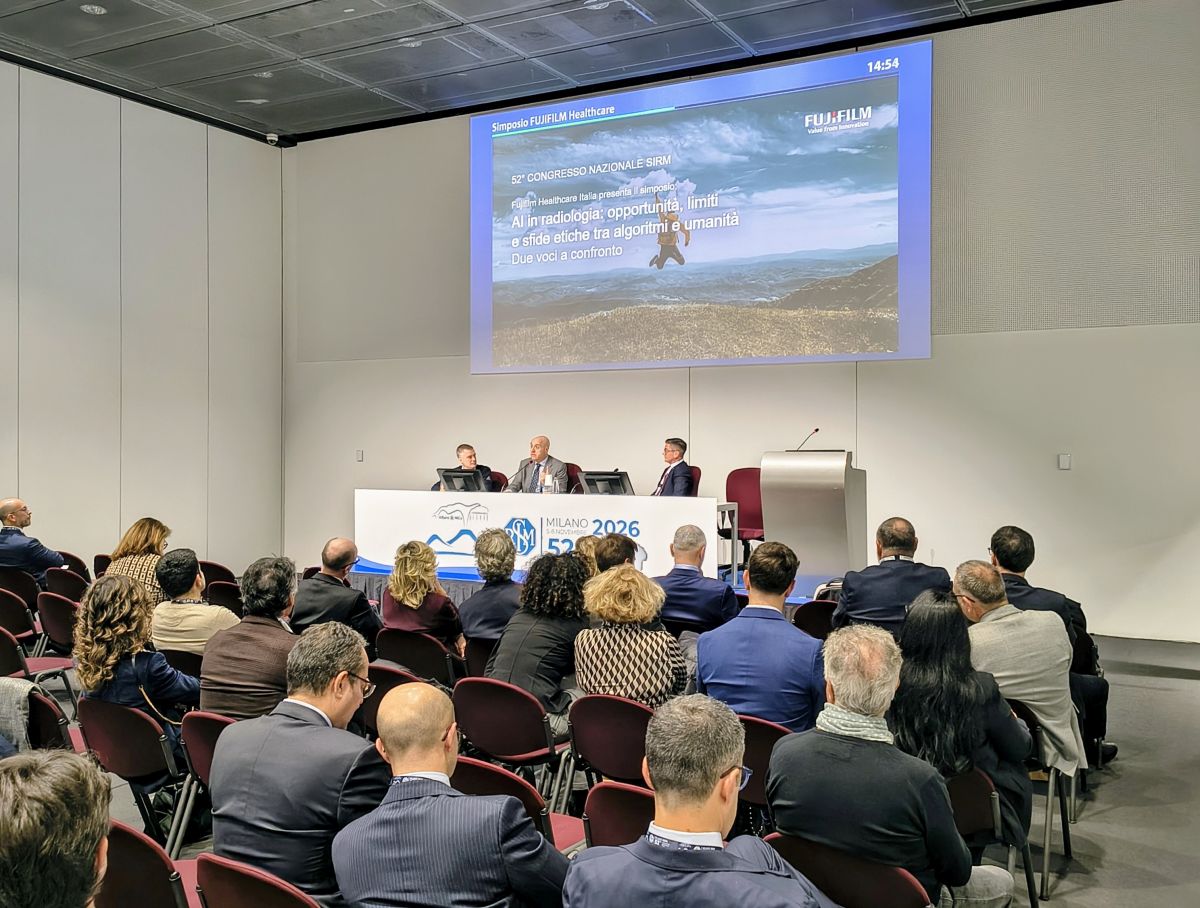
MILAN (ITALPRESS) – Artificial intelligence is expanding the possibilities of radiology, offering new opportunities to support the diagnostic process, risk stratification and clinical decisions. But alongside the potential of technology, questions arise concerning the role of healthcare professionals, responsibility for the patient and the ethical boundaries of innovation. It is from these questions that the symposium “AI in radiology: opportunities, limits and ethical challenges between algorithms and humanity. Two voices in comparison”, promoted by Fujifilm Healthcare Italia as part of the 52nd National Congress of the Italian Society of Medical and Interventistic Radiology (SIRM), scheduled in Milan at the Allianz MiCo from 5 to 8 November 2026. The meeting that took place on Saturday, November 7 confronted two different perspectives, the medical-scientific one of Professor Francesco Sardanelli and theological one of Don Alessandro Picchiarelli. “ Artificial intelligence puts us in the face of a responsibility that cannot be reduced to the verification of the performance of the algorithm: we must understand in what conditions its use assumes a concrete benefit to the patient, considering also the risks of overdiagnosis and the need to preserve the competences of the radiologist. The challenge is to integrate these technologies into clinical practice without sacrificing the critical judgement and responsibility of the professional: AI can support the decision, but its use must be guided by evidence, appropriateness and attention to the person”, says Professor Francesco Sardanelli, Coordinator of the Scientific Committee of the Italian League for Fight against Tumori (LILT) Milan Monza Brianza and scientific manager of the European project EU4Health BreastSCan. The clinical perspective is accompanied by that of moral theology, in order to deepen the ethical implications of the use of artificial intelligence and the relationship between technological innovation and individual responsibility. “The ethical question is not only about what we can or cannot entrust to artificial intelligence, but also the responsibility we have in using tools that can contribute to the good of the person. If technology can improve the quality of care, we are also called to question the need to know and evaluate it, but without transforming innovation into an absolute imperative. Moral responsibility requires discernment: it means recognizing the potential of technology, but also its limits, maintaining the dignity of the person and the human capacity to take informed decisions,” explains Fr. Alessandro Picchiarelli, priest and expert in technology and artificial intelligence, professor at the Pontifical Gregorian University and at the Theological Institute and Religious Sciences in Assisi. The dialogue between the medical-scientific and theological-moral perspectives will therefore offer an opportunity to reflect not only on the possibilities offered by artificial intelligence, but also on human skills and responsibilities that take on an increasing importance with the evolution of algorithms. The goal is to understand how to integrate these tools into the diagnostic path, preserving clinical judgment and centrality of the healing relationship. With this symposium, Fujifilm Healthcare Italia intends to contribute to the debate on the necessary conditions “so that technological progress is translated into a concrete benefit for patients and health professionals, favouring the comparison of medical, scientific, technological and ethical skills”. “To Fujifilm, innovating in health means evaluating not only technological performance, but also the concrete value for clinical practice and patients. AI offers great opportunities, to be integrated with awareness, listening to professionals and sharing responsibilities. The dialogue between scient skillsifiche, technological and ethical is essential for innovation that is always attentive to the human dimension of care,” concludes Davide Campari, Managing Director of Fujifilm Healthcare Italy. In addition to the contribution to the scientific program, Fujifilm Healthcare Italia is present at SIRM Congress with its offer of image diagnostic solutions and IT. “A portfolio that includes advanced technologies for different imaging modes, from ultrasound to magnetic resonance, and digital solutions for managing, archiving and sharing images and clinical information – explains the company. An offer that aims to combine diagnostic quality, workflow efficiency and information integration, supporting healthcare professionals in the different stages of the diagnostic path.”.
– News in collaboration with Fujifilm –– Fujifilm Press Office Photos –
(ITALPRESS).