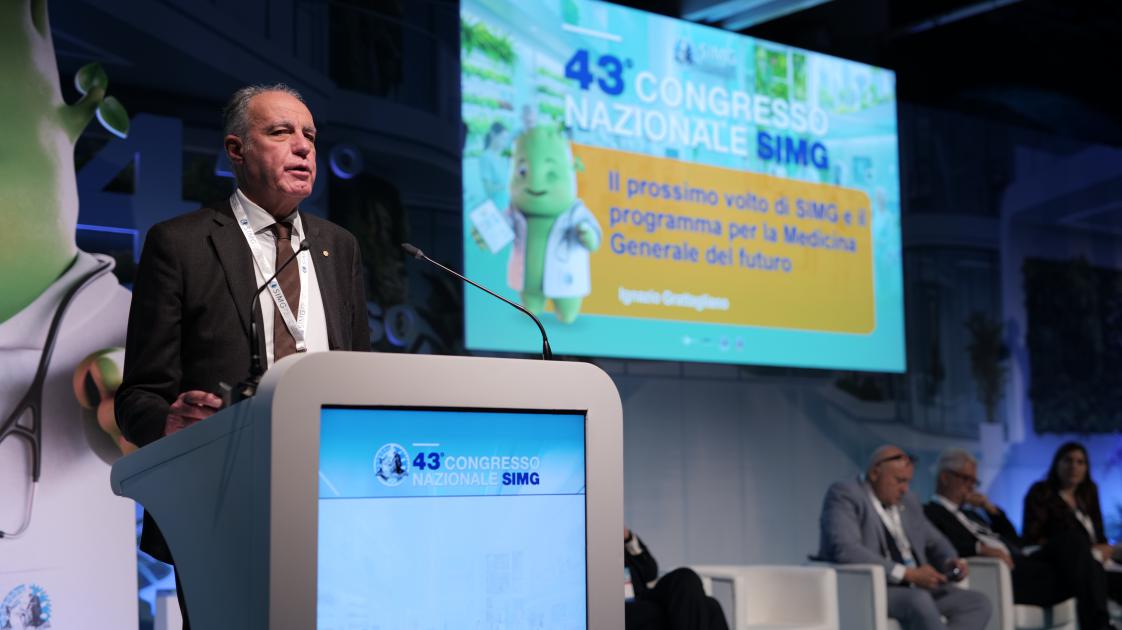
ROMA (ITALPRESS) – Professor Ignazio Grattagliano, doctor of General Medicine in Monopoli (Bari), is the new President of the Italian Society of Doctors of General Medicine and Primary Care (SIMG). Alessandro Rossi, who led the SIMG in the last three years, takes on the role of Past President, while Claudio Cricelli maintains that of President Emeritus Vicar.
The election, on the occasion of the renewal of the corporate bodies of 22 November, marks the start of a new phase for the main Italian scientific society of General Medicine, engaged in these days in its 43° National Congress, in course at the Fortezza da Basso in Florence until 28 November, with more than 3 thousand registered doctors.
Alongside Professor Grattagliano, Massimiliano Franco takes over as a national vice president. The new junta is also formed by Alberto Magni (Scientific Secretary), Claudia Piccioni (Secretary), Gaetano Piccinocchi (National Treasurer), Pietro Tasegian (Responsible for Research), Mariagiovanna Amoroso (Formation), Roberto Barone (Organization Secretary), Martina Musto (Responsible for Communication), Luca Maschietto (editoria), Daniele Morini.
Already national vice president SIMG, Ignazio Grattagliano is specialist in Internal Medicine, with a particular clinical and scientific experience in liver disease. During the pandemic he coordinated the activities of the SIMG dedicated to COVID-19, contributing to the response of General Medicine to the health emergency.
Its programme for the three-year period 2027-2029, “Science and Innovation in General Medicine”, focuses on strengthening research, the use of new technologies and the enhancement of professional skills.
“General Medicine must be the protagonist of the evolution of the National Health Service and contribute to orienting its change – says Professor Ignazio Grattagliano, new President SIMG – Our profession has an extraordinary heritage of clinical knowledge and a direct and continuous relationship with millions of citizens. We must value these resources through scientific research, training and technological innovation, strengthening the recognition of General Medicine as an autonomous discipline, capable of producing knowledge and contributing to the great health choices.”.
The new Presidency program identifies four strategic areas: identity, knowledge, innovation and renewal. The first objective is to consolidate the scientific, cultural and professional recognition of General Medicine, defining with greater precision competence and responsibility.
This is accompanied by the commitment to developing research, transforming the daily experience of primary care into data, evidence and scientific publications. Innovation is another priority: from artificial intelligence to digital and diagnostic tools, new technologies can help improve the quality of care, chronic patient management and work organization. The fourth point concerns the strengthening of external relations, with the commitment to follow scientific comparisons, to interlocution with institutions, to dialogue with trade union representations.
“We want to invest more and more in the ability of General Medicine to produce original research, starting from the clinical problems that doctors face every day in their clinics – adds Grattagliano – New technologies must become tools for professionals and patients, accompanied by continuous quality training. Renewal will also be a working method: integrating the experience of the most experienced colleagues with the ideas and skills of the new generations, encouraging participation and comparison between different professional and territorial realities.”.
The passage to the new presidency takes place during the 43rd National Congress of the SIMG, which brings together more than 3 thousand professionals in Florence, with a significant presence of young doctors.
The program addresses the main challenges of General Medicine, from prevention to management of chronic diseases, from new therapies to artificial intelligence, to reorganization of territorial assistance. Particular attention is devoted to advanced training, through clinical simulation laboratories, interdisciplinary activities and moments of confrontation with institutions and other scientific societies.
An approach that anticipates some of the strategic lines of the new Presidency and confirms the commitment of the SIMG for an increasingly qualified, innovative and close to the needs of citizens.
-Photos press office
(ITALPRESS).