ROMA (ITALPRESS) – A child who becomes a mice at six years has in front of him a long period during which his visual defect can worsen. And the more myopia increases, the more the risk that, with the passing of the years, there are problems much more serious than the need to wear glasses: from retina detachment, to maculopathy, up to glaucoma. This is also why myopia, once considered above all a lack of sight, today represents a question of public health. In the world it already affects billions of people and, according to the projections, by 2050 could cover almost half of the world population, that is 4,7 billion individuals. In Italy, about 15 million myopic adults are estimated to be more than one and a half million children and adolescents. To address a problem destined to become more widespread, the Foundation was born to the University Polyclinic Agostino Gemelli IRCCS and to the Hospital Isola Tiberina – Gemelli Isola the new European Centre of Miopia, directed by Professor Stanislao Rizzo, Director of the UOC of Oculistics of the Policlinico Gemelli. It will not be a simple surgery for prescription glasses, but a structure that will bring together prevention, diagnosis, progression control, treatment of complications and visual rehabilitation. An articulated path that will accompany patients from childhood to adulthood, offering innovative care and solutions even in case of complications.
“The epidemiological data and myopia projections are impressive – says Daniele Piacentini, Director General of the IRCCS Political Foundation. We must therefore be able to act early and invest in prevention and research. The activity of the clinics of the European Centre of Miopia starts immediately at the Gemelli and the Hospital Isola Tiberina. But this is only the first phase of a broader project, the Neurovision Lab, which already incorporates the object, that is, the view, but also a new vision of health. For us research, teaching and care are strongly integrated ever and in this case will also be physically integrated, in the same building that will be equipped with 20 outpatients, 4 operating rooms, 2 conference rooms (there are also a series of initiatives open to citizenship to make culture of prevention with dissemination events) and 10 research laboratories, also open to industry to activate collaborations aimed at developing new technologies and new devices to improve care and quality of the device. The construction of the Neurovision Lab will begin in 2027, thanks to the support of the INAIL and the strong collaboration with the Lazio Region, which has included it among the relevant projects of the new investment plan on regional health. We expect to inaugurate it in the spring 2029′′′.
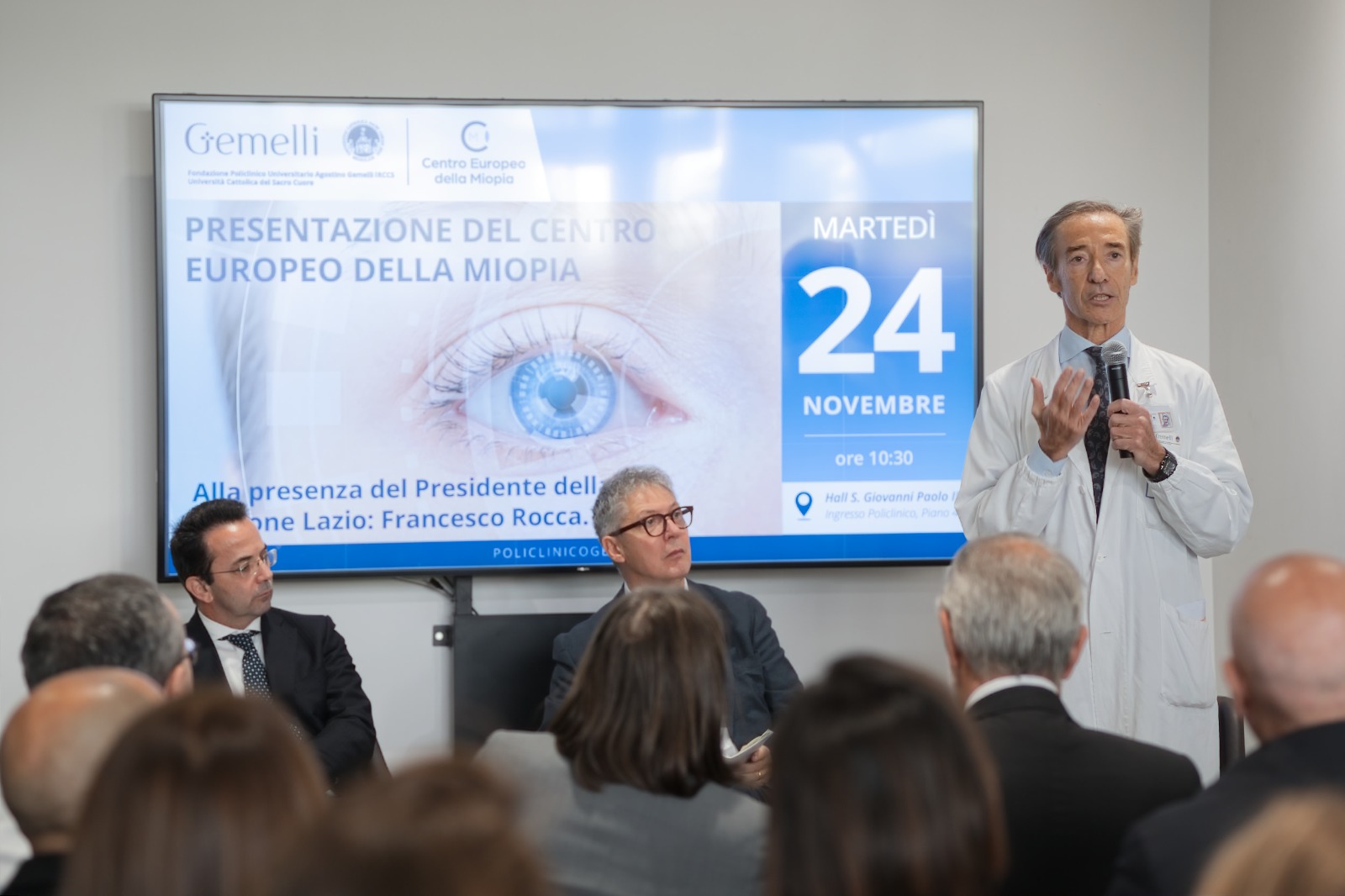
“The theme of myopia will be central in the coming years and the Gemelli decided to take charge of the problem, addressing it and following it along a path that starts from the pediatric age, to get to the advanced age, monitoring and managing any complications – recalls Francesco Rocca, President Lazio Region -. The European Centre of Myopia is yet another example of how the Gemelli is marking a new step in all sectors and in all specialties and as the Lazio Region we can not be proud of it. This Policlinic is an integral and essential part of our National Health Service, giving everyone the opportunity to receive good care. But next to this there is also an important growth factor, deriving from having constantly approached the search for the bed of the patient. The dedication and capacity of the Gemelli benefit not only the health system but also the growth of an entire Region. And we can only be grateful for this.” At the presentation of the new European Centre of Miopia which took place this morning in the hall of the Policlinico Gemelli took part Daniele Franco, President of the Fondazione Policlinico Universitario A. Gemelli IRCCS, Elena Beccalli, Rector of the Catholic University of the Sacred Heart, Giuseppe Fioroni, Vice President of the G Istituto. Tonimbaolo di Studi Superiori, Antonio Gasbarrini, Scientific Director of the Fondazione Policlinico Universitario A.
“We have given a hand to the realization of this project, but if there had not been the enthusiasm and the immediate intuition of President Rocca we would not be here – he recognizes Marcello Fiori, general manager INAIL -. He decided to focus on a structure that in our country did not exist and will bring benefits not only to patients of this region but to those of all Italy and Europe. It can count on a national and European centre of excellence as this is therefore very important. Then there is the theme of prevention; there are many problems of the visual apparatus related to occupational diseases and it is a subject often underestimated. By the will of the current government we have covered nine million students in insurance terms this year. We must begin to do prevention and screening already from primary school; prolonged exposure to digital devices will inevitably cause damage and disturbance in the coming years. Finally, the theme of research. We have just started a research project on regeneration of cornea tissues, which sees the collaboration of our Budrio Prosthetic Center with the UOC of Gemini Ophthalmology. And the European Centre of Miopia for us is an important project, on the level of care and research. It is an investment that looks to the future and health of millions of people. Because we have to deal with the epidemiological forecasts, look away and do the things they need right away.”.
“Myopia must be faced as a chronic disease with high health and social impact – explains Professor Stanislao Rizzo -. It is not enough to prescribe eyeglasses or contact lenses: we must intervene early, monitor progression over time and do research to reduce complications that, in the most serious cases, can lead to permanent loss of sight. The widespread and constant use of computers, tablets and smartphones increases the incidence of myopia in early age and requires new research to understand how we can not only correct, but cure and prevent the most serious effects.” The Centre will be activated from 1 December in the spaces of the Gemini Oculistics with the first four outpatients and research laboratories and at the Isola Tiberina Hospital with an outpatient dedicated to children and adolescents, but also to adults with high or complicated myopia. It is the start of a bigger and more important project for the citizens of the Lazio Region and all over Italy. The final seat of the European Centre of Miopia will be welcomed in the new building “Neurovision Lab”, whose construction will begin next year to end by the spring of 2029. The new building will be equipped with 20 outpatients, 10 research laboratories, 4 operating rooms and will include the center for hypovision; it will be a place where clinic, research, training and prevention education will coexist in close contiguity.
The Vickie & Jack Farber Institute for Neurosciences developed in collaboration with Thomas Jefferson University in Philadelphia will also be housed in the same building. This will allow us to develop joint research on neuroculistics and the new and promising branch of the “oculomic”. But how can one prevent myopia of a worse child? The first step will be to understand not only how many diopters are missing, but also because the defect is progressing. During the visit, specialists will reconstruct family history, school habits, time spent in front of smartphones, tablets and computers and that dedicated to outdoor activities. In addition to the traditional eye examinations, the length of the eyeball will be evaluated with the optical biometry, a fundamental parameter because many of the complications of myopia are linked to the elongation of the eye. The examination of the eye base and the photos of the retina will also allow to detect any alterations, even in the peripheral areas. Progression control will be just as important as diagnosis. Children can generally be reassessed every six months to see if and how much myopia is increasing. And if progression should be significant, it will be possible to intervene with treatments that have already proven to be able to slow it down: low concentration atropine collides, particular ophthalmic lenses with peripheral defocus or, in selected cases, a combination of the two approaches.
But prevention begins outside the clinic. Spending one or two hours a day outdoors, avoiding too long visual engagement and reducing the continuous use of electronic devices are important indications, especially during the years of growth. Genetic predisposition counts, but it is not enough to explain the rapid increase in myopia observed in recent decades. The environment and daily habits also play a role. “There is no completely risk-free myopia threshold – says Professor Rizzo. Each additional diopter is associated with an increase in the likelihood of developing degenerative eye diseases throughout life. For this reason, even modest slowdowns of progression obtained during childhood and adolescence can result in a substantial reduction of risk in adulthood.” The real challenge is to prevent a visual defect from becoming a threat to sight. In the higher forms (beyond the six diopters), the elongation of the eyeball can cause changes in the retina, favoring retinal breaks and gaps, myopic maculopathy and other complications. The Centre will be able to cope with these situations, through laser treatments for certain peripheral retinal lesions, intravitreal injections of anti- VEGF for the forms of myopic ideal choir neovascularization and, when necessary, vitreo-retinic surgery.
For adults with stable myopia it will also be possible to evaluate refractive surgery, which corrects the visual defect but does not eliminate the retinal risks related to elevated myopia. In cases where the disease has already severely compromised the view, the path will continue with visual rehabilitation, thanks to the presence of the Gemelli of the National Ipovision and Visive Rehabilitation of the IAPB. The goal is to offer a response to those who can no longer fully recover the visual function, helping to preserve the greatest possible autonomy. In addition to assistance, the new Centre will have a strong scientific vocation. Among the first strands of research will be the comparison between the different technologies of peripheral defocus lenses, to understand which are more effective in slowing down myopia. A second area will cover the study of retinal alterations in patients with high myopia, to identify signals that can anticipate the development of complications. Observation protocols have already been prepared for the evolution of peripheral retinal lesions. There is also room for artificial intelligence and smart glasses, smart glasses that can help people with severe reduction of sight to read a sign, recognize an object or orientate in unfamiliar environments. A field of research that looks not only to the disease, but also to the quality of life and autonomy of patients.
The collaboration between Gemelli, Università Cattolica del Sacro Cuore and Thomas Jefferson University will also develop projects that integrate ophthalmology, neuroscience and advanced data analysis. “In investing in prevention, progression control and research means reducing the number of patients who will develop severe forms of the disease and limit the future load of visual disability – concludes Professor Rizzo. With this Center we want to offer patients a reference point that can accompany them in every stage of life, from the first diagnosis to the treatment of the most severe complications.”.
– photo press office Fondazione Policlinico Gemelli IRCCS –
(ITALPRESS).