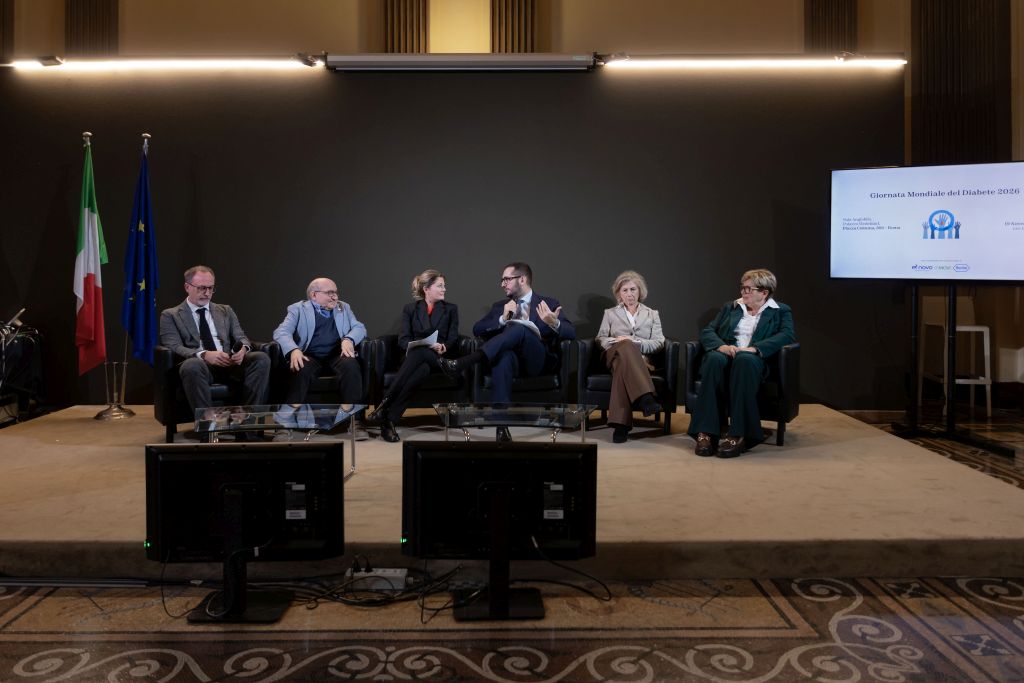
ROMA (ITALPRESS) – The event “World Day of Diabetes 2026” took place today in Rome, realized with the non-conditional contribution of Novo Italia, MOVI and Roche Diagnostics.
The initiative brought together representatives of the institutions, scientific societies and stakeholders in the field to deepen two closely related issues: early diagnosis and the possibility of accessing, without territorial disparity, the assistance paths and the necessary technologies.
The comparison centred on the transition from prevention to assistance. Identifying pathology is only the first step. In the institutional greetings, the Honorable Ilenia Malavasi, Member of the XII Commission of the Chamber of Deputies, highlighted: “Premature diagnosis can change the path of patients with type 1 diabetes and their families. The task of the Institutions is to create conditions for prevention and assistance opportunities to be accessible in each territory. Comparison with scientific societies and associations helps to identify the obstacles encountered in access to services.” On this point, the importance of starting the national pediatric screening programme for type 1 diabetes and celiac disease, provided for in Law No 130/2023, was discussed. The node is now translating the regulatory framework into operational paths in the regions, from the availability of diagnostic tests to monitoring and taken care of children with positive outcome. On the point, Senator Elena Murelli, Member of 10 to Permanent Commission of the Senate of the Republic, noted: “Identifying the risk of disease early means being able to intervene promptly, reducing complications in the case of type 1 diabetes, preventing dramatic beginnings such as diabetic ketoacidosis. But screening must be accompanied by structured PDTA, adequate information of parents and an effective link between pediatricians, general medical doctors, specialists and diabetologic centers.”
On the issue of screening for type 1 diabetes, the type 2 diabetes prevention has been accompanied, which requires attention to risk factors and possible complications over time. In particular, paediatric obesity places the need for early interventions and a grip capable of continuing even in the successive stages of growth. Malgorzata Wasniewska, President of the Italian Society of Endocrinology and Pediatric Diabetes (SIEDP), underlined: “Piediatric obesity requires a timely grip to reduce the risk that persists in adulthood and is associated with type 2 diabetes and cardiovascular disease. The priority is to intervene early on pediatric obesity with early diagnosis, multidisciplinary paths and fair access to care, accompanying the child and family over time.”
Raffaella Buzzetti, President of the Italian Society of Diabethology (SID): “The priority is to prevent the transition from pediatric diabetics to adult diabetics from disrupting monitoring and care. We need shared paths and a personalized accompaniment of young people. Scientific companies can support the implementation of screening through training, common protocols and indicators to verify its coverage and promptness of follow-up. In parallel, the early diagnosis of type 2 diabetes must result in an integrated management of cardio-reno-metabolic health, oriented to the prevention of complications.”
During the meeting, the use of medical devices for glycemic monitoring was also deepened and, when indicated, for insulin administration. In addition to clinical appropriateness and early access to technologies, the comparison involved the different modes of regional supply and updating of devices. Even the procedures of aquai am, in fact, affected the possibility of making innovative solutions available without compromising the continuity of assistance.
On the issue of access to technologies, with a greeting address, Salvatore De Cosmo, President of the Association Medici Diabetologi (AMD): “The use of technologies certainly requires appropriateness, therapeutic education, trained professionals. The clinical need must lead access with homogeneous opportunities across the country.”
The day has thus highlighted a guiding thread between the two panels, the opportunities offered by screening and innovation must correspond to accessible gripping paths, adequate supplies and homogeneous criteria between the territories. The dialogue between institutions, healthcare professionals, associations and stakeholders remains essential to combine quality and timeliness of medical care and safety and innovation.
– photo press office Esperia Advocacy –
(ITALPRESS).