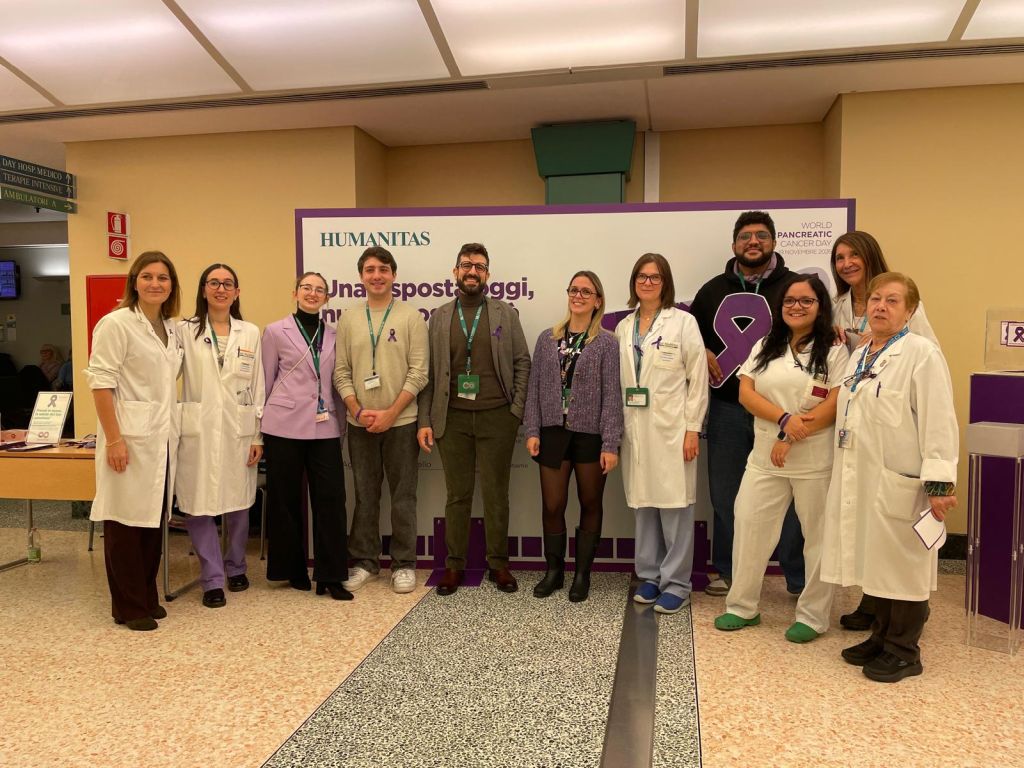
MILAN (ITALPRESS) – Every new knowledge can help identify new ways to deal with a complex disease such as pancreatic cancer. It is from this awareness that “An answer today, new possibilities tomorrow”, the initiative promoted by Humanitas on the occasion of the world day of pancreatic cancer, celebrated on November 19. In the IRCS Humanitas Clinical Institute in Rozzano, patients, escorts and professionals from the hospital participated in an interactive path of information and awareness. Through a path to questions and answers, participants were able to deepen some of the fundamental themes related to pancreatic cancer: from prevention to diagnosis, from therapeutic possibilities to perspectives opened by Research. How much does pancreas weigh? What’s that for? How to notice when suffering? What are the latest research findings? A way to make knowledge and information accessible, promoting dialogue between those who face the disease and the professionals who daily are engaged in its care and research, also thanks to the 5X1000. Pancreas is a small organ, about 80 grams of weight, essential for many digestive and metabolic processes. Among the pathologies that can affect it, pancreatic adenocarcinoma is one of the most aggressive and difficult to treat tumor forms, also due to the frequent diagnosis in the advanced phase. According to the data AIOM (Italian Association of Medical Oncology), in 2024 in Italy were estimated about 13.585 new diagnosis. Major risk factors include: advanced age, smoking, obesity, reduced physical activity, high alcohol and saturated fat consumption, low intake of vegetables and fresh fruits, chronic pancreatis and diabetes. “Today we know that some categories of people are more at risk of developing pancreatic cancer because they belong to families where there are more cases of this neoplasia, or because they are carriers of mutations that are involved in the development of pancreas tumor – says Silvia Carrara, headsection of the Diagnostic and Therapeutic Ecoendoscopy of the IRCCCS Humanitas Clinical Institute, Elected President of the European Pancreatic Club. Identification of people at risk and monitoring conducted with the right means can lead to early diagnosis and improved survival of patients. In this direction the PANC-GENOBIO, a research project funded by the PNRR Prevention Hub, aims to improve the early diagnosis of pancreas tumor in high-risk people, integrating echoendoscopy with liquid biopsy, which research biomarkers potentially associated with the presence of a tumor. The aim is to identify the disease in its early stages, when treatment possibilities are greater.” It is important to pay attention to some signs, including a yellow coloring of the skin and eyes (ittero), abdominal pain or back, loss of appetite or weight not explained by diets, persistent fatigue, alterations of the texture of the feces that appear untold and fat (steatorrea) and sudden appearance of diabetes. “ These symptoms are often confused with gastric or digestive problems, making the diagnosis complex or late – explains Alessandro Zerbi, Head of Pancreatic Surgery of the IRCS Humanitas Clinical Institute -. In addition, only 20% of patients diagnosed with pancreas carcinoma are eligible for “curritive” surgery with a 5-year survival of about 20-30%. The interventions are very complex due to the position of the organ located deep in the abdomen, near important blood vessels and delicate structures. For patients it is therefore essential to access specialized centers with multidisciplinary paths, clinical trials and a proven experience in the treatment of pathology.” The initiative was alsoan opportunity to learn more closely about the work of the Pancreas Unit of Humanitas, a specialized Hub, accredited by the Lombardy Region, which adopts a multidisciplinary approach to ensure precise diagnosis and personalized paths, thanks to refined imaging tools, mininvasive and robotic surgical techniques, radiotherapy protocols and medical and endoscopic treatments ever more advanced. In the Pancreas Unit there are also active research programs to improve knowledge of the disease and develop new therapeutic approaches. “Today in Italy are available chemotherapy treatments that are used both in neoadjuvant and adjuvant phase, that is before and after surgery, and in advanced phase, that is when there is no indication to the intervention – says Lorenza Rimassa, head of the Epato-Bilio Pancreatica dell’IRCCS Istituto Clinico Humanitas -. Research is focusing on developing new drugs and targeted therapies, even for patients who cannot be subjected to surgery. After years of work, Clinical Research is taking steps that we hope will soon be able to translate into new therapies accessible to all.” “As part of the Pancreas Unit, Radiotherapy plays an important role in at least four groups of patients – explains Marta Scorsetti, head of Radiotherapy and Radiosurgery at the IRCS Humanitas Clinical Institute. Mainly, for patients with inoperable localized disease, even after chemotherapy. In the oligomethastatic disease, that is, when there are limited metastases with a small number of injuries confined to one or few organs. There is also a palliative radiotherapy, which helps patients better manage symptoms. Finally, in case of relapse post surgery and even after other radiotherapy cycles, there is an opportunity to treat patients with Protons.” Another research direction is the improvement of techniques and tools available to surgeons. A concrete example is the phantom of pancreas, a three-dimensional artificial reproduction of the organ, created by researchers from Humanitas and Politecnico di Milano, with the support of the 3D Innovation Lab of Humanitas University and Humanitas Foundation for Research. Reproducing the anatomical structure and biomechanical properties of the organ, the model allows young surgeons and specialists to practice in realistic conditions and allows to study and test new tools and materials for pancreatic surgery, which is among the most difficult. A project that demonstrates how collaboration between clinical, scientific and technological skills can help innovate surgical practice for increasingly safe and targeted interventions.
– photo f12/Italpress –(ITALPRESS).