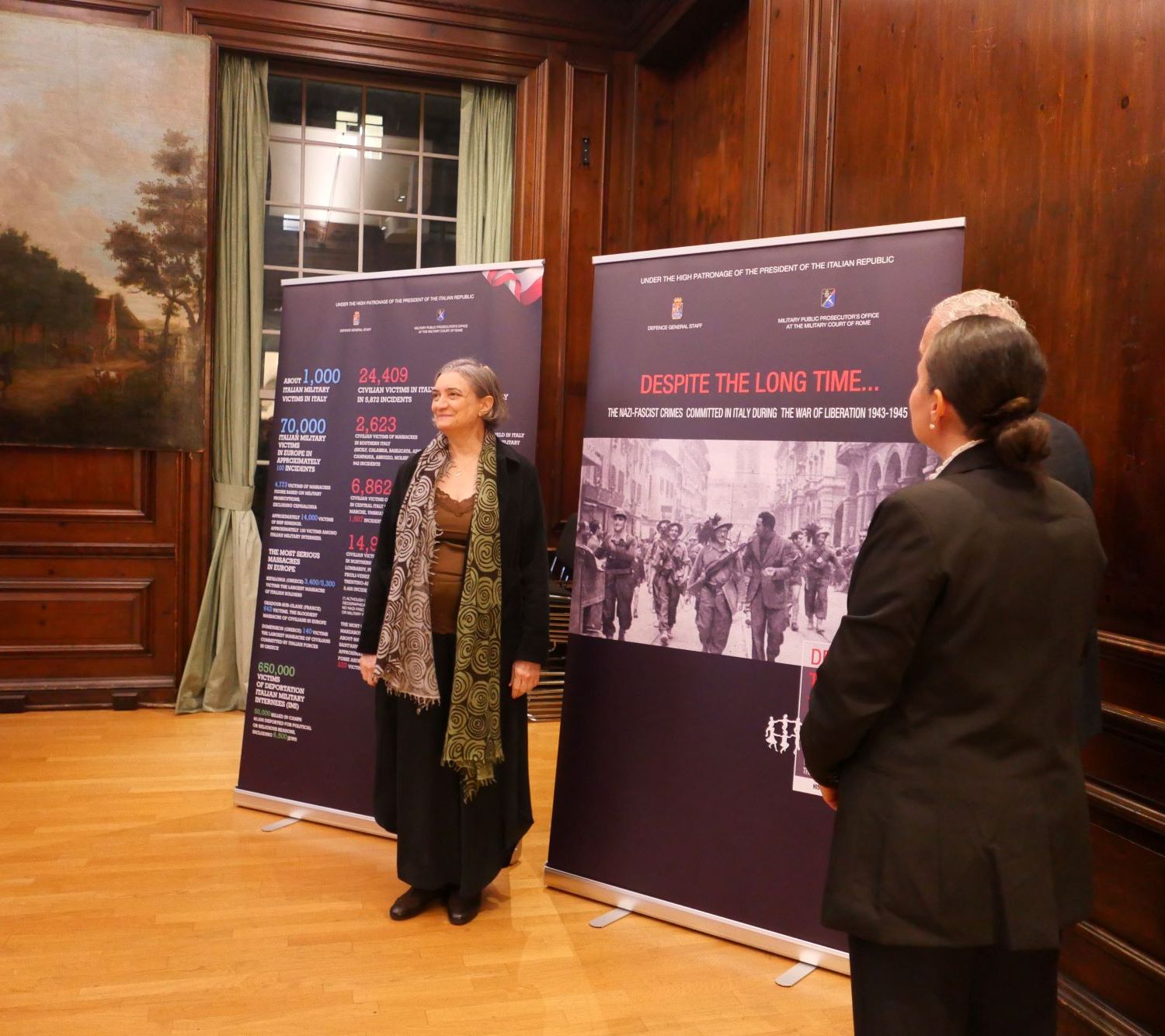
Marco De Paolis, Attorney General Military at the appeal court in Rome, enters the Italian Cultural Institute at 686 Park Avenue, New York City, with a kind smile and two escort agents. From the affability in his voice one does not perceive how many times in the course of his life he found himself “face to face with absolute evil”.
To welcome and present the prosecutor, the director of the Italian Institute of Culture Claudio Pagliara. Following a brief introduction by Laura Pirino, Consul Generale added.
More than eighty years after the crimes of Nazism, and with twenty years behind experience in the “caccia ai nazisti”, De Paolis reminds us of the importance of not forgetting, and traces the Italian judicial experience in accordance with the perspectives of humanitarian law.
“Not to forget, we must know first,” he says. At the beginning of his career as a prosecutor in La Spezia in 2002, he himself admits that he did not know “the 95% of these events”. The audience in the room listens to this confession in a silence full of amazement.
De Paolis says that a few days before he took office in April, for the first time the then president of Germany, Johannes Rau, visited Montesole, “to perform a historical act, pay tribute to our victims and apologize to the Italians for the atrocities committed by the Nazis in our country”.
The Shoah “is not a fairy tale”, he reminds us, “but a reconstruction of events”. After La Spezia, De Paolis then worked in the military prosecutor of Verona and Rome. There, he recalls 17 trials, 57 sentenced to life and over 500 investigations.
The phenomenon of collective disregard is what led him to feel a divulge duty that he speaks openly today, synthesized and expressed in the exhibition he curated and entitled “Despite the long time spent” (“Despite the long time”), which he brought into 17 Italian and 3 foreign cities.
The exhibition can be considered a direct manifestation of his desire to bring his judicial experience to America, which has turned into a very important personal experience. A project of historical memory that proves how people in their little can “contribute to education and training of a citizen starting from the negative consequences that the violation of human rights leads through war”.
The prosecutor speaks with bitterness of a neckline between “a certain reality and the surrounding reality, we have a world that is that of the victims who are ignored, forgotten and offended, and then there is the civil world that turns to the other side and also does activities contrary to prevent the protection of human rights”.
Many times it was found before people who argued that the phenomenon of the Shoah was “a closed page, a thing in the past because they are all dead”. He then decided to devote his life to ensuring that, at least in Italy, these crimes were recognized and justice was made for the families of the victims.
As a boy, like many of his peers, he had seen Rome open city and other films from which he had acquired a more or less general knowledge of the facts, which had contributed, in the mind of a De Paolis teenager, to place the phenomenon in the past.
But the presence of the brutality perpetrated and the systematic occultation of the documents that testify to it is, and must be, as ever present. Giving justice acquires even more importance today, eighty years after the events occurred during Nazism. “The victim doesn’t care which side the bomb comes, the bomb has no color.” The important is the consequences of the outrage, the violations committed by the commanders of the German armed forces and not only.
The prosecutor speaks of two levels of “anomalie, or injustices that can be covered by various profiles: judiciary, historical and political”. The first level is that of the crime itself, to which the second level is added, that of the negation of the facts happened, not by disregard but “because a deviated part, an institutional component did not want to do its duty”, says De Paolis with reference to the intentional cover of the files in 1960, during the mandate of the Attorney General Giorgio Santacroce.
But, despite the importance of the past, the focus of the speech continues to return to the present moment. The D.A. still confides in institutions of international law and continues to bring his experience to schools, to young boys of middle and upper schools, teaching them that there is still something to believe in.
“One thing I like to say to young people is that you don’t have to be heroes to do important things, you can do even in the daily life, but really believe us, and I often say it beginning with my grandchildren,” says the prosecutor when asked if he believes that you can reverse the tendency to the progressive distrust of the Gen-Z in institutions, fueled by economic and working precariousness. Young people should be more hungry for affirmation, shelter less behind the screen, “remember that we have in our hands much of our future”.
L’articolo Keep your memory alive with a look at the future proviene da IlNewyorkese.