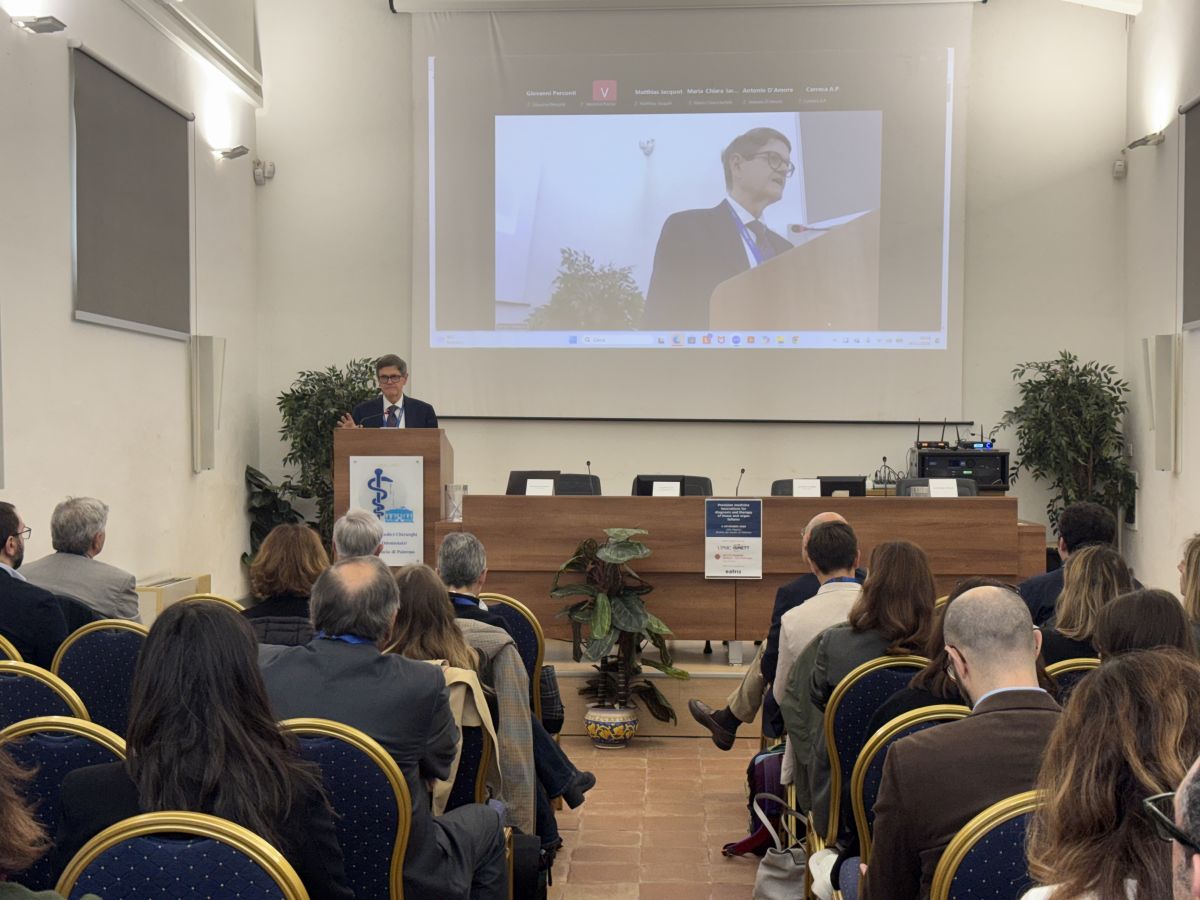
PALERMO (ITALPRESS) – From scientific research to clinical practice, with the aim of making care more personalized and responding to the characteristics of each patient. This is the main theme of the EATRIS Spotlight Programme’s national workshop, entitled “Precision medicine innovations for diagnosis and therapy of tissue and organ failures: from the research infrastructures to the healthcare”, hosted at Villa Magnisi, the headquarters of the Order of the Doctors of Palermo. An appointment that focuses on precision medicine and translational research, i.e. the path that allows you to transform the discoveries matured in laboratories into concrete applications for the diagnosis and treatment of diseases.
The initiative was born from the collaboration between the IRCS ISMETT in Palermo and the IRCCCS Ospedale Galeazzi-Sant’Ambrogio in Milan, with the coordination of A IATRIS, the Italian network for translational medicine coordinated by the Higher Institute of Health. A synergy between two reference realities of national biomedical research, called to share skills and design to accelerate the transfer of scientific innovation to the patient’s bed.
“Precision medicine – says Edy Tamajo, Regional Councillor for Production Activities – is one of the most important frontiers of contemporary innovation, but it also poses a political and economic question: what role do we want to assign to Sicily in the construction of new knowledge and new technologies? Our ambition cannot only be to use innovations developed elsewhere. We must create conditions for Sicily to become a place where research produces knowledge, generates enterprise, attracts investments and offers opportunities to our young people.
Experiences such as ISMETT and RiMED Foundation demonstrate that this path is possible. The collaboration between scientific institutions, universities and production system can contribute to the emergence of an economy based on skills and innovation.
Artificial intelligence, biotechnologies and personalized medicine do not only concern the future of health. They are also strategic sectors for industrial development and the competitiveness of the territories.
As Regional Councillor for productive activities, we have the duty to accompany this transformation, promoting technological transfer and dialogue between research and enterprises.
The real challenge is to ensure that the scientific value produced in Sicily also becomes economic and social value for Sicily. Because a land investing in knowledge is not limited to imagining its future: it begins to build it”.
‘It’s a conference on precision medicine, we are working to transform and carry care from the care of the disease to the care of the person. It means not having an equal therapy for all diseases, but having a specific therapy for each person”, explained Angelo Luca, director of the IRCS ISMETT in Palermo. A change of perspective that also passes through international research infrastructure. “EATRIS is a European research infrastructure, advanced translational research; we are in this infrastructure since 2014. It is an infrastructure that involves 15 countries, more than 175 centres across Europe, and is an infrastructure through which the entire Sicily, therefore not only ISMETT, has access to skills, advanced technologies, scientific design.”
A collaborative system that, according to Luca, can also represent an instrument to attract talent and investments, favouring the dialogue between research and the productive world. “They are international infrastructures that have the potential to attract talent, which obviously need international collaborations, to be able to interest companies, because today we need a research that interests businesses. It is an infrastructure into accelerate research products in concrete care for patients.”
Among the central themes of the day there is also artificial intelligence, increasingly present in diagnostic, therapeutic and surgical paths. “It is overturning our everyday life, perhaps without us knowing it. He is more likely to overwhelm the way we do, to cure our patients,” said the director of ISMETT, describing applications already entered in hospital daily life. “Today in the O.R. we take care of our patients with robotic systems integrated with artificial intelligence, which move the robotic arms alone, or having holograms, that is, three-dimensional images on the patient, which we move to see what is the best surgical approach.”
The aim is to further expand these possibilities on the research front. “What we are doing is now renewing our research infrastructure, we want to create a new platform that integrates artificial intelligence in this infrastructure.” A project aimed above all at enhancing the enormous amount of information available. “Concretely this will mean working on projects in which artificial intelligence plays a decisive role, because it is possible to analyze thousands of clinical and biological data of patients. And putting together clinical and biological data of patients means, of course, being able to give more personalized answers.”
A concrete example concerns transplant patients and the management of immunosuppressive therapies, indispensable to prevent organ rejection. “For our thousands of transplanted patients, today a transplanted patient takes an immunosuppressant drug pill, which is indispensable to avoid rejection. The problem is that we do not know in advance what is the concentration of drug in the patient’s blood: it could be too much and therefore have toxicity, it could be little and therefore have rejection.” It is precisely on this balance that artificial intelligence could make a decisive contribution: “With artificial intelligence we are concretely developing projects that help us predict what is the dose of drug the patient needs to avoid overdose or subdose of the drug itself.”
The collaboration with the Galeazzi in Milan is another strategic part of the route. Two institutions with different characteristics, but with common objectives and potentially complementary skills. “The Galeazzi is definitely a reality that has a great tradition and visibility in Italy. I would say we are very different, but very similar.” has observed Luca. “In the diversity, of course, the best synergies are born in my opinion: they are in the North of the country, we are in the South; they are linked to Human Technopole, we are closely integrated with the Ri.MED Foundation, which are the two great biomedical research centers that will determine the future of biomedical research in Italy, in my opinion.” Hence the perspective of consolidating an understanding capable of producing concrete relapses: “So I think this collaboration will certainly develop and give important results to patients, especially.”
On the same line Giuseppe Banfi, scientific director of the IRCCCS Ospedale Galeazzi-Sant’Ambrogio in Milan, who highlighted the work already started between the two structures. “It’s an excellent collaboration: we have started in recent years to cooperate between our institute and ISMETT on various issues, essentially linked to some grants, to some national bands that have seen us protagonists.” A relationship that has already produced positive experiences and that could now take on a more structured dimension. “A very active collaboration, of which we were really happy, and this collaboration was also appreciated by our administration. I thinkthis aim of cooperation must be supported by official cooperation between us and ISMETT, which I believe we will send it forward together with Professor Luca.”
Complementaryness concerns both clinical and scientific activity: “Our institutions are also complementary from the clinical point of view and also from the point of view of research, while having common goals and objectives.” Banfi also illustrated some of the research strands currently developed by Galeazzi: “We are working essentially on the use of particular cell structures to improve therapy, to introduce new therapies, to introduce new procedures regarding prevention, or in any case to delay, where it is not possible to determine primary prevention, to delay the determination of injuries that then lead to surgery.”
-photo xd6/Italpress-
(ITALPRESS).