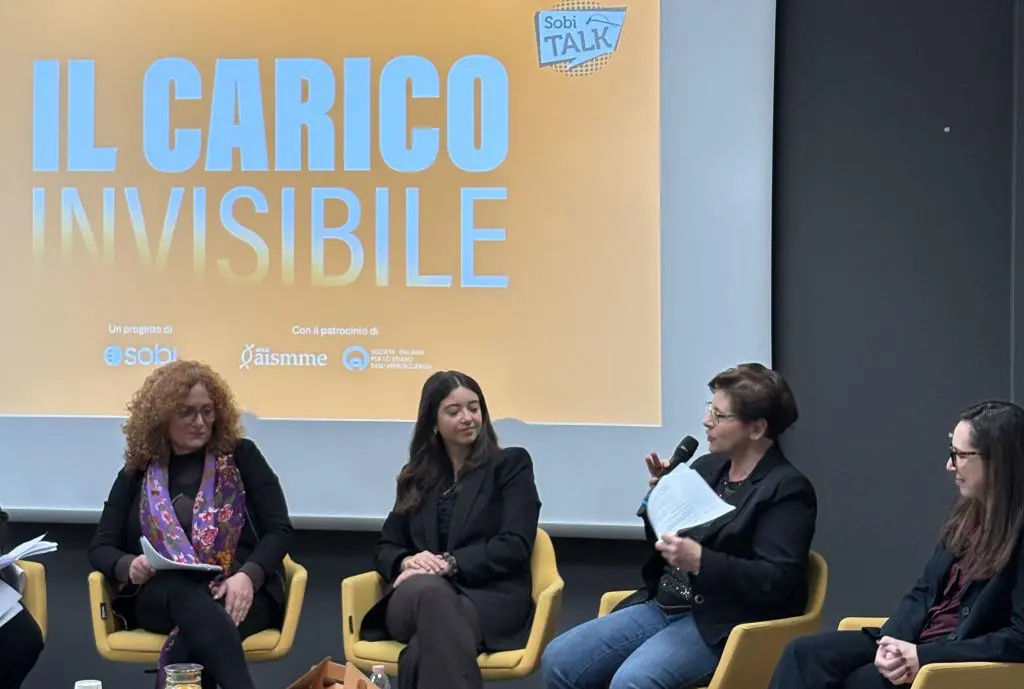
MILAN (ITALPRESS) – There are diseases whose impact is not only measured through the symptoms or values of an examination. It is the case of the Family Chilomicronemia Syndrome (FCS), ultra-rare genetic pathology that can impose a daily life on those who are affected with constant attention to nutrition, renunce, planning and worries that often remain invisible to the eyes of others. It is from this less visible dimension of the disease that is born “Il Carico Invisibile”, the awareness campaign promoted by Sobi Italia on the occasion of the World Day of FCS. The project takes the form of a vodcast in four episodes available on Spotify, realized with the patronage of AISMME – Italian Association of Supporting Herditary and SISA Metabolic Diseases – Italian Society for the Study of Atherosclerosis, and accompanies people listening to the discovery of triglycerides, their role and the consequences that elevated levels can have on health and daily life. The voice of actor Francesco Pannofino, with an accessible language and a narrative that alternates information and personal dimension: from the role of triglycerides to the relationship with food, from preventive choices to forced renunces, to the impact that an ultra-rare condition can have on sociality, relationships, everyday life and for future projects. Family Chilomicronemia Syndrome is an ultra-rare genetic pathology linked to an alteration of triglyceride metabolism. In people with FCS, the body fails to properly metabolize chilomycins, particles carrying triglycerides in the blood, resulting in severe blood accumulation and blood levels. A condition that is difficult to diagnose and is not exhausted in an altered value in blood tests but may associate itself with important manifestations and the risk of complications, including episodes of acute pancreatitis. Acute pancreatititis is a sudden inflammation of the pancreas that can cause intense and persistent abdominal pain and, in severe cases, potentially dangerous complications for life. The management of pathology also requires strict control of triglyceride levels and, in particular, an extremely poor diet of fat. 1As Carina Fiocchi, Medical Director of Sobi Italy, Greece, Malta and Cyprus declares, “in FCS it is particularly important to move attention beyond the clinical data, because it only tells a part of history. Behind extremely high levels of triglycerides there is a daily experience made of constant vigilance, renunciation and fear of possible complications, which deserves to be recognized and understood. Our commitment is to be alongside the scientific community and the people who live with FCS, listening to their needs and responding concretely through innovations, offering new perspectives. ‘The Invisible Charity is born of this vision: promoting knowledge and awareness, so that what often remains invisible finally comes to light.’ “When we observe very high values of triglycerides, it is important not to consider them simply as a data altered in blood tests – explains Giuliana Germana Mombelli, cardiologist and lipidologa of the Dislipidemie Center of the ASST Grand Metropolitan Hospital Niguarda of Milan -. In some cases they can be the signal of a rare condition such as Family Chilomicronemia Syndrome, which requires a specific framework and careful management over time. Increasing the knowledge of FCS, including among doctors working in different clinical areas, means encouraging a more timely recognition of pathology and directing patients to specialist centers with experience in the diagnosis and management of rare disorders, so that they can receive an appropriate and continuous takeover. In this sense, initiativesof information and awareness can help bring attention to a pathology that is still little known and to the needs of people who live with us every day”. It is precisely this set of consequences, not always immediately perceived from the outside, to constitute the invisible load of the pathology: renunces, worries, fear of possible complications and need to adapt their habits to a chronic and rare condition. “When we talk about a rare disease like FCS, we cannot stop to the clinical aspects: we must look at everything that pathology entails in the life of every day – commented Manuela Vaccarotto, Vice President AISMME – Italian Association of Supporting Herditary Metabolic Diseases –. The relationship with food, a lunch with friends, a dinner outside the house or a party time can become a source of concern and require continuous planning, with repercussions on sociality and psychological well-being. This adds the weight of living with a condition that others often do not know and struggle to understand. This is why it is essential to listen to the needs of people and families, to give voice to their experience and to promote greater awareness around FCS, so that no one feels only in facing the disease.” The rarity of FCS is one of the main challenges also on the diagnosis plan. Not all forms of hypertriglyceridemia are in fact attributable to the same condition and distinguishing the FCS from the most common forms is essential to arrive at a correct frame of the patient. Conviving with FCS often means having to live with high levels of apprehension and strong restrictions, with a significant impact on family, work, socio-relational life and future projects and ambitions. “ Hypertriglyceridemia includes different conditions for triglyceride levels, causes and clinical implications. The increase of triglycerides can in fact be mild or achieve extremely high values, and may depend on metabolic factors, other conditions or on the intake of drugs or, in some cases, on genetic alterations – emphasizes Manuela Casula, SISA – Società Italiana per lo Studio dell’Aterosclerosi -. With the increase of triglyceride levels, the risk of complications also grows: in particular, the risk of acute pancreatitis increases progressively and becomes particularly relevant when triglycerides reach extremely high values4. The Family Chilomicronemia Syndrome (FCS) is the most severe form of hypertriglyceridemia, with extremely high and persistent triglyceride levels due to a blood accumulation of kilomycorons, lipoproteins carrying triglycerides resulting from feeding. FCS is an ultra-rare genetic disease, due to a hereditary defect in the mechanisms that allow the removal of blood kilos.” “This pathology requires a specific diagnostic framework and management. Early recognition of particularly high levels of triglycerides and understanding the cause is essential to identify patients with persistent milomicronemia and reduce the risk of complications. Behind an altered value there may be a complex clinical history, which deserves to be thorough. Increasing awareness about hypertriglyceridemia and FCS means encouraging more timely diagnosis and appropriate treatment paths,” Casula concludes.
– photo press office Sobi –(ITALPRESS).