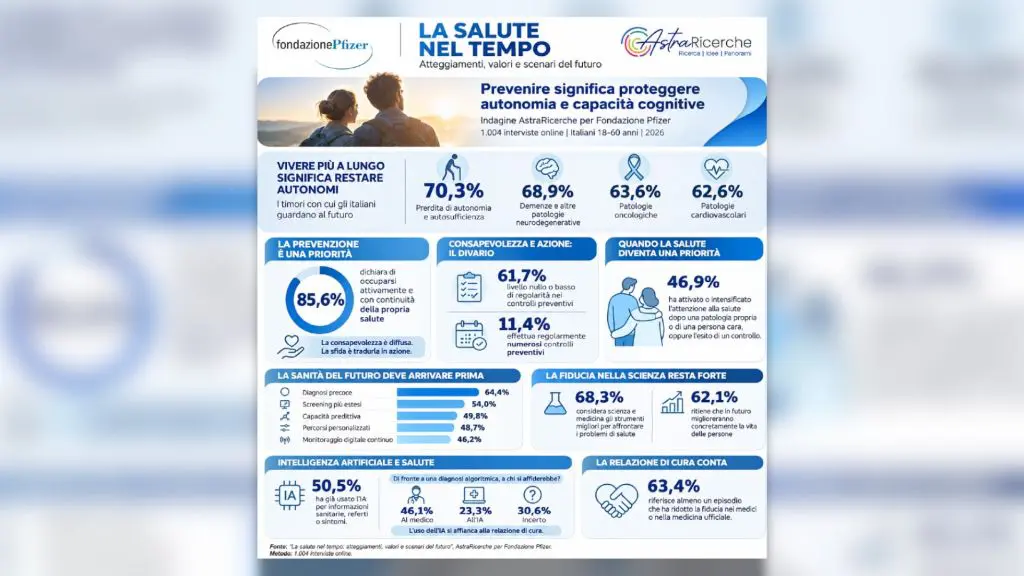
ROMA (ITALPRESS) – Pfizer Foundation opens a new phase of its commitment by putting prevention at the centre of its action. The starting point is the listening of Italians: their relationship with health, the choices adopted in daily life and the obstacles that still make it difficult to transform awareness into concrete and continuous behaviors. With this goal “Health in time: attitudes, values and scenarios of the future”, an investigation carried out by AstraRicerche for Fondazione Pfizer on a representative sample of over 1,000 people between 18 and 60 years. Research explores what fosters or hinders prevention and offers useful elements to promote initiatives closer to people’s needs throughout the life.The fears with which Italians look to the future help to understand the value attributed to prevention: the loss of autonomy and self-sufficiency worries 70.3% of respondents. At the heart of these concerns there is the possibility to continue to decide for itself and lead an independent life. To these expectations lies a significant distance between awareness and action. 85.6% of respondents say they are actively and continuously involved in their health, but 61.7% have a zero or low level in the indicator on the regularity of preventive controls and only 11.4% reach a high level. Prevention is therefore widely recognized as a value, but it does not always manage to translate into regular practices and maintained over time. The research also shows that, for 46.9% of respondents, attention to health has been activated or intensified by a proper pathology or a loved one or by the outcome of a control. A fact that strengthens the importance of continuously promoting primary and secondary prevention interventions, screening and appropriate controls, favouring more early diagnosis throughout life. “The Pfizer Foundation’s mission is to help improve people’s health and quality of life, supporting initiatives capable of creating a concrete impact in the community – says Barbara Capaccetti, President of Pfizer Foundation –. We chose to put prevention at the centre of our commitment, promoting innovative and inclusive design that help transform knowledge and awareness into behavior and opportunities. “Health in time” research is an important step in this journey: listening to people, understanding needs and obstacles is indispensable to fostering a culture of concrete prevention, continuous and close to everyday life.”To condition the gaze on the future is a present in which disease and fragility are already very widespread experiences. 53.9% of the sample live, personally or through a loved one, with a serious, chronic or disability pathology. 20.5% currently assists a non-self-sufficient person or with serious health problems and an additional 36.3% has done so in the last five years: altogether, 56.8% has lived or lives a continuous experience of care. Even among young people, the perception of health is not always fully positive. Among the under 45, 46% of the population is declared in excellent physical form. Prevention therefore covers all ages and requires attention to the needs of people in the different stages of life. Research has a widespread awareness: 85.6% of respondents say that they are actively involved and continuously in their health, and over three quarters of the sample recognize in balanced nutrition, physical activity, sleep quality, cognitive stimulation and stress management determining factors to age in good health. However, when behaviour is observed, the picture changes: 61.7% has a zero or low level in the synthetic indicator for preventive controlsi and only 11.4% reaches a high level. Moreover, for 46.9% attention to health has been activated or intensified by a personal pathology or a loved one or by the outcome of a control: for almost one person on two, therefore, prevention becomes really important when vulnerability has already entered its experience or affective network. The distance between awareness and behavior is one of the leading threads of the investigation, which returns an articulated picture of habits and the relationship with prevention in the different stages of life.“The results highlight a double paradox – comments Cosimo Finzi, Director and CEO of AstraRicerche -. On the one hand, the Italians know the behaviors that can help protect health and declare to take care of it actively; on the other, this awareness struggles to translate into regular controls and habits maintained over time. Prevention, moreover, still tends to act in response to a negative experience, when a pathology or vulnerability signal has already directly involved the person or someone close to her. It is precisely in the gap between the value attributed to health and the regularity of daily actions that emerges one of the most significant aspects of research”. The Italians continue to entrust their hopes to science: 68.3% considers science and medicine the best tools to address health problems and 62.1% believes that in the future they will improve the lives of people. Artificial intelligence is a signal of change in access to health information. 50.5% of the sample declares that it has already been used to search for information, interpret reports or evaluate symptoms. Adoption, however, runs faster than trust. In the face of a diagnosis formulated by an algorithm based on its clinical data, 46.1% would choose to rely on the doctor, 23.3% on artificial intelligence and 30.6% would remain uncertain. The data thus returns a relationship with the AI that is still evolving: its use is already widespread, while the confidence in its diagnostic applications remains more contained. “Research confirms how prevention is linked to the desire to intervene before, accompany people and preserve their autonomy and quality of life over time – concludes Barbara Capaccetti. It is from this perspective that our commitment is born: to support projects that bring the culture of prevention in everyday life, with particular attention to the most fragile people and the new generations. We want to help transform trust in science and the value recognised to health into a greater awareness of everyday choices.”.
– Pfizer press office photos –(ITALPRESS).