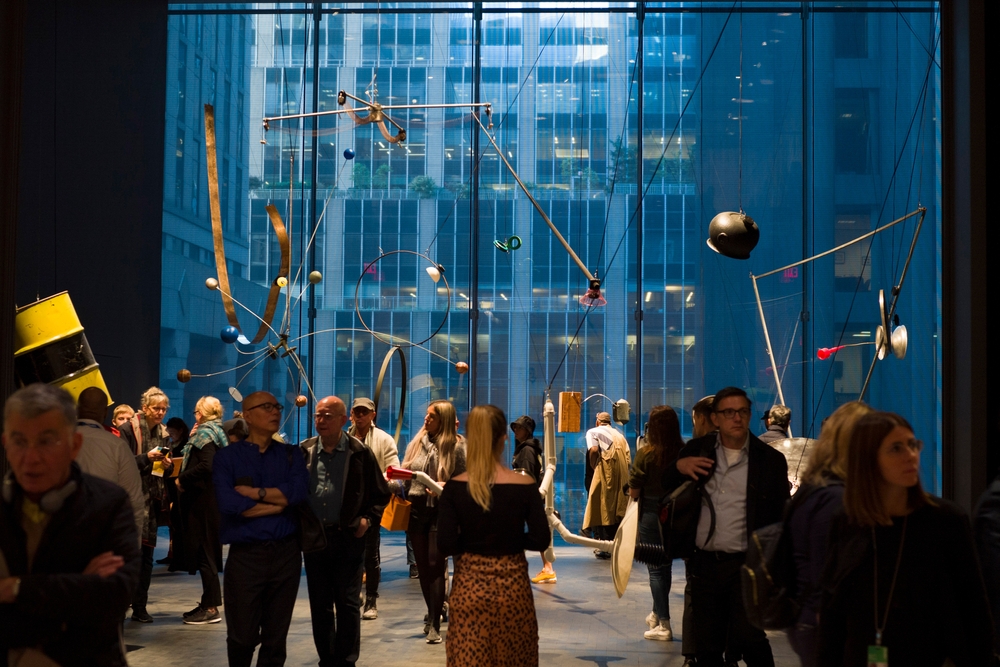
If you want to measure the blood pressure of contemporary New York, there is a fixed, feverish appointment, which goes on stage every week in the heart of Midtown: Friday night at MoMA (Museum of Modern Art). When the clock hands exceed four o’clock in the afternoon, the glass fortress and granite on the 53rd Road stops being the silent temple of elite collecting and turns into a human anthill. The reason is noble: thanks to the support of historical sponsors, the entrance is completely free for all residents of New York City.
The result is an anthropological shock wave that fills the immense spaces designed by Yoshio Taniguchi. But behind the apparent festival of accessible culture, the evening raises deep questions about the real function of the mass museum today.
The queue on the outside winds through blocks, an absolute melting pot of Columbia students, Bronx families, Brooklyn creatives and Upper West Side elders. Inside, the atmosphere is electric, almost from music festival. There is something profoundly political and beautiful in seeing a museum so important returned to its own city, freed for a few hours by the oblivion of the $30 entrance that makes culture a luxury for many. gratuitousness is a right, and it is the greatest victory of cultural democracy in New York.
However, once the controls have been exceeded, the dream of democratization collides with the reality of perception. Moving between the rooms of the fifth floor, where the permanent collection is kept, becomes an exercise of visual survival. The crowd hops, pushes, layers. But he doesn’t do it evenly.
This is where the critical short circuit emerges. The audience of Friday evening moves for digital magnetism. There is a real polarization of the museum space: an oceanic mass is hosessively lit in the face of very few works-fetish, those that the Instagram or TikTok algorithm has transformed into universal pop icons.
Everyone wants the perfect selfie with Van Gogh’s Starry Night, everyone clings around Picasso’s Demoiselles or Andy Warhol’s Campbell soup cans. In front of these canvases, the aesthetic experience is reduced to a digital trophy to be exhibited: one takes pictures, turns his shoulders and goes beyond. Meanwhile, a few meters away, absolute masterpieces of abstract expressionism, conceptual sculpture or the European avant-garde – works that do not enjoy the same virtual hype – remain duly deserted, ignored by hectic looks.
The central node is this: opening free doors is a sublime act, but it alone is not enough. Without cultural mediation, the museum risks becoming a gigantic empty cathedral where people pass, consume images and understand nothing.
Today more than ever, in an era of visual illiteracy of return led by screens, the MoMA would need to invest not only on gratuitousness, but on the pedagogy of the gaze. In addition to the works, among the corridors, they would serve art historians, cultural mediators, guides able to stop the passer, to explain the context, to reveal the reason why that cut on the canvas or that acid color changed the history of humanity.
Without this intellectual heat network, gratuitousness becomes a philanthropic marketing operation that moves masses of people without creating real awareness. People hop in front of what they already know (because they saw it on the phone) and lose the rest of the world. The museum of the future should not only open the turnstiles; it must give to those who enter the tools to decode the present. Otherwise, the “Star Night” will remain only a bright background for the umpteenth Instagram story.
L’articolo Friday night at MoMA proviene da IlNewyorkese.