For the first time in our World Tour in New York we do something we never did: let’s get out of New York. We go to the Hudson and descend for a hundred kilometers south, in the heart of New Jersey, to Robbinsville. It is a name that many will not say anything, but here is one of the most amazing places that I have been visiting since I live in America. A small transgression to the rules of the column, I admit. But the communities living in this city do not stop at the borders of the five boroughs, and the Indian one less than all.
I discovered the BAPS Swaminarayan Akshardham thanks to two friends: Alessandra, who lives in New Jersey and loves to often return to this place, and Alessia, an expert in Ayurveda, a deep acquaintance of India and the practices of Hindu religion. I was not completely unprepared: Hinduism has always fascinated me, and in my travels to the world, as well as in the streets of New York, I always try to approach the most authentic places of cultures that I meet. But one thing is to know, another is to live. Alessandra’s habitual gaze and Alessia’s expertise helped me through this experience with a new awareness. It is one of the most beautiful lessons that this World Tour is teaching me: the places are really understood only when someone, next to us, knows how to tell them.
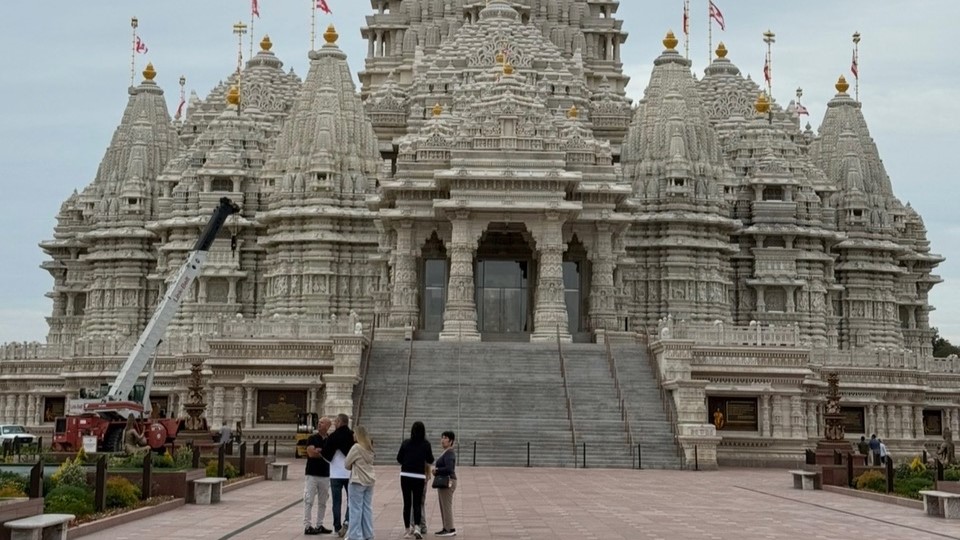
Some numbers help to measure what awaits us in front of this incredible structure. Opened on 8 October 2023, Robbinsville’s Akshardham is the largest Hindu temple in the western hemisphere. It was created by over twelve thousand five hundred volunteers in twelve years of work and its campus extends for about seventy-five hectares. Stones come from Italy, Greece, Turkey, Bulgaria, India and other countries. They were hand carved by master craftsmen in India and then assembled here, piece after piece, as a gigantic mosaic. It is the third Akshardham in the world, after those of Gandhinagar, Gujarat (1992), and New Delhi (2005), and houses the largest elliptical dome ever built in stone according to traditional architecture. I like to think that some Italian marble is also finished here, among the columns of a Hindu temple in New Jersey: another small, unforeseen plot of worlds.
At the entrance of the temple Nilkanth Plaza welcomes us, dominated by a statue about fifteen meters tall that depicts Bhagwan Swaminarayan as a young man, when, a teenager and ascetic, he was known as Nilkanth Varni. It was he who founded, at the end of the eighteenth century, the tradition that bears his name. A little further, the Brahm Kund opens, a pool like the traditional Indian ones, filled with water from the hundred and eighteen sacred rivers of India and the water streams of the fifty American States. It is the image that perhaps best represents the contamination between cultures: two distant geographies that mix in one tub, exactly as it happens to those who chose to live between two worlds.
The main structure of the complex is the Mahamandir, the real temple. We take off our shoes to enter, as tradition wants, and crossed the threshold really seems to have passed through a portal to travel in time and space. Each surface of the temple is carved from columns to ceilings to arches and niches that run into a stone embroidery that does not leave a single empty centimeter, populated with deities, animals, flowers and dancing figures. I walk slowly, with my nose up, and I find myself suddenly in Rajasthan, on my trip to India. I find the same rich architecture, the same almost obsessive care of detail, and above all the same silence, the same peace that envelops the places of worship and that seems to slow down the breath of anyone who enters. It is the magic I look for every time in this column, but I rarely felt it so strong: a journey in the journey, in fact.
To make this place alive, and not only beautiful, are people. The temple is frequented by the Indian community of New Jersey and the whole area of New York: whole families, grandparents and grandchildren, girls in sari with colors lit next to young jeans, devotees who arrive with offerings of flowers and food. At eleven and a quarter we participated in the Rajbhog Arti, the noon ritual in which to the murti, the sacred images, offers food and they let themselves sway the lamps lit. And here the silence just before leaves room to another face of Hinduism made of colors, choral participation, rhythmic beat of hands, prayers and songs that fill the room. As in Rajasthan, devotion here is never only recollection, but also shared feast. We participated in the rite while Alessia whispered in my ear the meaning of gestures that followed before the altar. Although I do not understand everything I felt the same feeling that I feel during travel, a mix of loss and excitement in front of something new that makes me feel at peace.
Some practical advice for those who want to go there. The entrance is free and the campus is open every day from 9 to 19:30, except on Tuesday. In the main public holidays and during the Diwali you need a reservation (free): you should however consult the site before leaving. The dress code is rigorous: shoulders and knees covered, no necklines, a sign of respect that the place deserves. However, the most important advice is another: arrive in time for the 11:15 Art, or stop until sunset for the evening. For lunch, on campus, the Shayona Café offers a fully vegetarian, Indian and Western cuisine, where each dish is first offered to the divine and thus becomes prasad, blessed food. Alternatively, as we did, you can continue for Princeton, a few kilometers away: a town that deserves a visit at least once in life and always gives a pleasant afternoon.
Going back to Manhattan, with the skyline that reappeared on the horizon, I realized how much more to tell about India in New York. From the scents of Curry Hill, of which I have already told you, to the streets of Jackson Heights, from parties to the temples of Queens: there is a whole subcontinent waiting to be explored, and this day in New Jersey is just a small window. We’ll be back soon, I promise! For now we add a new stamp to the passport of our World Tour in New York, the first outside of the city. Thank you for coming here and the next adventure!
L’articolo Beyond the Hudson, a stone and silence temple proviene da IlNewyorkese.