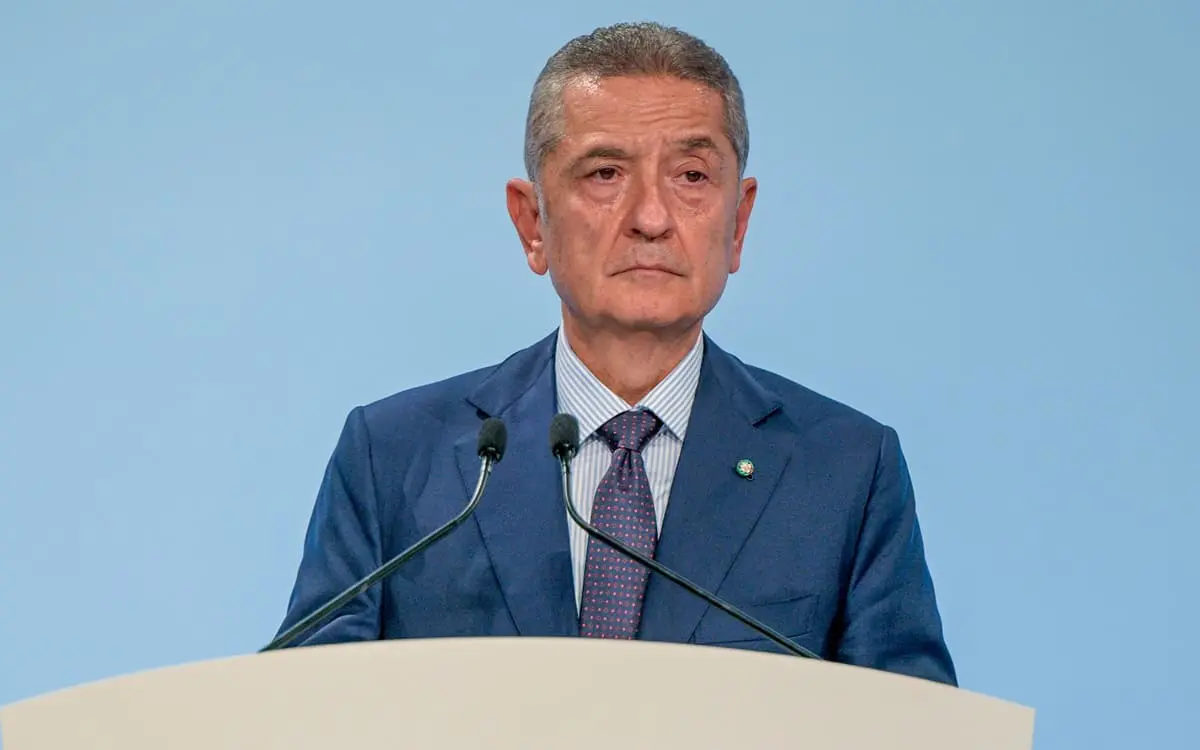
MANILA (FILIPPINE) (ITALPRESS) – “Extreme weather events have caused over 200 billion dollars of direct damage in 2025, more than twice as much as in the early 2000′′′′′: the Governor of the Bank of Italy, Fabio Panetta, said, opening in Manila the Green Swan Conference 2026.
“What was once considered primarily a threat to future generations is already affecting economic and financial conditions,” said Panetta, stressing that “some climate damage is now inevitable and this makes resilience increasingly important.”.
“Climate risk should not be treated as a separate compliance exercise, but integrated into credit, market, operational and insurance risk assessment,” the Governor warned.
Panetta finally drew attention to investments in prevention. “Adjustment is generally less expensive than repeated reconstructions,” he said, adding that “our economic and financial systems must be able to absorb climate shocks without allowing them to become wider crises.”.
“A large part of the losses caused by natural disasters remains uninsured and this protection gap leaves families and enterprises exposed to serious difficulties, forcing governments to intervene ex-post with considerable tax costs, Insurance is a central component of climate resilience and its role goes beyond the simple compensation of losses”, Panetta pointed out, explaining that “when the risks are properly pre-taken, coverage encourages prevention by providing financial incentives to reduce exposure.” For the Governor, “reducing the protection gap requires a multi-tier model that combines private insurance, reinsurance, public guarantees and capital markets,” in which “the State intervenes as a backstop for extreme events that exceed the capacity of the private market”. In this regard, Panetta recalled, “to reduce dependence on state aid ex-post, Italy has recently introduced the obligation to insurance against floods, earthquakes and land for non-agricultural enterprises, supported by a public guarantee.” “The objective of these schemes,” the Governor concluded, “is to prevent losses from falling entirely on those who are less able to support them or come to threaten the entire financial system.”.
“Artificial intelligence can improve climate models and early alert systems, but technological progress is not cost-free. The expansion of data centers is increasing demand for energy, water and critical raw materials,” said Panetta, stressing that “this pressure must be managed so that digital innovation will strengthen resilience without creating new economic and social vulnerabilities.” “The new instruments cannot replace reliable data, solid models or human judgment,” the Governor concluded, “but if used carefully, they can improve our ability to anticipate shocks before risks materialize.”.
– Photo Ipa Agency-
(ITALPRESS).