
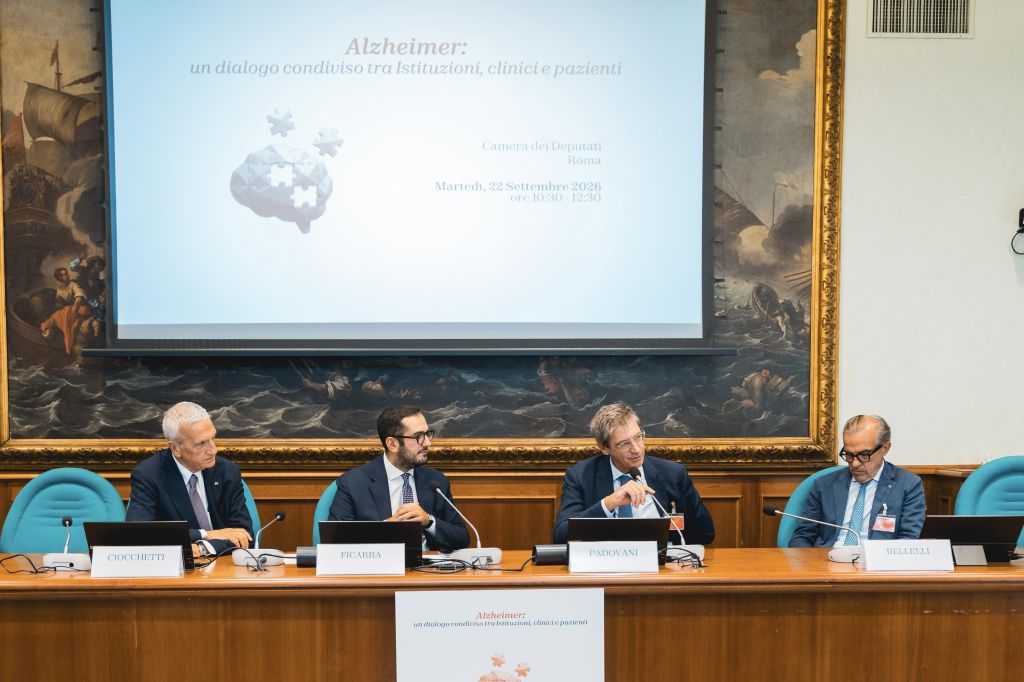
ROMA (ITALPRESS) – The Round Table “Alzheimer: a shared dialogue between institutions, clinicians and patients” was held at the Chamber of Deputies, realized with the non-conditional contribution of the Menarini Group, with the aim of deepening the main priorities related to prevention, early diagnosis, taking charge and access to therapies for patients with Alzheimer. Alzheimer’s is the most frequent form of dementia and causes a growing demand for assistance to health and territorial services and families. In Italy, in 2025, approximately 1.5 million people are estimated with dementia, to which about 950.000 people are added with mild cognitive deterioration and about 4 million family members and caregiver directly or indirectly involved in assistance. The comparison has placed particular attention to the prevention, also in the light of the National Plan of Prevention 2026-2031, with reference to the factors of changeable risk along the course of life and to the connection between prevention, general medicine, territorial services and network of the Centers for Cognitive Disorders and Dementia, so that recognition of the first signals can be translated in a timely access to diagnostic framing and loading. “For Alzheimer’s, it is necessary to create permanent networks, because through the exchange of experiences and organizational models we can optimize resources and make more effective any regulatory intervention. It is therefore essential to intervene on the organization, ensuring a capillary and homogeneous system that allows the patient to be followed in the same way wherever it is. It cannot be an organizational or territorial problem to prevent fair access to a therapy,” said Annarita Patriarch, Secretary of the Chamber of Deputies and Promoter of the Parliamentary Intergroup for Neurosciences and Alzheimer Daniela Merlo, Director of the Department of Neuroscience of the Higher Institute of Health, said: “In the face of prevention, it is important to intervene on changing risk factors and to identify early signs of decline, before conclaimed pathological conditions arise, so as to be able to intervene promptly. This also requires a paradigm shift, rethinking aging in an active perspective and intervening on the prevention of loss of functions. It also needs to expand the range of therapy possibilities, it is essential that basic research individuals new pathogenic mechanisms on which they can intervene. Alzheimer’s is in fact a very complex disease and can hardly be faced with a single approach, only research can lead us to more effective solutions.” In addition to prevention, the need to anticipate the recognition of the first signals has emerged and to strengthen the grip from the initial stages, through paths capable of integrating specialist evaluation and welfare continuity. “ Today the early diagnosis of Alzheimer’s can also intervene in the phases in which the symptoms are not yet clearly recognizable, when the patient begins to feel the first signs of a possible decline”, said Alessandro Padovani, Past President of the Italian Society Neurology and Director of the Neurological Clinic of the University of Brescia. “It is essential to arrive at a correct diagnosis and to start an early grip that considers all the factors that can affect the pathology trajectory. In addition, in this path it is important to build a truly multidisciplinary grip, connecting the different skills involved, trying to harmonize and standardize diagnostic and therapeutic paths in the regions, exceeding the logic of Note 85, to optimize care and interventions.” The comparison also recalled the need to simplify the management ofand conventional therapies for the patient and for the doctor, with particular reference to what provided by Note 85 in the phase after the definition of diagnosis and treatment. A greater simplification of prescription and monitoring would therefore allow to reduce passages that can also affect the time of the path, maintaining a continuous grip of the patient and allowing the CDCDs to focus more on the needs that require a specialist evaluation with the aim of reducing access to diagnostic paths and defining clinical frameworks. “We have some therapies that can be prescribed more simplified than they are prescribed now, but we are still bound to a note that involves a further step and risks slowing down the timing. Once the patient is defined in the diagnosis and prescription of conventional drugs by the CDCD, it is to be considered within the path, and it is the system of proximity care that must be charged to it”, said Camillo Marra, Head of Operational Unit Simple Department of Clinical Area of Memory and Professor of Psychology at the University Polyclinic Agostino Gemelli IRCCS in Rome. Moreover, the sustainability of the therapies has been discussed in relation to the ability of the system to guarantee over time treatment, follow-up, monitoring, therapeutic adherence and welfare continuity. At the same time, the need to reduce regional differences in the availability of services and access to diagnostic and therapeutic paths has emerged, ensuring a greater homogeneity of the takeover on the territory. Finally, special attention was also devoted to the role of caregiver, whose involvement grows with the progressive loss of patient autonomy. Information, guidance, training and access to services must accompany the family from the diagnosis, avoiding that coordination between the different levels of assistance falls exclusively on caregiver.Katia Pinto, President of Alzheimer Italy, said: “In Italy there are still significant differences between the territories in access to services dedicated to people with Alzheimer and their families. After diagnosis it is essential that the patient and caregiver may receive adequate information, guidance and support and be directed towards the available services. It is necessary to reduce these unevenness and ensure a continuous grip, so that the place where you live does not determine differences in the received assistance”. In the course of the initiative, the need to consolidate a coordinated path between prevention, timely recognition of the first signals, diagnosis, fair access to therapies and continuity of the takeover has emerged. The reduction of territorial differences, the strengthening of the link between services and the management of the most simple and sustainable therapies over time are therefore essential conditions to ensure a more equitable response to the needs related to Alzheimer’s.
– photos Esperia Advocacy – (ITALPRESS).