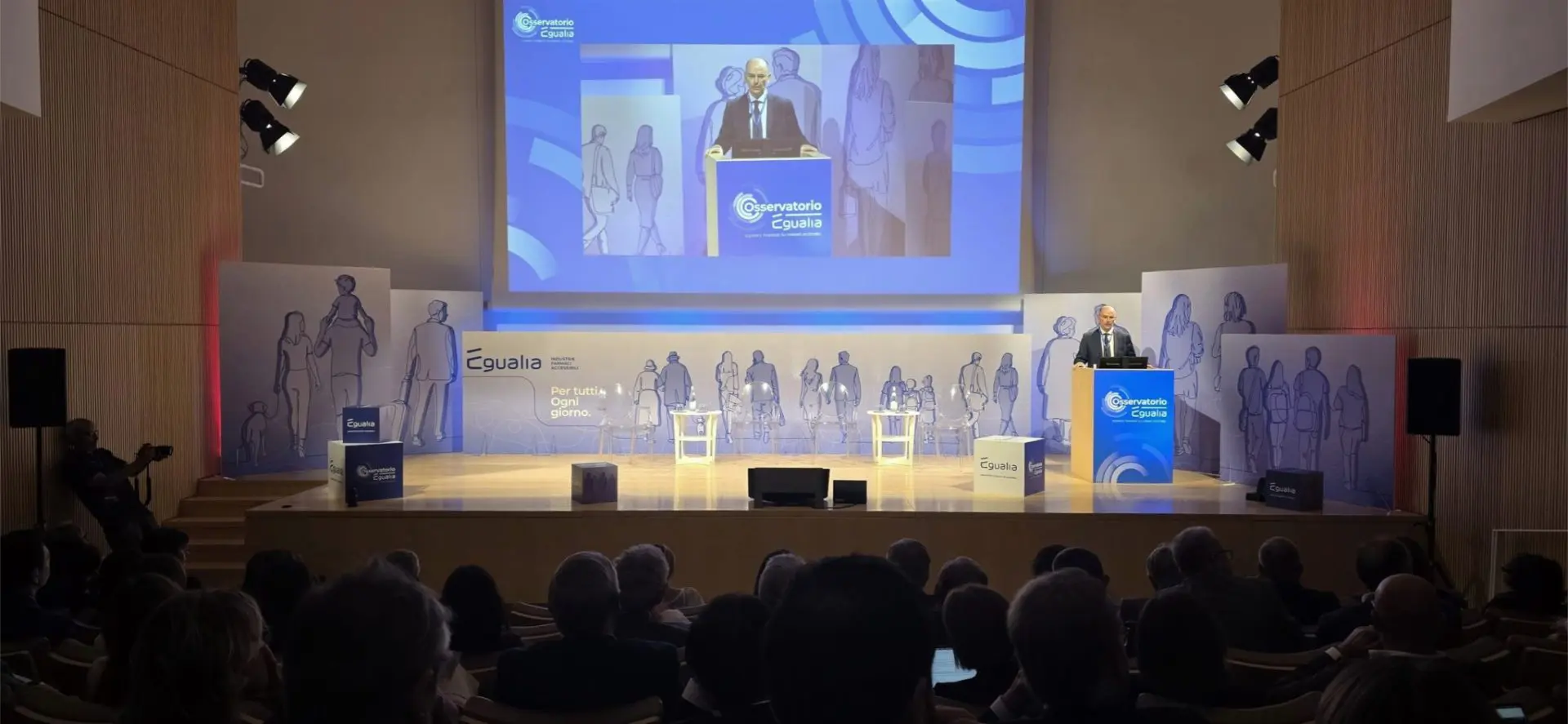
ROMA (ITALPRESS) – It slows down the profitability of the enterprises of the drugs accessible, that in 2025 is at 2.8%, in decrease of 0.3 percentage points regarding the previous year. The sector continues to grow, with 6.8 billion revenues and 11.792 direct employees, up 1.9% in a year. The growth of production costs, increased by 32.1% between 2020 and 2024, is mainly the margin burden. This is what emerges from the XI Report of the Observatory on the Accessible Drugs of Egualia, realized with the contribution of Nomisma and TEHA Group and presented at the Auditorium of Ara Pacis.
“Companies have demonstrated an extraordinary ability to adapt over the past few years, absorbing costs of more than 30%, reorganizing processes and continuing to invest and create jobs. However, the first decline in profitability tells us that this balance is becoming increasingly fragile,” said Egualia President Riccardo Zagaria. Considering also the indirect and induced effects, the overall economic impact of the sector reaches 20.4 billion, while the employment one exceeds 49 thousand employees.
Between 2020 and 2024, in particular, raw materials recorded an increase of 30.9% and services of 34.4%. So far the enterprises have absorbed pressure through efficiency, rationalization and transformation of processes, but according to the Observatory the adaptation space is gradually reducing. “The point is that, in a market at regulated prices, efficiency has a limit and cannot indefinitely compensate for the growth of costs”, explained Lucio Poma, chief economist of Nomisma.
“It is a signal not to be underestimated, because over time it can be translated into smaller investments and a progressive reduction of the offer,” he added. Pressure on margins is inserted in a pharmaceutical market characterized by a strong polarization. In 2025, with substantially stable amounts, hospital spending increased by 5.2%, reaching 13.1 billion. To determine the dynamics are mainly the drugs still covered by patents, which absorb 94.7% of hospital spending, while the equivalents have a share of 2.1%.
For Egualia it is two segments with different economic characteristics, but both relevant for the seal of the National Health Service: on the one hand innovative drugs, characterized by more contained volumes and high unit values; on the other, non-patent medicines, which guarantee large volumes of care at low prices and with lower industrial margins.
According to Daniela Bianco, partner of The European House – Ambrosetti and Head Health & Life Sciences of TEHA Group, “innovation and affordable drugs play different but complementary roles for the National Health Service”. For this reason, he stressed, it serves “a greater integration between health policy and industrial policy”, recognizing to the drugs accessible also a strategic value for the resilience of the supply chains and the security of supply. The theme takes on a dimension that goes beyond the economic sustainability of enterprises. Between 60% and 80% of the active ingredients used in medicinal products marketed in Europe are produced outside the European Union, mainly in China and India.
In a scenario characterized by increasing geopolitical tensions, according to the Observatory the sustainability of the productions of accessible drugs therefore also becomes a question of security of supply and European productive autonomy. From here Egualia’s demands for the next interventions on pharmaceutical governance: to adapt the prices of affordable and essential drugs when the structural increase of costs compromises sustainability, to fully operational multi-adjustment framework agreements, to review the payback for the patented drugs already subjected to competition and to intervene on territorial differences in the use of equivalents. For the association, updating governance does not necessarily mean increasing expenditure, but creating conditions to use it more efficiently.
Between 2016 and 2025 equivalents, biosimilars and patented drugs generated, according to the Observatory estimates, 8.2 billion savings, over 850 million of which in only 2025. The new shortterm deadlines between 2026 and 2028 could release further 1.2 billion.
– Egualia press office photos –
(ITALPRESS).