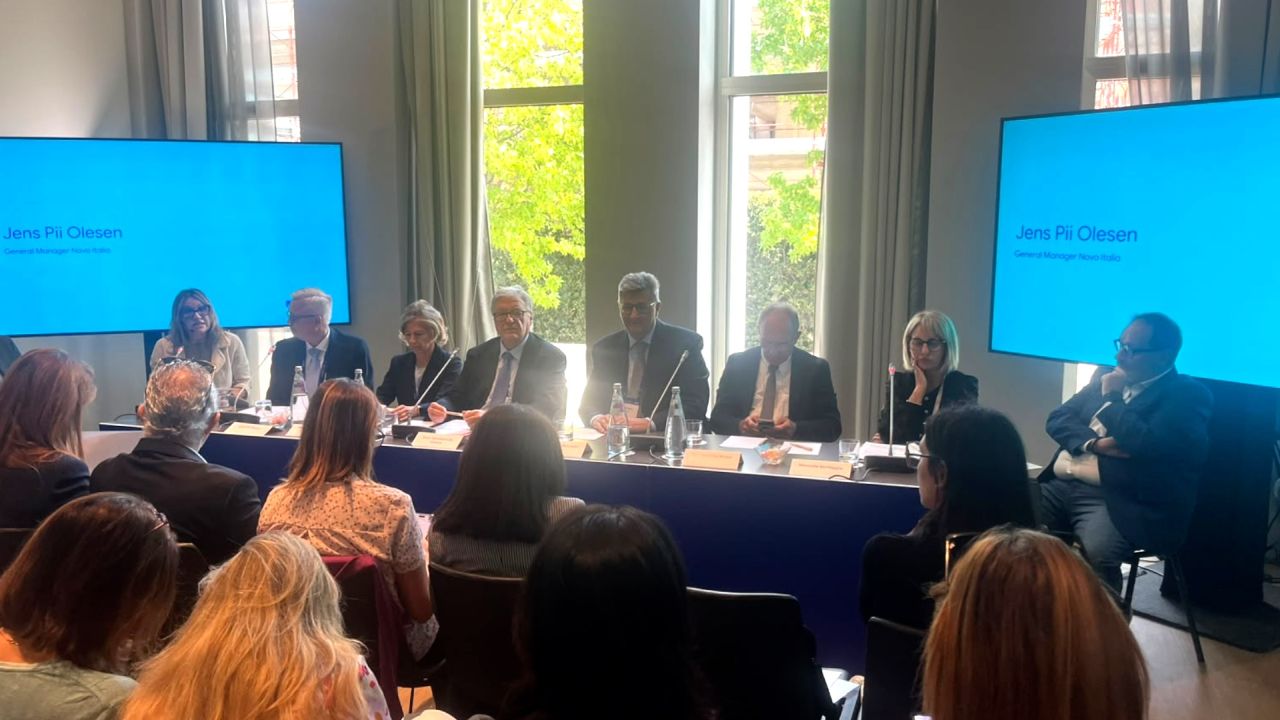
MILAN (ITALPRESS) – Value of innovation, clinical evidence and new therapeutic options. On these issues, at the 62° EASD congress, some of the top clinical experts on diabetes and obesity issues focused on the main innovations, in a meeting organized by Novo. Efficacy, safety, quality of life and adherence were the themes at the center of comparison. A meeting that has perfectly translated the renewed commitment of a company like Novo that has given way to a new chapter in its history: Lasting health starts now. “On the diabetes front – says Salvatore De Cosmo, national president of the Association Medici Diabetologi (AMD) – the evolution of scientific evidence on semaglutide also reflects well the evolution of diabethology. Today we no longer limit ourselves to evaluating blood glucose control, but we increasingly focus on preventing complications, organ protection and integrated management of cardiovascular, kidney and metabolic risk over the long term. In this path, semaglutide is one of the most solid examples of how therapeutic innovation can affect many aspects of the disease. The data collected in recent years show an extremely wide clinical profile. In addition to effectively reducing glycated hemoglobin by allowing most patients to reach their glycemic target, it has shown benefits on higher cardiovascular events (-26%), non-fatal stroke (-39%), composite kidney risk (-24%) and functional capacity, with an improvement of 13% of the distance traveled and a reduction of 54% of peripheral arteriopathy progression. The recent recognition in the ESC 2026 Guidelines, which has placed semaglutide in recommendation 1A to improve the cardiovascular outcome of the pz with diabetes and kidney disease, increasingly confirms the central role of the semaglutide molecule in favoring an increasingly more therapeutic approach to cardio-renal protection and improving the quality of vita. He echoes the President of the Italian Society of Obesity, Prof Silvio Buscemi. “In the management of overweight and obesity, the evolution of treatment has opened the way to personalization of care. The two options of administration – oral and injective – will allow us to ensure greater flexibility to respond to different needs, always focusing on the safety and effectiveness demonstrated by semaglutide. And in this sense the data on weight loss (21%) and the quality of weight loss (84% consists of fat mass) as well as the maintenance of muscle function ensure a weight loss not only relevant in quantitative terms, but also of quality. The future of obesity therapy – Buscemi concludes – is not simply to have new drugs, but to be able to have ever more effective and customizable solutions, capable of facing the complexity of obesity and to consider, in addition to weight, metabolic health, cardiovascular, psychological and the quality of life of people”. The arrival of new therapeutic options confirms how innovation represents a value that affects the quality of life of people living with a chronic disease such as diabetes and obesity. For type 2 diabetes, one of the most anticipated innovations is the combination in a single weekly administration of basal insulin and semaglutide. “This new option was born to respond to one of the main problems still present in clinical practice: therapeutic inertia – explains Raffaella Buzzetti, president of the Italian Society of Diabethology (SID). ‘Even today in Italy, about 30% of people with type 2 diabetes who need insulin therapy delay the beginning of over two years and, even after the insulin starts, many patients do not reach adequate glycemic control. Clinical studieslayer the potential of this therapeutic strategy in reducing injective load by improving quality of life and maintaining glycemic control, benefits on body weight and lower rates of hypoglycemia.” Hence the importance of a new paradigm of care that meets the new needs of the person with diabetes and maximizes the effectiveness and impacts of the currently available therapies. “Italy – Buzzetti concludes – which in recent years has often played a leading role in accessing the main therapeutic innovations, will be the first country in Europe to provide this new opportunity of care, helping to make the disease more effective, personalized and sustainable. We hope that this option will be available for patients as soon as possible.” But the novelties are also on the front of the therapies for the management of overweight and obesity. “Semaglutide in pill represents one of the most anticipated innovations – says Roberto Vettor, Scientific Director of the Center for Metabolic Diseases and Nutrition at the Humanitas Research Hospital in Milan – because it responds to a still relevant need in managing overweight and obesity: offering effective treatment in a simple form to integrate into daily routine and able to respond to different needs. This is a concrete possibility for people eligible for treatment who prefer an alternative to injective therapy.” The confirmations come from the recent published studies. “In the study OASIS 4 – adds Vettor – semaglutide in pill showed an average weight loss of 17%, which reached about 22% in 1 person out of 3. The results are associated with a consolidated and consistent safety profile with what has already been observed for the injective formulation of semaglutis for weight management. In addition, ORION indirect comparison showed that semaglutide in pill causes a lower probability of suspending therapy due to side effects and gastrointestinal than orforglipron. Overall, these evidences help to outline semaglutide in pill as an effective therapeutic option, well tolerated and easily integrated in everyday life, manageable even in the presence of concomitant treatments of broad use, including oral and statin contraceptives: a concrete possibility for people eligible for treatment who prefer an oral formulation or are not yet ready to start injective therapy.” The meeting also attended some representatives of Patient Associations to witness how pharmacological innovation takes a fundamental value for those who live the disease every day. “Therapeutic innovation represents for people with diabetes much more than the availability of new treatment options. It means being able to manage the disease with greater serenity, improve the quality of life and reduce the weight that diabetes continues to have in the daily life of patients and their families – says Manuela Bertaggia, national president of the Italian Diabetic Association (FAND). The prospect of even disposing solutions in Italy such as the combination of weekly insulin and semaglutide is an important signal, but should we ask ourselves not only ‘how does a drug work?’, but also ‘how much does it improve the life of the person?’. The hope is that you will ensure easy access to innovative technologies and new therapeutic options for the progress of research to become really progress for people.” A scientific and cultural evolution that fully involves obesity. “Obesity today is one of the most significant examples of how innovation can change the way of dealing with a chronic disease, contributing to overcome stigma and prejudice – adds Eligi Linoci, president of the association ‘La Mattina after Aps’ and vice president of the Italian Federation associations obesity (FIAO). The new formulations, including the oral ones, allow to better respond to the different needs of patients and to make the management of the disease increasingly compatible with daily life, favoring adherence and continuity in the treatment paths. Looking at the future also means investing in the prevention and health of the new generations: obesity in evolutionary age requires innovation, new skills and models of intervention capable of favoring early diagnosis and early taking charge.” “The whole of these scientific and clinical evidence confirms that innovation in the management of diabetes and obesity is an indispensable strategic investment – says Jens Pii Olesen, General Manager of Novo Italia. We are committed every day to ensure treatments that are able to impact concretely in everyday life and to promote an idea of health that takes into account the real and unsatisfied needs of people. Durable health starts now – Lasting Health starts now’ – a simple and concrete message, presented precisely in these days, which represents and strengthens what always distinguishes our way of working and communicating with people: progress must be translated into perceived benefits immediately, in the real life of those who manage complex conditions. Changing people’s lives – concludes Olesen – and contributing to lasting health is our mission.
– Photo f50/Italpress – (ITALPRESS).