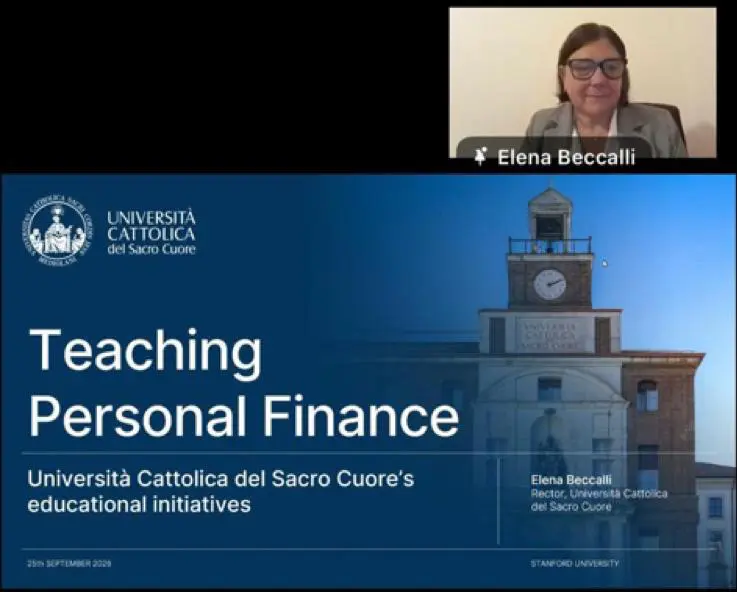
MILAN (ITALPRESS) – From university students not specialists to primary and secondary school teachers, up to people under conditions of vulnerability and migrants. They are the recipients of personal finance proposals developed by the Catholic University of the Sacred Heart to promote financial literacy, with the aim of spreading greater awareness and economic skills. The group of training activities was presented by rector Elena Beccalli at the University of Stanford, taking part in the “2026 Teaching Personal Finance Conference”, promoted by the Initiative for Financial Decision-Making, the annual meeting of the American University on financial education directed by Annamaria Lusardi. The conference brought together teachers, researchers and industry specialists to share experiences, teaching methods and research projects.
“It was a privilege to be able to illustrate at Stanford University the activities that our University has undertaken in the field of personal finance. This is a concrete way to contribute to the development of the country, promoting resilience and social inclusion, in a context in which the level of financial education remains under the European media,” said Rector Elena Beccalli.
“The University’s projects are aimed at non-specialized university students, through paths dedicated to the acquisition of basic financial skills; to primary school children, with educational programs designed for children; to teachers, through training initiatives that support the inclusion of financial knowledge in civic education. A project dedicated to vulnerable people, especially migrants, integrates financial literacy and language learning. A variety of initiatives born from the dialogue between the professors of finance of the University and the other disciplines that generated a real effect of propagation. A progressively increasing number of teachers is putting their skills on this aware of the social impact that comes from it,” said Rector Elena Beccalli, presenting them to the audience of experts gathered in Stanford.
The commitment of the Catholic University of the Sacred Heart is part of the priorities indicated by the European Union which, in 2025, defined financial education as an “essential competence for life”, aimed at enabling citizens to take responsible and conscious economic decisions. Eurobarometer data (2023) confirm the need for action: less than one out of five European citizen, equal to 18%, has a high level of financial literacy. While Italy continues to record delays, with significant differences related to gender, age and geographical area of residence.
Hence the articulated portfolio of proposals of the Catholic University of the Sacred Heart. These include the “Personal Finance Labs” for non-specialized university students, initially promoted on impulse by the Faculty of Foreign Language Science and Literature and Banking, Financial and Insurance Sciences, under the supervision of professors Maria Cristina Gatti, Francesca Pampurini and Alberto Banfi. From this pilot experience, the project is expanding to other Faculties and, in the current academic year, thanks to an interdisciplinary collaboration, also involves Psychology and Educational Sciences. It is precisely from this experience that a second line of intervention is formed, dedicated to secondary school teachers.
This is the course of “Personal Finance at school. Forming aware citizens”, promoted by the Catholic platform for the School and addressed to teachers of secondary schools. The training activity, which represents a concrete example of lifelong learning, pursues a dual goal: on the one hand, to put teachers in a position to accompany students in the economic and financial choices of daily life and the future; on the other, to offer teachers the same knowledge and tools useful to make financial decisions more aware in their personal life.
A second initiative, entitled “Educated to educate. Financial training for civic education”, also promoted by the Catholic platform for the School. Produced by the professors Federica Poli and Mariarosa Borroni, he intends to raise awareness among the teachers of secondary schools on the importance of financial education and to provide useful tools and resources to systematically integrate these issues into civic education programs.
As for the target of children, the Economic Psychology Research Unit of the Department of Psychology is developing a program for primary schools to teach to manage money “with the head”, through conscious and critical choices, and “with the heart”, paying attention to others and to the social implications of their decisions, also through the use of new technologies. In this perspective, the Conscious volume is inserted from children (edited by Silvia Della Rocca, Christian Tarchi, Elisabetta Lombardi and Annalisa Valle, 2026), which proposes an integrated model of intervention for the primary school, placing financial education within an interdisciplinary perspective, in which the teaching of economic skills intertwines with the development of cognitive processes at the basis of decisions, with the promotion of pro-critical attitudes and with a reading of criticism.
For the target of the most vulnerable people, the University, in collaboration with several associations in Milan, including the Realmonte Association, has launched a financial education program aimed at people from different cultural contexts and low income families. “IBAN”, the project developed by Professor Annalisa Valle, stands out for a particularly innovative approach that integrates financial literacy with Italian language learning. In addition to economic-financial training, the course proposes a language module aimed at acquiring the lexicon necessary to understand concepts and tools of everyday economic life.
To further characterize the project is the active involvement of participants in the realization of a shared glossary and the production of video pills on issues of financial education. To complete the picture are the numerous actions of dissemination and scientific dissemination promoted within the Third Mission, in support of a greater financial culture outside academic and school contexts. Not to mention “Women in Finance”, the program dedicated to the enhancement of women’s presence in the financial sector and the reduction of gender differences in economic skills and professional opportunities.
-Photo Università Cattolica-
(ITALPRESS).