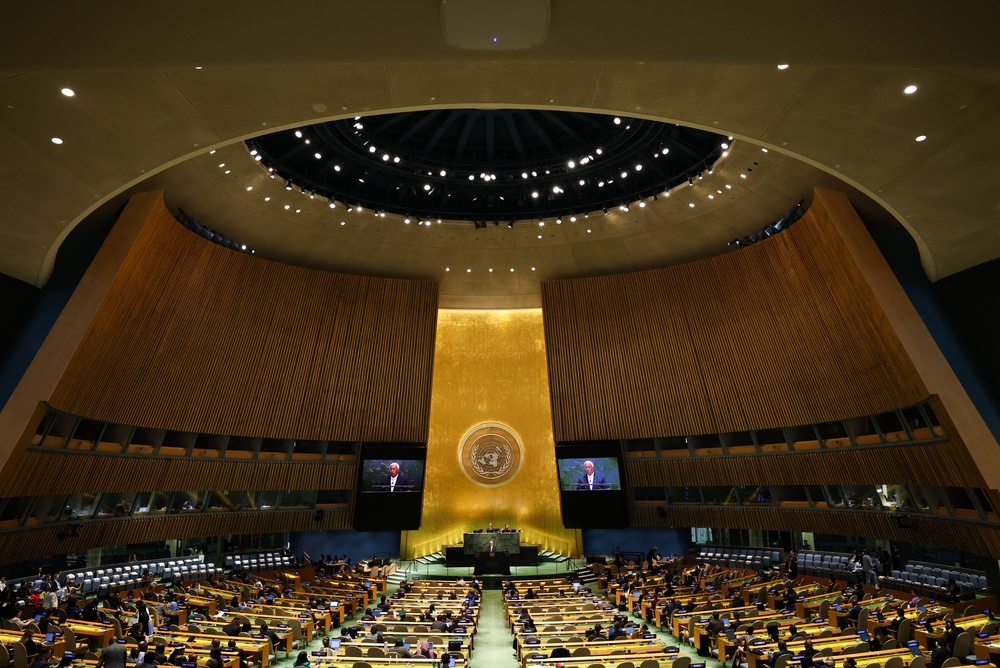
On Thursday, 24 September, the Vice-President of the Council and Minister of Foreign Affairs Antonio Tajani spoke before the General Assembly of the United Nations, representing Italy on delegation of the President of the Council Giorgia Meloni. In his speech, Tajani touched the main foreign policy dossiers of the moment, from Italy’s support to Ukraine to the need to reopen the Strait of Hormuz, from the situation in the Gaza Strip, so he reiterated the solution “two peoples, two states”, to the crisis in Sudan and Sahel. He also spoke of artificial intelligence, inviting the Assembly to establish common rules on opportunities and risks of technology.
The most mentioned passage of the speech was the role of the UN itself: “The United Nations was born to prevent violence from becoming the only law. But to remain faithful to that mission, they must find the ability to decide and, above all, to act,” said Tajani, adding that “too often this organization appears impotent. ” He raised the Italian request for a Security Council reform: “Italy wants a more legitimate, representative and responsible Security Council in front of all Member States,” a council that, he said, “is not an exclusive club. ” The minister also summarized the Italian diplomatic line with a formula: “With the law of the strongest, we choose the strength of the law. Against force policy, we choose the strength of politics. “Tajani finally announced the Italian commitment to “a universal moratorium on the death penalty,” collecting the applause of the Assembly.
The same day of Thursday was dedicated to the Middle East, and in particular to the confrontation between Israel and the Palestinian Territories. Israeli Prime Minister Benjamin Netanyahu spoke in front of a semi-empty court, after several delegations left the hall as a protest, while Palestinian President Mahmoud Abbas intervened in video message from Ramallah, having not received the visa to go to New York in person. The Vatican Secretary of State, Cardinal Pietro Parolin, called “decisously insufficient” diplomatic progress on the dossier, speaking on behalf of the Holy See. The Venezuelan Vice-President Delcy Rodríguez also took part in the same session, announcing the start of a democratic transition process in the country.
On Friday, September 25, the general debate entered its fourth day, with the morning and afternoon session dedicated to the continuation of national interventions. The day, according to the official calendar of the United Nations, is dedicated to the theme of prevention, preparation and response to the pandemics, an appointment born to learn from the health crises of recent years.
The Uniting for Consensus group, which includes twelve countries including Italy, which is Focal Point, together with Argentina, Canada, Colombia, Costa Rica and other member states, met on the edge of the work. The meeting, chaired by the Deputy Minister of Foreign Affairs Edmondo Cirielli, focused on the reform of the Security Council: the group calls for an extension of the elective seats, even with longer rotation mandates, rejecting the establishment of new permanent seats, and proposes limits to the use of veto in circumstances such as mass atrocities and war crimes.
L’articolo At the UN General Assembly two days to talk about reforms, Middle East and pandemics proviene da IlNewyorkese.