by Stefano Vaccara
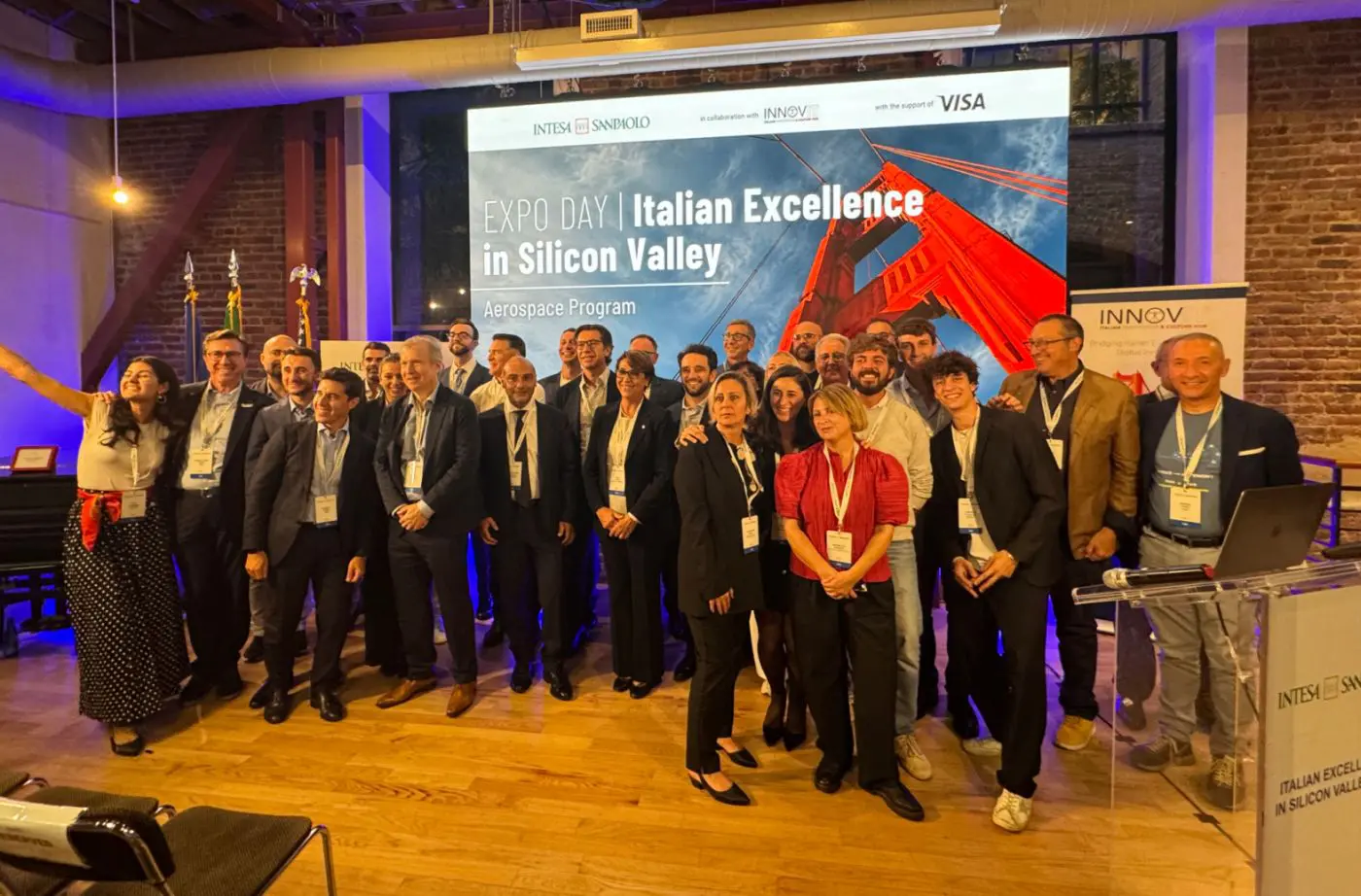
SAN FRANCISCO (UNITED STATES) (ITALPRESS) – From precision mechanics to composite materials, from robotics to cybersecurity, from lasers for space exploration to satellite systems and launchers. For five days in the Silicon Valley, 12 small and medium-sized Italian companies have brought a cross-section of the national aerospace industry, meeting investors, companies, researchers and protagonists of the American technological ecosystem.
The mission, promoted by Intesa Sanpaolo in collaboration with INNOVIT from 31 August to 4 September, represents the third initiative carried out together in three years and the first entirely focused on aerospace. The goal is to accompany high-potential Italian companies not only in the search for new customers, but towards industrial partnerships, capital and a more structured presence on the American market. The program has provided direct meetings with protagonists of the US space industry, investors and potential partners, as well as training sessions and deepening in the Silicon Valley ecosystem.
The twelve selected companies are ALI di Napoli, APR di Torino, Bercella di Parma, Bisiach & Carrù di Torino, Bright Solutions di Pavia, Cospal Composites di Bergamo, Curti, Dino Paoli di Reggio Emilia, Leas di Padova, Netgroup di Napoli, Novation Tech di Treviso and SAB Aerospace di Benevento. Different realities for size, history and specialization, but combined with technologies that can find space in the new value chain of the American aerospace industry.
Stefano Barrese, head of the Banca dei Territori Division, accompanied by Anna Roscio, Executive Director Sales & Marketing Enterprise, and Nicola Baiocchi Di Silvestri, Country Manager USA & Americas of the IMI Corporate & Investment Banking Division. The mission was carried out in San Francisco working alongside INNOVIT, whose Innovation Centre is directed by Alberto Acito. The initiative was also supported by the Consul General of Italy in San Francisco Massimo Carnelos and the Italian Trade Agency, with Filippo Fusaro of the ITA office in Houston
Behind the mission there is a strategy that Intesa Sanpaolo wants to make more and more structural. The bank has already funded over 500 SMEs of the Italian aerospace industry for more than a billion euros and is the first European commercial bank to have joined the ESA Investor Network. An agreement signed with the European Investment Bank and the European Space Agency also aims to activate another 300 million euros of financing for SME investments.
“The opening of new business and industrial routes is crucial for the Italian economy and, more generally, for the European economy,” said Barrese. Since 2020 Intesa Sanpaolo has provided SMEs more than 141 billion euros of credit, of which 12 billion euros for internationalization and export and 14 billion for extraordinary finance operations, including acquisitions, mergers and capital openings. For Barrese, the task of the bank is not exhausted in financing: it means to accompany the company in growth and prepare it to face increasingly complex markets, investors and corporate operations.
A particularly delicate issue in the Silicon Valley, where some of the Italian SMEs present, although relatively small, have high-level technologies and know-how that can also make them attractive for large American groups. Asked by Italpress about the risk that opening up US investors can translate into selling strategic companies and ultimately losing technology and Made in Italy, Barrese explained that the role of the bank is also to prepare businesses before they are in front of these choices, strengthening them and accompanying them in evaluating opportunities. To internationalize, therefore, must not necessarily mean selling: the goal is to put the entrepreneur in the condition of knowingly choosing partners, capitals and methods of growth, preserving when possible the industrial value built in Italy.
In San Francisco, the bank also presented Connecting Markets, a new artificial intelligence-based digital platform that allows customers to search for potential industrial, commercial and supply chain partners, as well as possible targets for acquisitions and collaborations. The system allows to consult information on more than 560 million companies, belonging to more than 2,000 sectors in more than 170 countries. Since 2020 Intesa Sanpaolo has already earmarked 12 billion euros for internationalisation and export support projects.
But the mission was not limited to business meetings at INNOVIT. At UC Berkeley we met some of the Italians involved in the scientific and technological research of the university, guided on tour by Prof. Alessandro Ratti, Lawrence Berkeley National Laboratory. On the campus then meetings (and interviews) with Professor Massimiliano Fratoni, nuclear engineer, along with a new generation of PhDs and researchers. Among them Carlo Bosio, engaged in robotics, Matteo Guarrera, who works in the field of artificial intelligence, as well as Gianluca Sampaolo, MSCA Global Fellow, and Gianmarco Fifi, Marie Sklodowska-Curie Research Fellow. Italpress interviewed them to tell through their experiences the contribution of Italian researchers to the Californian technological ecosystem.
At Stanford University the comparison directly involved representatives of the 12 Italian companies, who participated in briefing and lecture with the academic world. Among the protagonists, Professor Alberto Salleo, professor of Materials Science & Engineering and Photon Science and Senior Fellow of the Precourt Institute for Energy, with whom Italpress also faced the major technological transformations in progress and the international competition, including that with China.
In Stanford Italpress also interviewed the young Italian researcher Daniele Gammelli, specialized in artificial intelligence applied to robotics and systems autonomy and also engaged on possible use in space. Gammelli is also a significant case of “return brain”: after the experience in the United States it is destined to bring in Italy skills matured in the ecosystem of Stanford, assuming a leading role in Turin within the Italian Institute of Artificial Intelligence (AI4I).
A reception at the General Consulate of Italy in San Francisco brought together companies, institutions and protagonists of the mission. Among the guests Silvio Savarese, Italian scientist of artificial intelligence, intervened on the transformations that AI is destined to produce in industry and society. For the Consul General Carnelos, the skills shown by SMEs coming from Italy show that the country has the skills to play in the “Champions League” of the Space Economy. And it is precisely the convergence between space and new technologies to make strategic presence in the Bay Area. “The convergence between space, AI, software and data is opening new opportunities,” said Acito. INNOVIT has developed 48 programs for innovative startups and SMEs, supporting nearly 500 companies and a thousand entrepreneurs, through over 1,750 sessions and over a thousand mentor and speaker. The collaboration with Intesa Sanpaolo is now at the third year.
A collaboration that more generally involves the Italian System. The Italian ambassador in the United States Marco Peronaci stressed that the aerospace is one of the most technological sectors in the economic relations between Italy and the United States, also characterized by the complementarity between the respective productive sectors.
For Carnelos, on the other hand, “to make system” is essential to transform Italian technological excellence into lasting connections with strategic American partners. The stakes are enormous. According to the estimates of the Space Foundation reported by Intesa Sanpaolo, the global Space Economy should reach approximately $800 billion by 2027 and a thousand billion by 2032. Italy starts from a significant base: more than 50 thousand employees in the aerospace industry and a chain that runs through software, electronics, telecommunications, engineering, mechanics and production of spacecraft. SMEs are often highly specialised in this production system.
The challenge emerged in the five Californian days is to transform this technological excellence into a major international scale without losing its Italian industrial heritage. Do not go to Silicon Valley only to learn or seek funding, but to do business, build alliances and bring Italian technology into the American space industry. And, at the same time, get there strong enough to choose how to grow and with whom to do it. A game in which advanced manufacturing, research and engineering skills of Made in Italy can become a passport for a stronger presence in the United States without necessarily renouncing its identity.
– Photo xo9/Italpress –
(ITALPRESS).