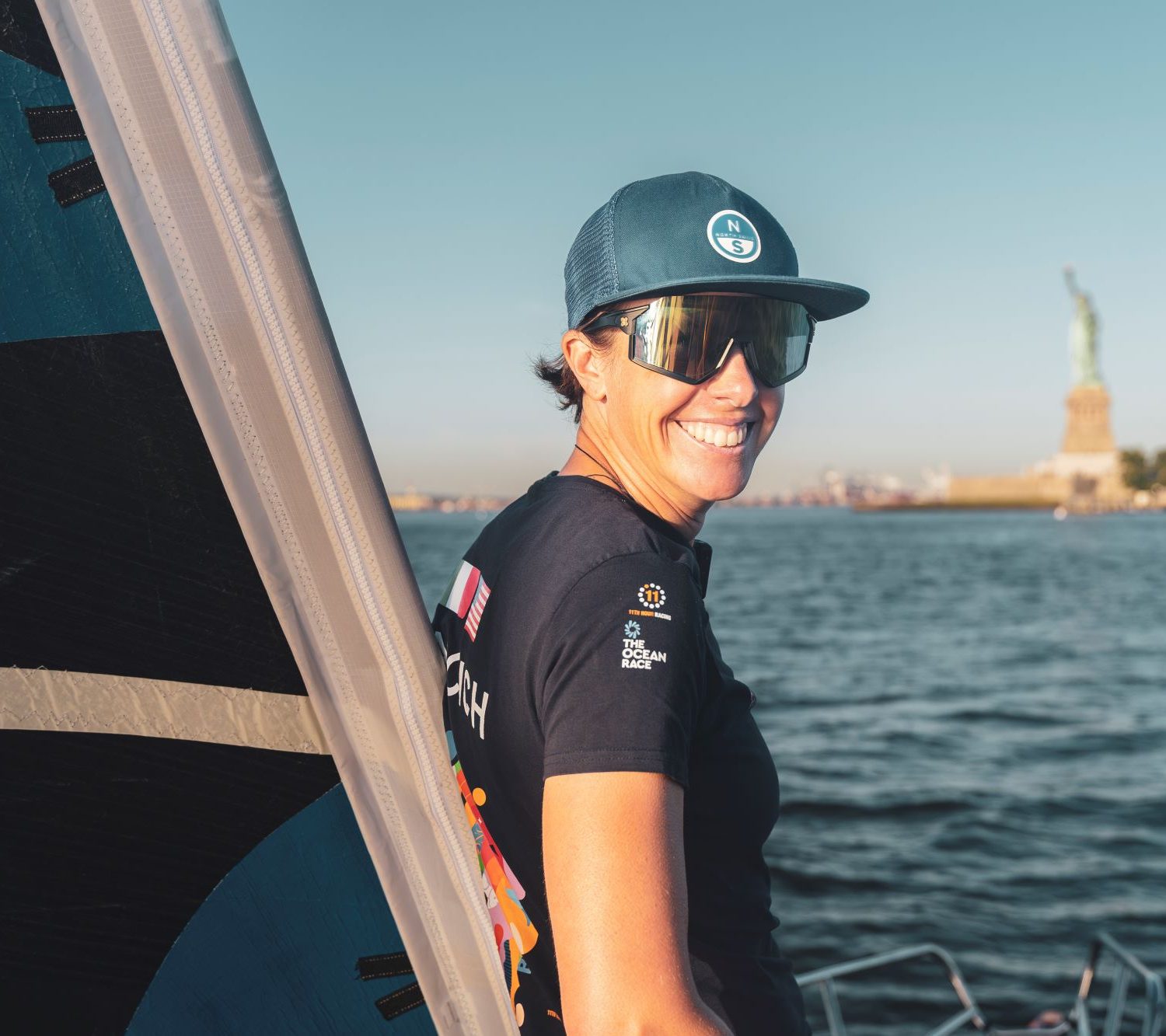
On September 1, Francesca Clapcich’s IMOCA left the Brooklyn Bridge Marina for Lorient, in Brittany: about 3,000 miles of Atlantic in the first edition of The Ocean Race Atlantic, the first point-to-point race in the fifty years of organization history. On board a mixed crew for regulation, two women and two men, plus a reporter on board, with the Italian co-skipper Alberto Bona, the Swiss Elodie-Jane Mettraux and the British Will Harris.
Triestina, 38 years old, American citizen, Clapcich is the only Italian to have won the world’s crew race, in 2023 with 11th Hour Racing. Two Olympics, London 2012 and Rio 2016, and in 2024 the Puig Women’s America’s Cup had arrived. Now the crossing is a step of preparation for the Vendée Globe 2028, the world tour in solitary, without call and without assistance. We met her in the dock in Brooklyn, a few days from the start.
After the Olympics, the victory at The Ocean Race and the Women’s America’s Cup, now face The Ocean Race Atlantic. What is this race in your route to the Vendée Globe 2028 and what difficulties do you expect?
This is the first edition of the Atlantic Ocean Race. The Ocean Race has a great history of regattas around the world, even around Europe, but it is the first time the organization set up a transatlantic: for me it is a great honor to be part of the first edition.
And then I live in the United States, now the States are home, while Lorient is our base with the boat. So it’s a crossing that starts from New York, comes to Lorient and connects our two worlds a bit. We will see how it goes: the conditions are beautiful hard, but we are ready.
Your career has become a symbol of determination and innovation in sailing. Looking at the path done so far, what goal has transformed you more as an athlete and as a person?
The regattas I lost, or those went worse, are the ones that taught me the most. From there I found the strength to improve, to try to build projects made better, preparations made better. All the experiences I’ve had so far taught me something.
Today is a great opportunity for me, but also a responsibility, to be head of a team: not only for the sailing part, for the whole managerial part. It’s something relatively new, I only do it for a couple of years.
In 2023 you won The Ocean Race in crew, with other people on board to divide shifts, decisions and repairs. The Vendée Globe 2028 is the world’s solo tour, without a stop and without assistance: two and a half months by boat alone. What are you looking for in solitary navigation and what in the crew?
The big difference is that in solitary you have to handle everything. The timings on board are the same, you never stop, the boat goes on twenty-four hours on twenty-four for days in a row, but the maneuvers you have to do on your own, the sailing changes you have to do on your own, and the shifts do not exist because there are only you. Even sleeping becomes a series of 20-minute riposini, here and there. It’s a harder life.
In crew we manage it better, because we divide the time on board in longer shifts, almost four hours, and for the maneuvers we are in four. I give you an example: a change of sail in a crew takes 20 minutes, alone almost an hour. The difference is great.
The sleep we leave him at home when I get back. Coffee not: the espresso machine on board is not bad.
In addition to the competition you are ambassador of the campaign Believe, Belong, Achieve, which promotes a more inclusive sport. How important is it for athletes to use their visibility to talk about inclusion, gender equality and sustainability?
Sport now has enormous social responsibility. There are studies that show how people listen much more to sportsmen and teams than politicians: the messages that pass through sports are strong messages, which come.
For me it was important to build a project where vision was not only to win the races, but to do something more. Believe Belong, Achieve was born from here: using sports to have a voice, through media and competitions, and sending messages on climate sustainability but above all on social sustainability.
Your crew is international and composed of women and men. Do you think this model represents the future of ocean sailing?
I think it’s fundamental in ocean sailing, but also in general. It goes in an office as on board: having more diversity, different backgrounds, brings more creativity. And in difficult times, when there are problems, you find yourself next to people who think differently and attack the question on another side. It is a way to perform better and to work with more serenity.
It is our goal as a team, but also of the races themselves: to finally push the sport to widen the doors, not only to a few characters, but to really increase the basin of those who enter us.
In this crossing you are flanked by co-skipper Alberto Bona. How did you build your trust report and how do you share responsibility on board?
Alberto has so much experience in solitary and double, experience that I do not have at the same level: I find in him a great support also in deciding which regattas to do and how to prepare them well.
We have known each other for several years, so among us there is a relationship of trust, a relationship of work but also of friendship. And for him it’s an important experience: finding himself co-skipper of an IMOCA project is not a matter of small, he’s taking it as a very serious opportunity. I think we’re gonna do a good job together.
Are the opportunities for men and women really the same in professional sailing? I’m asking about sponsors: an oceanic campaign stands on funding, and the feeling is that a woman is asked to show more things before someone decides to invest on her.
Unfortunately, yes, it is still a problem. These are millions of dollars projects, and finding partners and sponsors investing similar figures today is very difficult. For a woman it is even more.
The times are changing: we see many skippers with new boats and projects very structured around. Women are no longer only related to communication projects, but also to high-level programmes, with new boats and facilities. But we remain a minority. In a few days we leave for the Atlantic Ocean Race and are the only female skipper of the entire fleet. On the road there is still.
L’articolo The Ocean Race Atlantic, from New York starts the challenge of Francesca Clapcich proviene da IlNewyorkese.