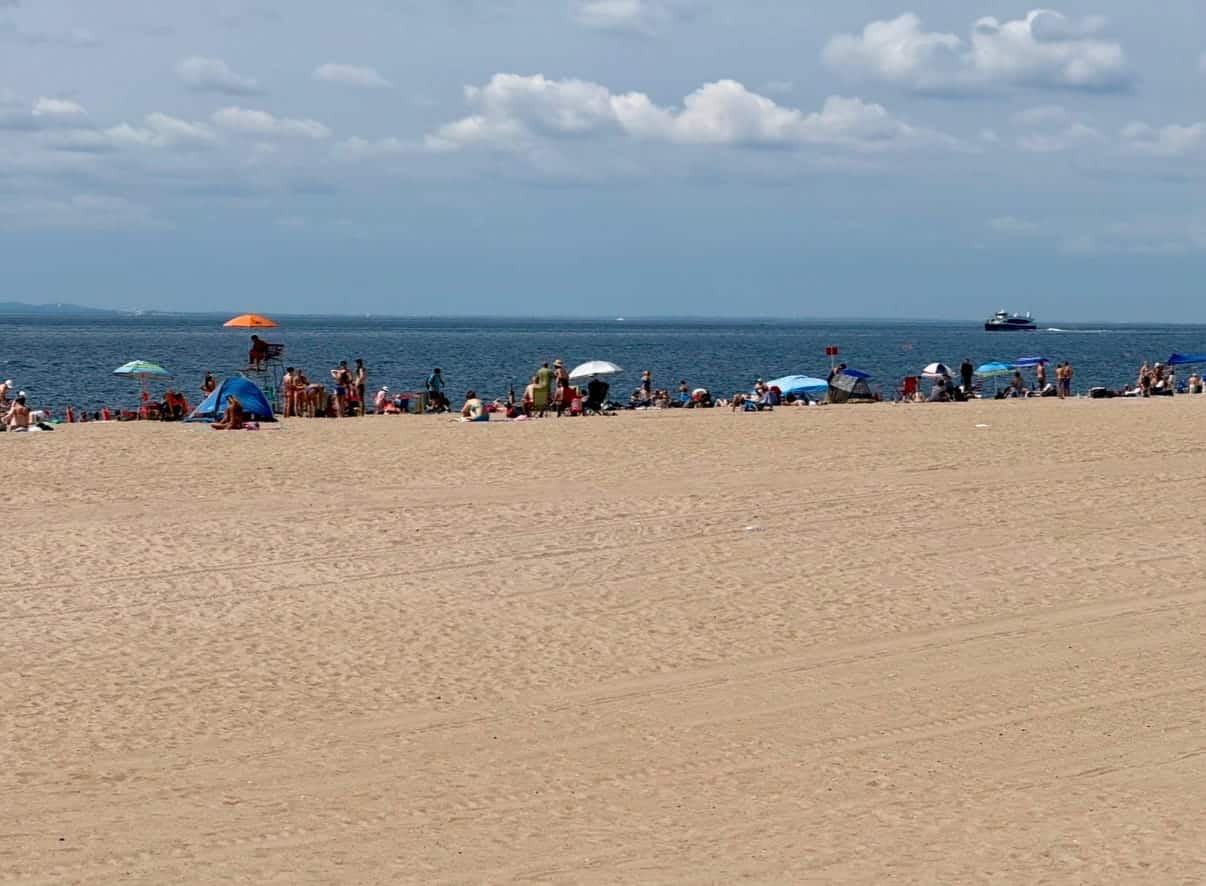
New York, August 2026. While I sit in front of the computer to tell a new stage of the World Tour in New York out there are thirty-eight degrees and a humidity rate I recently read has matched that of the Amazon Forest. Good, but not great! This New York summer is beating every record of afa, and walking through the streets of Manhattan means feeling the asphalt melt literally under your feet and wanting to find refrigeration in every splash corner of shadow. It is on days so that thought inevitably runs to the sea. Who is not dreaming of a stretch of golden sand and the cool of the breeze and the frost waves of the ocean?
Ok, in New York we can not boast Caribbean landscapes but having made our art of resilience as in a few other cities in the world, here we are ready to settle also of a somewhat imperfect sea. In fact, just take the Q line and let yourself be carried to the end of the line to discover that the sea, in reality, is at the reach of metro. I chose to spend a day in Brighton Beach, a Brooklyn flap overlooking the Atlantic and a stone’s throw from the most famous Coney Island, with the curiosity of discovering what is hidden behind its most famous nickname of Little Odessa.
We immediately do some geographical clarity, because the two beaches are often confused: Coney Island and Brighton Beach share the same long strip of sand and the same promenade, the Riegelmann Boardwalk, but are two separate neighborhoods, ideally separated to Ocean Parkway. Coney Island, in the west, is the realm of the lights of the carnival, Nathan’s hot dogs and historical roller coasters. Brighton Beach, just east, has a quieter and more residential soul, and is crossed by a single language that feels and reads everywhere, from shop signs to chatter on boardwalk benches: Russian.
This neighborhood was not born as a neighborhood of immigrants but until the middle of the nineteenth century it was part of the agricultural lands of Gravesend, an ancient British settlement in Brooklyn. Its name, in fact, is a tribute to the seaside town of Brighton in England but it is today only an echo that survives in the toponomastic of the neighborhood and that has little to do with its cultural soul. The first Jewish families settled here since the 1920s, but it was in the 1970s that Brighton Beach found the identity that still defines it. In 1974 the Jackson-Vanik Amendment read the trade relations between the United States and the Soviet Union to the freedom of migration of Soviet Jews, opening a door that seemed sealed for decades. From that door, between 1975 and 1980, almost forty thousand Soviet Jews passed, many of which originated in Odessa (which is the nickname for the neighborhood), as well as in Kiev, Moscow and Leningrad, attracted by the accessible rents of a district that was then declining, from the proximity to the sea and the network of synagogues and care agencies that helped them to root.
A second, broader wave followed the collapse of the Soviet Union in 1991, bringing often more educated and wealthy arrivals, which consolidated a collective identity more widely “russofona”, able to unite through the Hebrew, Russian, Ukrainian, Georgian and the many other nationalities of the former Soviet bloc. It is a linguistic heritage, more than ethnic, that which has always made it difficult to distinguish from outside the exact origin of people, but a distinction that the invasion of Ukraine by Russia in 2022 made it suddenly central.
Since then the distinction between who is Russian and Ukrainian, in Brighton Beach, has become more delicate but perhaps not for everyone in the same way. Swapping some chats in the neighborhood seems that among long-standing residents living together remains often natural, almost a “small utopia” as I was told on the occasion of the writing of this other article dedicated to Little Ukraine in Manhattan. Above all, the newcomers arrived in New York in recent years, to live the theme with more sensitivity, claiming a more clear Ukrainian identity. However, it remains very difficult to outline such complex dynamics and this is not our purpose here. Even today, however, in the eyes of those who arrive at Brighton beach for the first time what is perceived is a world shared more by language than by origin, religion or nationality. Just do the shopping in one of the many supermarkets in the neighborhood, including Ukrainian and Polish sweets, Georgian sausages and spices in Central Asia, to understand how today this identity is a mosaic far from monolithic.
I like to explore the neighborhoods starting from supermarkets that are often real open books on people’s lives: here we discover customs, ways of acting and attitudes of families as well as, of course, typical products and eating habits of a culture. Most of the business activities in the district spread along Brighton Beach Avenue, under the elevated metro tracks where you can still breathe the atmosphere of a true bazaar of Eastern Europe, especially during the weekend.
To do shopping as a real family in the neighborhood, we enter the NetCost Market (1029 Brighton Beach Avenue) a curious supermarket that today occupies the spaces of a cinema-theatre opened in 1934 and became in the 2000s the Millennium Theatre. The entrance still retains the original ticket office and velvet cords, while inside there are cold cuts, cheeses and pastries from all over Eastern Europe. Those looking for flavors of Central Asia can continue until the Tashkent Supermarket, opened in 2013 at the corner with Coney Island Avenue and grown up to become a small town chain: between smoky plov benches and Uzbeki sweets you can breathe again how much the neighborhood is faceted.
But surprises aren’t just at the supermarket! A must for shopping in Brighton Beach is definitely the St-Petersburg Books & Gifts, a library and souvenir shop that boasts one of the largest collections of Russian texts outside Russia, including matrioske, samovar and old Soviet posters. Not far away, small shops of the district keep jewelry, objects, body care products and medicines, strictly with Cyrillic writings. For a sweet break the small pastry shop Brioche Café, or Brighton Güllüoglu, are the most popular destinations where you can find authentic dishes. For a special occasion, why not book an entrance to Mermaid Spa? It is located in the nearby Sea Gate and is a historic banya with steam rooms, frozen pools and the possibility to indulge in a salt scrub of the Dead Sea!
For me this time the best way to close the day remains only one: to go back to the boardwalk, whose old crunchy axes are about to be remade thanks to a plan of a billion dollars just announced from the city, and to take place to a coffee table outdoors from Tatiana, that since 1990 welcomes its guests just in front of the ocean, between shows, live music and a plate of pelmeni to taste with the salty breeze in the face:?
Before leaving you, two tips for those who Little Odessa wants to know it outside these streets: the novel “Panic in a Suitcase” by Yelena Akhtiorskaya, born in Odessa and grown right here in Brighton Beach, which tells with irony and melancholy the story of a family of Ukrainian immigrants struggling with the new life in America; and the film “Little Odessa” (1994), the crime drama of James Gray’s same streets. Two different ways, but equally true, to continue the journey once you return home.
With this stage between the waves and stories of Little Odessa, our passport of the “World Day in New York” is enriched with a new stamp. Thank you for coming here and sharing with me this piece of Brooklyn overlooking the Atlantic: the next month you start, discovering a new corner of the world hidden in the streets of this city. Goodbye to the next adventure!
L’articolo Brighton Beach, where the Black Sea faces the Atlantic proviene da IlNewyorkese.