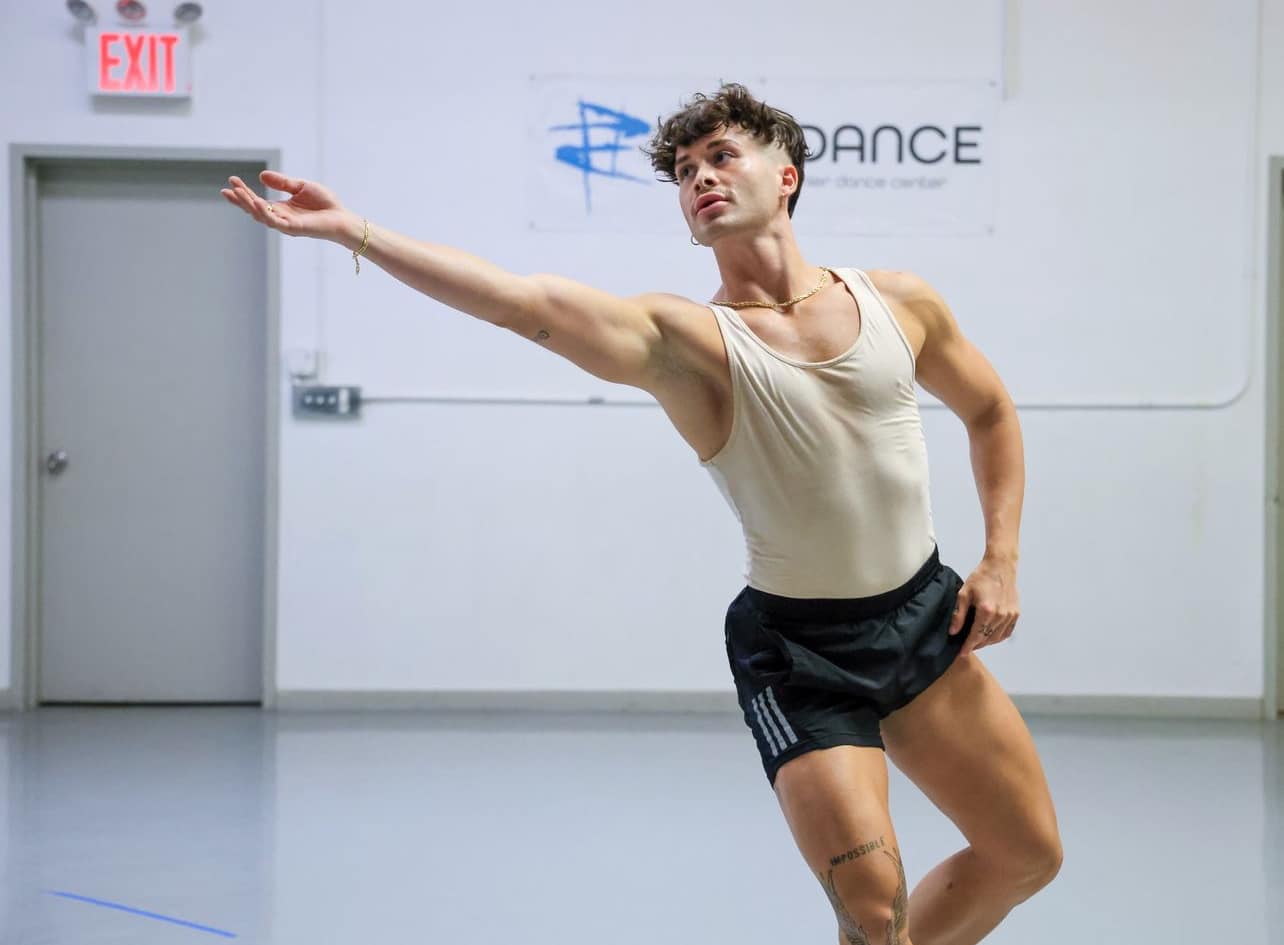
Mikael Pasini was born and raised in Castelvetrano, Sicily, and began studying dance when he was four. At fourteen years he moved alone to Rome to continue his training and, a few years later, a scholarship allowed him to reach the United States. Today he lives in New York, where he is the first dancer of the Peridance Contemporary Dance Company, founded and directed by Igal Perry. In this interview he tells the path that brought him from Sicily to the international stage, the difficulties of adapting to New York, the competition in the world of dance and his next dream: to inspire other young artists.
Mikael, we start from the beginning. When did you start studying dance and what path did you take from Sicily to Rome?
I started studying dance at the age of four. I followed a pre-professional study path until fourteen years, when I moved alone to Rome to deepen my training.
In Rome I had the opportunity to study with different teachers and artists of dance, many of which are renowned in Italy, such as Garrison Rochelle and Kledi. I also studied with some first dancers of the Teatro dell’Opera in Rome and the Teatro alla Scala in Milan.
My training was therefore quite varied. I started with classical dance, building solid foundations, and then began to explore contemporary dance and other sectors. First I tried to build a strong preparation, then I began to open myself to different languages.
After Rome you arrived in the United States thanks to a scholarship. How was this opportunity born?
When I was 18, I attended a workshop called World Dance Movement. We were so many dancers, more than a thousand, and the artistic director, Igal Perry, noticed me among the participants.
At the end of the workshop he asked me if I wanted to come to the United States to study and offered me a full scholarship. That was the first step to get here.
When I attended the workshop, I didn’t even know there could be such an opportunity. That’s why when I was proposed, I was pretty surprised. I had just finished school and graduated, so I was trying to stabilize in Italy and build my path.
I had already taken home, I had contacts with several teachers and artists and I had started working on some TV shows. I had participated in some episodes of Amici, I had worked at House Party with Laura Pausini and I had collaborated with Giuliano Peparini and Carla Fracci. At that moment I was somehow stabilizing in Italy.
Then this call came. I thought maybe it was the right time to change and live a different experience.
Accepting meant moving across the ocean. It was an act of courage.
I believe that everything happens for a reason and that everything can take you to a better place. When I got that call, I thought maybe it was a signal and I had to accept it.
At first I wasn’t completely convinced. Then, however, I told myself that maybe it was time to leave and I decided to do it. »
At 14, you’ve already moved to Rome alone. How important was your family’s support?
My parents always supported me. They always believed in my dream and gave me love and strength. But, of course, seeing a fourteen-year-old child leaving home in Sicily to go to Rome was difficult for them too.
Maybe it was the first time I saw my dad cry. I studied at the National Convitto Vittorio Emanuele II in Rome and, when he left me in front of the entrance of the convitto, there was a huge park before the exit. I remember seeing him turn around and I saw the first tears coming out of his eyes.
Leaving a fourteen-year-old child is a heavy thing. I, like all the children, at first thought it was good to be alone. Then, however, when I came back to my room and there were no mother, my father or my brothers to console me, it became difficult.
At the same time, their support and their love, even at a distance, were what prompted me to move forward and continue on this path.
Mikael’s parents: their support was decisive
A few years later, you left for New York. Was it even more difficult for your parents?
After the fact that I had already gone to fourteen years, when I told my parents that I would leave for America, for them it was a time when they realized that it was an even stronger and more concrete choice. The distance was greater and the decision seemed more definitive.
At the same time, they told me to stay calm, because they knew it was what I wanted. They told me that if they had to take a plane from Sicily to Rome or a plane from Sicily to New York, it would eventually not have changed much. It was always a plane.
They’re amazing people and they’ve always supported me. For an artist this is very important. Many singers, dancers and musicians find themselves having to explain to their family that what they want to undertake is not only a passion or hobby, but can become a job. I was lucky to have constant support.
When you arrived in New York, what was your first impact with the city?
The first month was difficult. When you have to start over from scratch, you are in a completely new situation. At the time I spoke English in a very school way and I could not express myself as I do today.
I had no friends, and I had already had an important separation when, at fourteen, I had left the family and all my friends. Finding myself back in a place where I didn’t know the language, I didn’t have a job and I didn’t have people nearby was strong enough.
It was like coming back when I first moved in, so it wasn’t easy. The first month I experienced it very difficult. Sometimes I wanted to go back because I didn’t understand anything and everything seemed complicated.
Even comparing the prices of the United States to the Italian ones, it seemed to me that everything was very expensive and I wondered how I would do it. Then, slowly, also thanks to my roommates, who were Italian, I managed to adapt myself. They made me feel at home.
In the end it was mainly a difficulty of the first month. Afterwards I became accustomed and the experience became beautiful.
How is the day of a dancer living and working in New York?
In the morning, after doing my stuff at home and having breakfast, I go out and go to dance. I usually do classical dance class at 10:00. Then the evidence begins with the company, from eleven and a half to two and a half.
When we are in season, sometimes we can also have tests in the afternoon. It depends on the choreographer we work with and the shows we have to prepare.
After the tests, I usually teach. I go to work with the children and the boys I work with and try to convey to them the passion and art of dance.
Every day I also go to the gym and try to keep the body as much as possible trained. I do saunas and massages and try to take care of me anyway.
Dance is a meeting point between sports and art: how hard is it to keep the physical ready for shows?
When you are on tour, you must always have a very high resistance. You can’t get half the show and think you can’t do it anymore.
Especially when you have important roles, as in my case, where I am the first dancer of the company, shows can be very challenging. Last month, when we went to Israel, I had an hour and a half shows during which I was on stage for an hour and eight minutes.
You might think that, with twenty minutes of pause, the show is simpler, but those twenty minutes are divided in very short intervals: two minutes, five minutes, and then you go back to the scene. From the moment you start to the end it is therefore very heavy.
You are now one of the first dancers of the Peridance Contemporary Dance Company.
Yes, the Peridance Contemporary Dance Company is a company based in Manhattan. Igal Perry is the artistic director and the founder and is the same person who gave me the opportunity to come to the United States.
When I got here, after just a week he put me in the company and I started working and training with the other dancers. I was taken and put immediately to work, without having much time to stop.
It was a very nice experience, because in company I learned a lot and I grew up a lot. Teaching was one of the most beautiful things, besides dancing and collaborating with different choreographers.
When you teach you feel rewarded with all the efforts you’ve done. Sending your passion to children and boys and seeing that what you’re doing comes to them is a very strong feeling.
Credits Ronen Rosenblatt
New York is an extremely competitive city. How much is the world of dance?
It’s a very competitive environment. During the season and in the different collaborations with choreographers we always face a sort of audition, because every artist or choreographer who comes to work with us chooses the dancers with whom he wants to collaborate.
Even if we’re a company made up of 20 boys, we’re still testing. We must demonstrate who is able to achieve a certain role or a certain part.
They may tell you that you are one of the company’s main dancers, but when a new person comes, it’s like I always have to put you back in the game and show you can stay at the highest level.
The choreographer who does not know you can look at you and think: I like this person, I want to work with her and I want to entrust her with this role. Even in front of the artistic director you must continually reaffirm your value and your abilities.
The artistic director knows what you can do and knows your path, but this system also serves to be correct and to avoid someone thinking that a person has only got a role because it is the favorite.
You come to a part because people see in you a level of excellence that others may not yet have reached. It’s a way to prove every time you deserve the role you’ve been entrusted to.
What is your American dream idea today?
I think I’ve already realized my American dream, which was to get from Sicily to New York. I started from a small country and managed to get here continuing to dream and believe in myself.
Sometimes I met people who told me that I would never be able to do certain things or get to certain places. For me to have come here and have realized what I always wanted was also a way to prove to those who never believed in me that I did it.
I realized my American dream coming to New York, dancing on big stage and at the same time getting in touch with different people: children, adults and artists. Poter transmitting something to others is a fundamental part of what I do.
For an artist and a dancer, this is already the American dream. It wasn’t easy, but I’m sure that that Sicilian baby, if today could look at the future, would be very proud of the path I made and the way I got here.
What were the greatest difficulties you had to overcome?
It wasn’t a simple road. It was a continuous struggle: I had to make room, run, fall and rise. If you really believe in yourself and your possibilities, however, you can do it.
If I look back and think about the route from Sicily to New York, I realize I would not have come here without overcoming many bureaucratic and economic obstacles. To come to the United States and live here you must have certain requirements and also the economic opportunity to face the transfer.
That’s why when I look back, I think I did it. I can say I’m proud of myself. I never said that before, but today I can say it.
I managed, through dance, to show that with love for art and passion you can transform a profession into a lifestyle and something that makes you really happy.
Today it is difficult to find something that makes us happy. We often feel empty and keep looking for something that gives us that feeling. But if you really cultivate a dream and you can live and work thanks to that dream, I think in life you have already found something very important.
What’s your next dream?
My next dream is already something I’m working on: inspire people and make known my passion, which is the art of dance, sharing my history with as many people as possible.
That’s what I’m doing with the children I teach and with the artists and actors I work with in the workshops during the summer. I want to convey to them the passion, the grin and the tenacity necessary to say: you have to do it, you have to keep pushing.
I would like to reach as many people as possible and make sure that they too can feel motivated to move forward, to continue to struggle and believe in their dreams.
In the world in which we live it is not always easy to believe in its own objectives. There are people trying to tarpare our wings and, when it happens, it is difficult to find strength and determination to continue.
That is why I want to share what I have learned and help others to believe that it is still possible to move forward.
L’articolo Mikael Pasini: “My American dream began in a small country in Sicily” comes from IlNewyorkese.