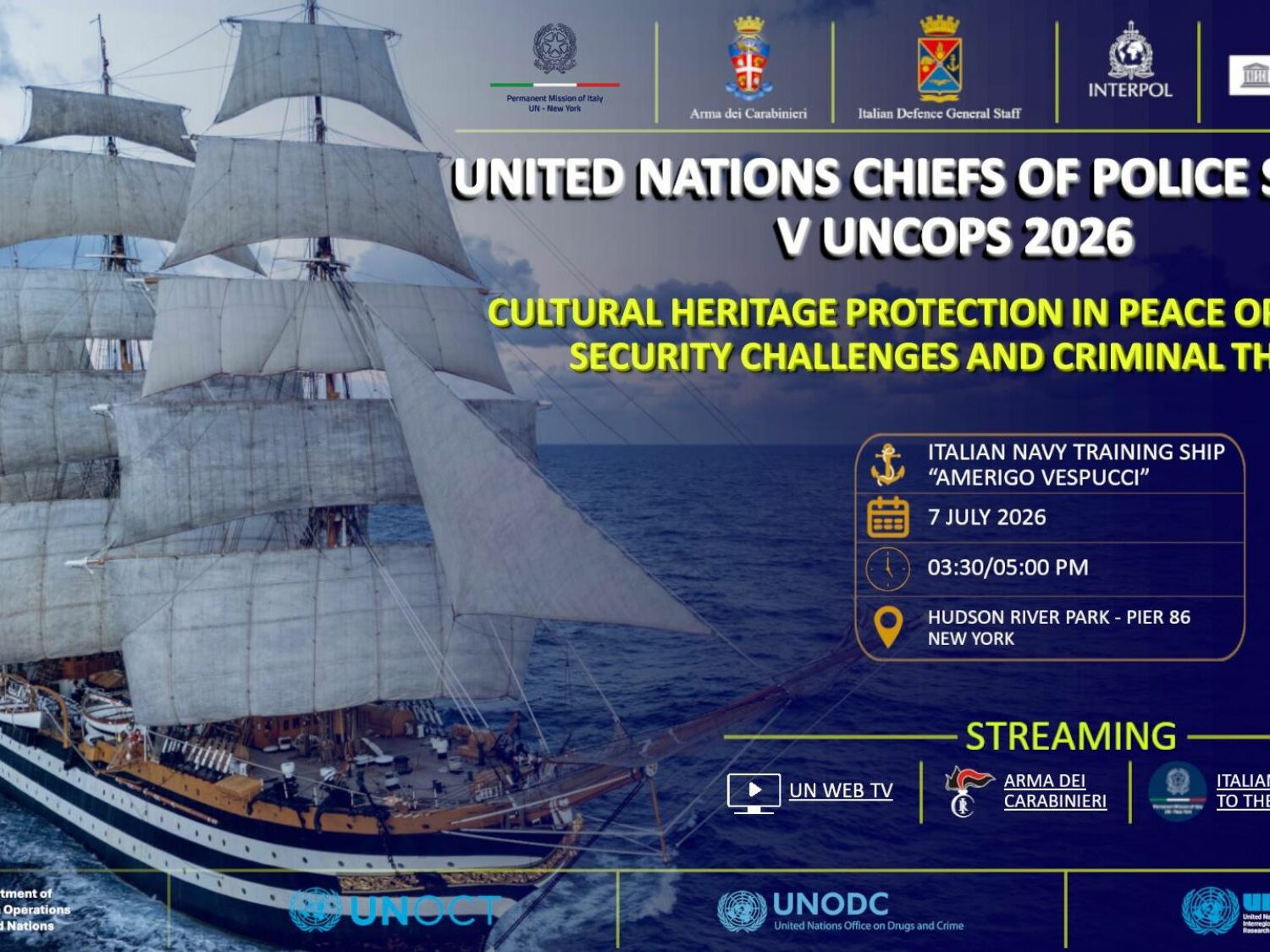
On July 7, the Amerigo Vespucci school ship docked in New York will host the Italian Permanent Mission to the UN for a meeting on the protection of cultural heritage in peacekeeping operations, organized in the margin of the fifth United Nations Chiefs of Police Summit, the summit that brings together police leaders, ministers and institutional representatives to discuss the role of police in UN missions. The program also includes UNESCO, INTERPOL, UNODC, UNOCT, UNICRI, the Department for Peace Operations and Carabinieri.
In war, armies, infrastructure and civilians are not affected. Religious places, archives, archaeological sites, libraries and monuments are often destroyed, often also to directly affect the memory of a community. When a armed group knocks down a mausoleum or plunders a museum is not only doing cultural damage: it can try to erase a story, intimidate a population or finance its activities by selling objects on the illegal market. In 2017 the UN Security Council unanimously adopted Resolution 2347 on the destruction and trafficking of cultural heritage by terrorist groups in armed conflict contexts.
The case that has changed a lot the way he talks about it is Mali. In 2012, during the jihadist occupation of Timbuktu, mausoleums and religious places enrolled in the UNESCO World Heritage Site were attacked. In 2016 the International Criminal Court condemned Ahmad Al Faqi Al Mahdi for the crime of war linked to the attack against ten historical and religious monuments: it was one of the first cases in which the destruction of the heritage was treated as an international criminal matter and not as simple collateral damage. The UN mission in Mali, MINUSMA, was the first major example of peacekeeping operation with explicit tasks related to the protection of cultural and historical sites.
The Vespucci will then insist on mandates, traceability, databases, police cooperation, staff training. It will also try to understand how to save a cultural site during a peacekeeping mission that does not have to do exclusively that, because the priorities are already so many and often lack resources, security and reliable information. It means knowing when a plunder is only a theft and when it is part of a precise criminal design; it also means having inventories and photographs before objects disappear; it means making soldiers, cops, customs, magistrates and cultural institutions speak without waiting for the crisis to be over.
Italy brings to this discussion a special experience, not only because it has 61 sites listed in the UNESCO World Heritage List, more than any other state, but because in 1969 it established the specialized department of Carabinieri for the protection of cultural heritage. The Italian data bank of illicitly subtracted cultural assets has over 7.2 million objects catalogued and more than 1.1 million images. And this tells how Italy has very developed tools, but also a huge problem to manage.
The international part passes mainly from INTERPOL. Its database on stolen works of art contains almost 57 thousand objects and is built on certified information provided by the competent authorities; the ID-Art app allows police, customs, collectors and market operators to verify more easily if a good is stolen. UNESCO is also working on a virtual museum of subtracted objects, designed to make visible what often disappears between property passes, borders and private collections.
You can follow the meeting through the appropriate streaming link.
L’articolo An international meeting on Vespucci to understand how to protect cultural heritage proviene da IlNewyorkese.