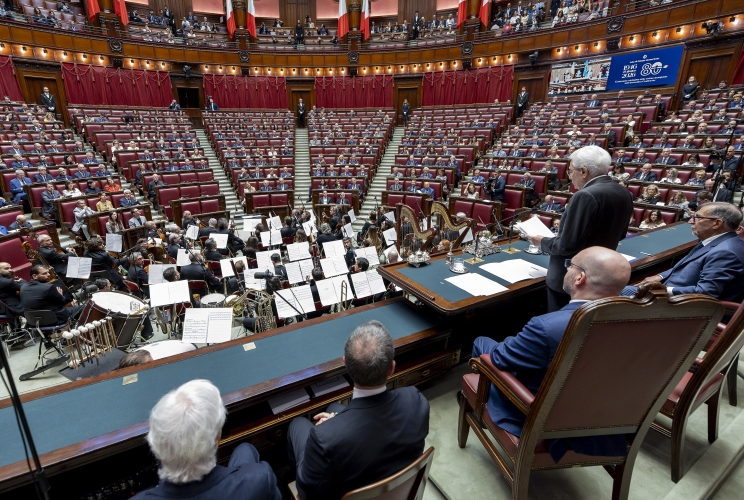
ROMA (ITALPRESS) – We make “honour for women and men who, in the Constituent Assembly, can form the freedom and democracy of the Italians, after the referendum that chose the Republic as a state order, and were able to guarantee its independence. The path, the progress that republican Italy has made in these decades is a reason for pride for the Italian people and, together, a witness of wisdom and foresight that the mothers and fathers of the Constitution are able to exercise in that turn of history.” Thus the president of the Republic, Sergio Mattarella, on the occasion of the solemn session of the Chamber and Senate for the 80 years of the opening of the works of the Constituent Assembly, in the presence of the President of the Chamber, Lorenzo Fontana; of the President of the Senate, Ignazio La Russo; of the President of the Council, Giorgia Meloni.
Upon his arrival the Head of State visited the exhibition “1946: the Republic was born, the Constituent Assembly in Montecitorio”, set up in the Sala della Lupa where the results of the June 2 referendum were proclaimed for the choice between Monarchy and Republic, immediately after his entry into the Hall of Montecitorio where Mattarella was welcomed by a long applause.
“It was not easy to see how the referendum and election of the Constituent Assembly took place on June 2, 1946. It was a high price that allowed the Italians to conquer the right to dictate the rules of their civil coexistence after the dictatorship and war – he recalled. The partisans paid it, the populations subjected to the Nazi vessations and the Republic of Salò, the soldiers left to the disembarkation and then participate in the effort to honour the Homeland with the Italian Liberation Corps and with the more than 600,000 military interned in Germany, with their refusal to serve the new invaders. It was paid by the Italians of Jewish origin who started in the extermination camps and those who in the Jewish Brigade and partisan formations participated in the Liberation of Italy and the construction of a new society that did not see the oppression of man on man. It was all that allowed the Constituent to be a sovereign assembly without the tribute of a division of the government of its territories by the Allied powers as it would be touched, instead, to other Axis countries, where this movement did not manifest. A ruling class not compromised with the fascist regime – a regime that had put the same unit of Italy at risk – was able to assume the responsibilities of the transition, waiting for the vote,” he added.
“Despite the ineptitude manifested by the monarchy, Italy was not the land of anyone. This is the merit of those women and men. Concordia and unity, this is the program of the new Republican Italy, summed up by the president of reconstruction, with an act of faith in the virtue of democracy”. Mattarella then recalled the “martyrs” of fascism, passage welcomed by the House standing and a long applause. “In the address of the settlement of the Consulta, on 25 September 1945, Carlo Sforza appealed to the memory of martyrs assassinated by fascism, Matteotti, Amendola, Don Minzoni, Gramsci, Carlo and Nello Rosselli, to conclude that Italy would have had a future identifying its interests with those of a peaceful and united Europe.”.
Then the drafting of the Constitution where social rights were affirmed. “The five hundred and thirty-five men and twenty-one women called to be part of the Assembly would be willing, working intensively for 18 months, to give back the invoked face to Italy and the result would be the Constitution that has ensured in the past decades stability to democratic institutions, to the international placement of Italy and promoted the progress of the Country. Legal country and real country, with the truly universal electoral suffrage, coincided for the first time in national history.”.
“Protagonist of the Constituent was the becoming of the form of democracy of the twentieth century, founded on the parties and the vision of the world of which each of them appeared as interpreter. It is, in this respect, even more appreciable the work of synthesis completed in the drafting of the Constitution, whose starting point was precisely in the ‘constituent’ meaning of the work. The eighty-year experience showed the relevance of that choice: social rights were affirmed. The crisis of civilization induced by the harmful dictatorships of the nineteenth century called for a clear stance: the option for a Constitution ‘personalist’, with the primacy of the person compared to the state. It would have been one of the characteristics proper to the Italian Constitution that of wanting to be also a card of values, to start a process for their implementation, with the rules defined programmatic”. Mattarella also highlighted how one of the critical interpretations of the work of the Constituent Assembly “was to present the effort of dialogue and synthesis, which marked it, as a compromise in the deteriorous sense of the term, whose outcome would be translated into fragile structures of the Republic.”.
“Nothing more, according to those critics, of a barter among the main protagonists, the Christian Democracy, the Socialist Party, the Communist Party, each of which would aim to safeguard visions if not own interests. On the contrary, he obeyed a basic principle which was, by the way, affirmed in the common sense of the citizens: the Republic is of all. Opening the work of the Constituent President Saragat urged: ‘May the face of the Republic be a human face’. The face and soul we have delivered – and that citizens feel their own – is that of the Constitution. Fruit of an assembly of women and free men. He lives the Republic, lives the Constitution”, concluded the head of the State.
-Photo press office Quirinale-
(ITALPRESS).