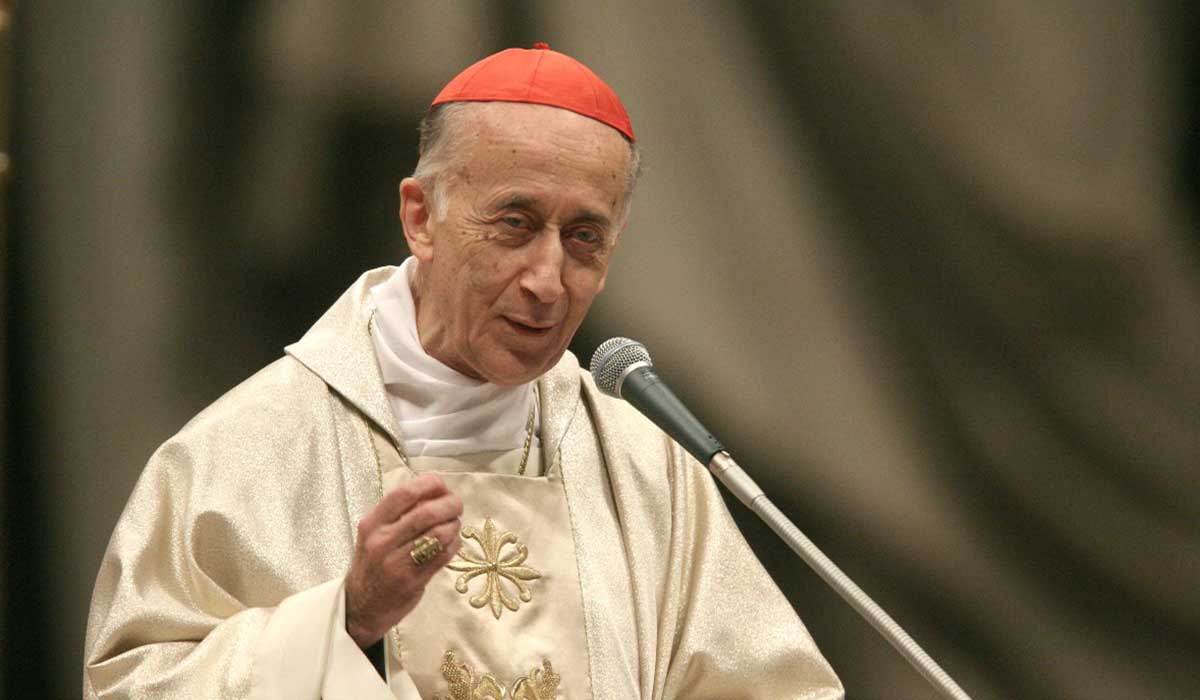
Cardinal Camillo Ruini died on 16 June in Rome, at 95. In the last few months his health conditions had worsened and he had long received assistance in his home. The announcement was given by the Diocese of Rome, of which Ruini had been vicar general for seventeen years. Exequies are scheduled on 18 June in the Basilica of St. Peter, chaired by Pope Leo XIV. For the Italian Church not only dies an elderly cardinal, but the man who for more than twenty years has given a precise form to the public presence of Catholics in Italy.
Ruini was born in Sassuolo, Modena province, in 1931. He studied philosophy and theology at the Pontifical Gregorian University, was ordained a priest in 1954 and for many years taught in seminars and theological institutes of Emilia. In 1983 he became auxiliary bishop of Reggio Emilia, in 1986 secretary general of the Italian Episcopal Conference. The turn came in 1991, when John Paul II appointed him president of the CEI, vicar general for the diocese of Rome and, a few months later, Cardinal. It was a very rare task concentration: Ruini led the Italian bishops and at the same time administered the diocese of the Pope.
To understand his weight, we must look at the years when he reached the summit of the CEI. In the early 1990s, the Christian Democracy, which for decades had been the main political reference of Italian Catholics, was eventually overwhelmed by Tangentopoli and the crisis of the First Republic. In that void Ruini chose a different line from that of the old collateralism with a party: the Church was no longer bound to support a political force, but to speak directly to society, governments and parliaments. It was an effective choice, but also very divisive, because it made CEI a more visible and more interventionist public subject than it had been in other seasons.
Its main instrument was the so-called Cultural Project, launched in the nineties. It was not a simple pastoral program, but an attempt to give Italian Catholics a common language after the end of their reference party. Ruini insisted that faith could not be confined to individual consciousness or parish life. He had to enter the debate on school, family, bioethics, education, relations between science and person. From here the formula of “non-negotiable values” was born, which in the following years would become one of the characteristic features of its way of understanding the relationship between the Church and politics.
The moment when this line showed its strength was the 2005 referendum on Law 40, which ruled medically assisted procreation. Ruini supported abstention, a legitimate but very controversial choice, because he wanted not to reach quorum instead of winning the merits of the questions. The quorum was not reached: it voted about a quarter of the rightholders. For his supporters it was proof that the Italian Church could still guide an important part of the country. For his critics it was the sign of a Church too within the political clash, able to block a popular consultation on issues that also concerned non-Catholic citizens.
With John Paul II Ruini he had a relationship of complete trust; with Benedict XVI, the harmony was even more evident, especially on the themes of relativism, reason and the presence of Christianity in public space. With Francis the relationship was more complicated, not so much for a personal break as for a change of accent: the pontificate of Bergoglio moved the center of the ecclesial speech towards the peripheries, social inclusion, mercy, leaving less room for the season of cultural battles conducted by CEI as a recognizable political subject.
L’articolo Cardinal Camillo Ruini died from IlNewyorkese.