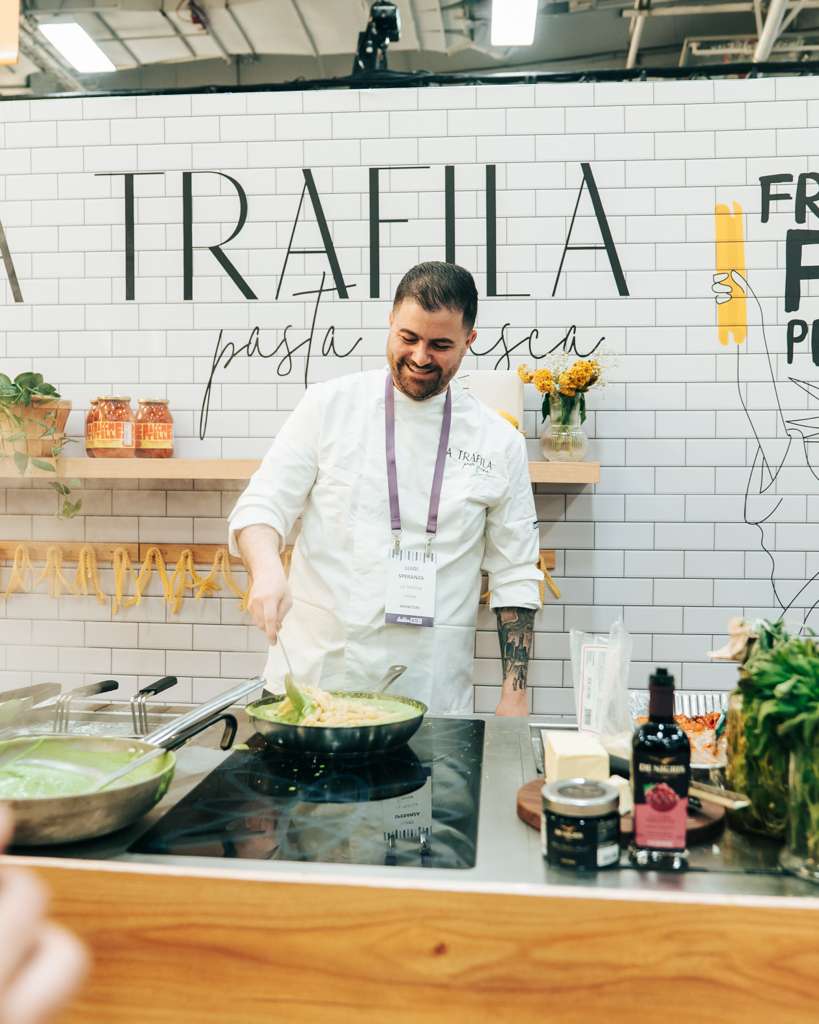
Founded in Brooklyn during the pandemic, the Trafila has become a reality recognized in the fresh pasta industry in the United States. Behind the project is Luigi Speranza, a Neapolitan chef and entrepreneur who arrived in New York in 2017 with the idea of playing in the most competitive city in the world.
Let’s start with an inevitable question: what is that dish that you would never get tired of eating, even if you prepare it every day?
Tomato spaghetti, no doubt. For me they represent: Italy, the Mediterranean, my origins. There is white pasta, red tomato and green basil. It looks like a simple dish, but that’s why it’s hard to do well: when you have few ingredients you can’t hide, they all have to be excellent. And then it is a dish that you can always eat, in summer as in winter. It’s a classic that never tires.
When did you realize the kitchen would be your way?
The truth is, I have always had this passion. My mother has transmitted it to me since I was a kid. I was born with curiosity about food: I asked questions about everything, I wanted to understand why things were done in a certain way. Sometimes I say that one of my greatest fortunes was born in Naples. The other was born with this passion. Some things you learn, others you bring them in from the beginning.
What is the first memory you associate with the kitchen?
Sunday morning. I was four or five years old and I woke up early to stay close to my mother while cooking. I asked her why the meatballs were made in a certain way, because they were round, so that they would be fried before they ended up in the sauce. To think about it today, it is curious: instead of asking why the ball was round, I was questioning myself on the meatballs. Perhaps it was already a fairly clear signal of what would be my future.
Before you became an entrepreneur in New York you worked between Italy, Europe and the United States. What do you remember about that time?
When I arrived in New York in 2017, the Trafila still did not exist. I worked as a corporate chef for a company that managed a format dedicated to fresh pasta. It was a very important phase because it allowed me to know the American market from within. I continued until early 2020. Then, a month before the pandemic, I decided to stop that professional path. Shortly afterwards, the Trafila was born.
With what dream, or with what idea, did you leave for New York in 2017?
With the desire to put me in the game. New York is a city that forces you to continuously measure yourself. He doesn’t give you any breaks and doesn’t let you sleep. I have come with my experiences, my training and the belief that work and determination, in the long run, make a difference.
How hard is it to build a career in a city like New York?
It serves determination, but above all humility. It’s a city that never feels like it. Actually, as soon as you think you are, New York changes the rules of the game. I see it like this: you are not the one who imposes your conditions on the city, it is the city that imposes them on you. You must have the energy and the ability to adapt continuously. It is a constant challenge, but it is also what makes it unique.
What was the intuition that led to the birth of the Trafila?
It was born of a combination of necessity and vision. During the pandemic many restaurants closed or worked with enormous difficulties. There was a strong economic and professional pressure, and at the same time the need to move forward. I decided to put into play everything I had learned over the years and to bet on fresh pasta. Not because fresh pasta did not exist already, but because I thought it lacked a different approach: great attention to ingredients, respect of tradition and a very wide range of products.
Why did you decide to focus on fresh pasta?
Because it is a product that offers almost endless possibilities. We do not only make a classic cutter: we produce dozens of variants, from spinach to sepia black, to smoked processing. I like to make a comparison with a painter. If you give him one color, it can do little. If you give it twenty colors, it can create a much richer work of art. We wanted to offer chefs that freedom of expression.
La Trafila was born during the pandemic. How much did that period affect the project?
He’s engraved a lot. Pandemic was a tragedy that changed the world, bringing with it huge pain and consequences. But it has also profoundly changed the dynamics of catering. Many locals, while reopening, worked with strong limitations. They needed products to speed up service without sacrificing quality. Fresh pasta responded perfectly to this requirement. In that context many customers have discovered the potential of a product that until then considered more limited. We were ready to intercept that change.
Was there a particularly difficult time to deal with?
Actually, difficult times never end. They change shape, but there are always. At first I tended to blame myself for every problem. With time I realized that obstacles are part of the path. Today I try to consider them lessons. Every problem already contains a solution. The point is to find it. When you find her, you stepped forward. That’s how we grew up these years.
What are today the biggest challenges for a craft manufacturer?
The most important is to maintain the same quality over time. When you grow up, the risk is to lose that craft dimension that made you recognizable. We want to avoid that. We want the customer who chose us six years ago to find the same attention and the same care today. Then there is another huge challenge: building a team and keeping it motivated. Finding valid people is difficult, but making them stay and grow up with you is even more.
Looking at the future. How do you picture the Trafila in five years?
Today it is difficult to make plans too long. The world changes quickly and must be flexible. What I can say is that we want to continue to grow in the United States. Today we reach about 15% of the American States and demand continues to increase. A novelty we are working on is the extension of the laboratory, with the aim of increasing the production capacity by 50%. It is an important investment that will allow us to prepare for the next stage of our growth.
Is there a goal you haven’t reached yet and would you like to accomplish in the coming years?
More than a single goal, my goal is to continue expanding the project without losing our identity. I want a restaurant in California to receive our pasta with the same quality as one located a few kilometres from the New York lab. This is the challenge that motivates me every day.
If I had to sum up your business history in one sentence what would it be?
Always believe it, never quit. It may seem like a simple phrase, but it is really the summary of everything. Problems inevitably come. Even today. The difference is how you deal with them. I learned that every obstacle is an opportunity to improve the company and improve themselves. For this I keep repeating the same thing for years: never give up. Never stop believing in what you do.
The article Luigi Speranza has only one recipe: “Never give up” comes from IlNewyorkese.