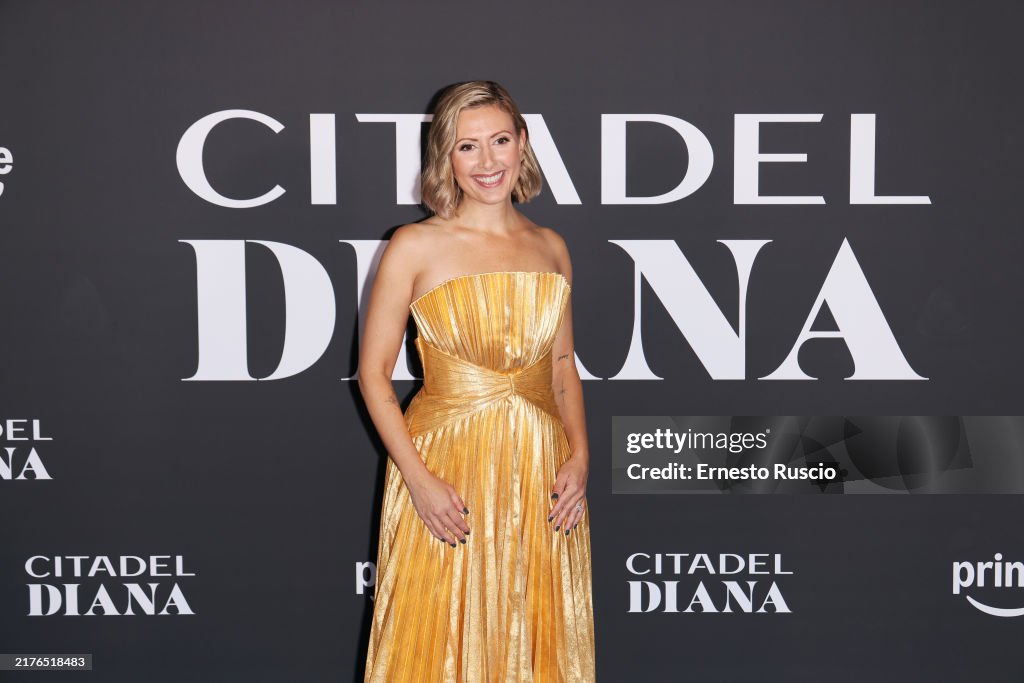
Angela Russo is Chief Creative Officer of AGBO, the global production company founded by Anthony and Joe Russo. With a background as an actress, screenwriter and producer, it plays a key role in the development of projects that combine great show and strong creative vision, making it a bridge between Hollywood and an increasingly global entertainment landscape.
How’s Hollywood doing today? In recent years we have witnessed great transformations: from artificial intelligence to the rise of streaming, to productions that move out of Los Angeles. What time is industry really living?
I think industry is going through a phase of evolution. In some respects it may be destabilizing, but I prefer to focus on positive elements. There is a real opportunity to use technology as a tool led by artists. Today we have more chances than ever to tell, share and live stories. In addition, the sector is becoming increasingly global in terms of inclusion and representation, and I consider this a very positive change.
Are cinemas really at risk or are we entering a new phase of coexistence with streaming?
I think we have now fully entered a coexistence phase. That said, the experience of the cinema is something unique and must continue to exist. I hope industry continues to invest in films capable of bringing the audience back to the cinema, to live together a collective and shared experience.
Speaking of artificial intelligence, do you consider it a threat or a creative tool?
I think it can be used as a tool, or rather as a series of tools, able to broaden creative horizons and foster new forms of experimentation. What worries me is the idea that these technologies are developed by companies without the involvement of artists who will then have to use them.
From a productive point of view, is Hollywood losing its central role?
More than losing centrality, it is evolving towards a more global dimension. For a certain period some destinations in the United States have become more competitive thanks to tax incentives, attracting many productions. More recently, international hubs such as the UK and Australia have grown a lot, offering both incentives and solid infrastructure.
As a company with a global vision, in the last year we have turned on five continents, including the United States. This allows us to truly represent the different worlds of our stories, which want to reflect people and cultures from all over the planet.
She grew up in Cleveland in a family of Italian origins. How much has this dual cultural heritage influenced its creative identity?
Deeply. My love for narration comes from the stories my family told me as a child. Telling stories was our way of communicating: at the table, during the holidays, in the church. I also attach great value to collaboration. This sense of belonging to a collective comes from the way our family worked and I think it is deeply rooted in Italian and Italian-American culture.
How do you still feel Italian today?
I recognize myself in passion, in expressing both heart and mind. At the same time I always try to be fair and right. For me these are very Italian qualities.
Films like “Cabrini” tell the true story of the first Italians arrived in the United States. Do you think it is necessary to change the narrative of Italianity in America?
Absolutely. I am very proud to be Italian-American, but I think there is still work to do to overcome some stereotypes that persist over time. I often think of the path of Italian-American women, which is why I appreciate a lot of movies like Cabrini. That path has evolved enormously, especially with regard to the role of women. Today I am proud to be a working mother and a woman who contributes to the economic support of the family, with the opportunity to convey my values not only in the home, but also through my work.
He launched initiatives as a scholarship for young Italian artists. How important is it to build bridges between Italy and the United States?
It is essential to keep this connection alive. In addition to this, I believe that sharing our collective experiences, both within the Italian communities and outside, can have a great value. Our experiences can have a universal resonance even for those who did not live them directly. And I think that the new generations are particularly prepared to tell these stories in a current and meaningful way.
The finalists of the scholarship were just announced. What struck you most?
This year’s candidates were extraordinary. We have received twice as many applications as last year and the quality has not decreased, indeed. The general level was very high. The selected finalists each bring an original, fresh and very personal vision. They are extremely talented filmmakers and represent a great variety of stories, tones and themes.
Before becoming a producer and screenwriter he studied theater and acting. How much has this route affected?
Very much. It allows me to get out of my perspective and trust the people I work with. I really love collaborative environments, and that’s something I learned from the theatre. I also try to practice empathy at work and creative processes. I think a lot about the motivations and perspectives of others, and this helps me to support them and put them in the best conditions to express themselves.
Is there a memory of the beginnings in the cinema that still brings with it?
Yes, a lot. They’re still very alive memories. Sometimes I consider them sweet, sometimes a little bit misunderstanding, especially when I think about how far we’ve been going since.
How do you reconcile creative vision with the needs of industry?
For me it means being a reliable partner from a creative, financial and strategic point of view. It is important to create conditions for each project to succeed and generate an impact, both economic and emotional. At the same time I try to respect the artistic vision, entrusting myself to the collaboration to find the best ideas and my instinct when it is time to make decisions.
“Cherry”, who co-wrote, represents a more intimate dimension than blockbuster. How important was that?
Cherry was a very personal project. In the adaptation I have attracted sensory experiences, humor and even pain related to our growth in Cleveland. It was a very different and more intimate approach to the big action films.
Today cinema is increasingly global and serialized. How do you see this evolution?
With the global distribution of films and series there is the opportunity, but also the desire, to continue the stories and deepen the emotional bond with the public through serialization. It is also essential to invite as many voices to the creative table. This is what makes stories richer and more relevant internationally. Globally, we focus on stories that have a strong local authenticity but are able to dialogue with an international audience. Projects like Citadel, developed between the United States, Italy and India, are an excellent example.
He works closely with Anthony and Joe Russo. How does family collaboration become a global business?
It is interesting: paradoxically, the more we become global, the more we are scattered in the world and the less we see ourselves in person. Coordinating work between different time zones means that someone always has a meeting at dawn or late night. But that spirit of collaboration remains the heart of everything we do.
What makes your approach unique?
We work as a collective. More manufacturers collaborate on the same project, and this requires a very strong communication, but allows each one to contribute with their own strengths. There are no ponds in AGBO. We gather artists, executives, engineers and creatives of all kinds around a common vision. This collective approach leads to better results.
Looking at the future, what are the most urgent stories to tell?
I think today the most important stories are those of the new generations. From there comes inspiration, and those are the voices we must listen.
L’articolo Angela Russo, AGBO and Italian stories in international cinema proviene da IlNewyorkese.