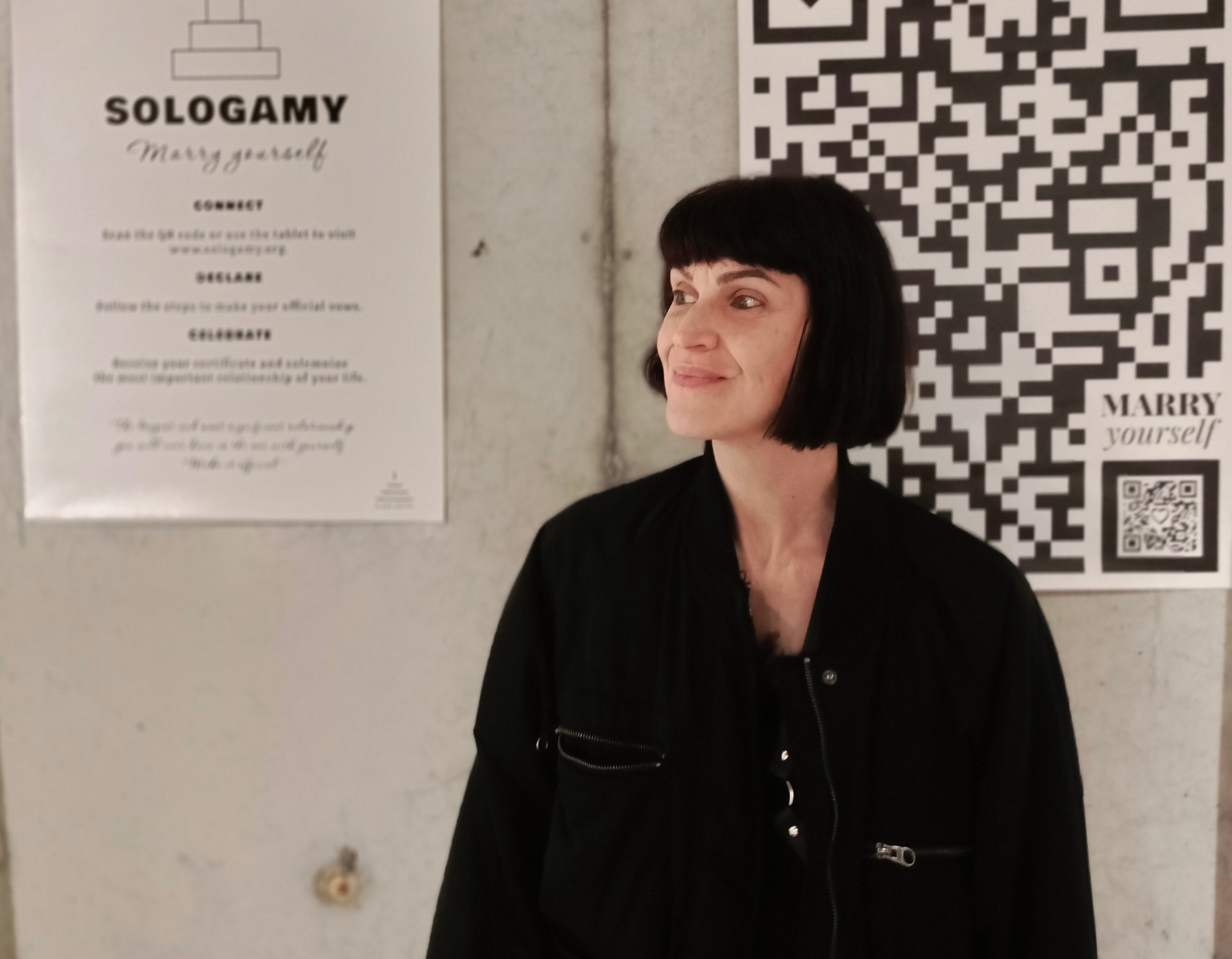
Elena Ketra is in New York with two projects that hold art, body and political language together. On the one hand there is Luchadoras, presented in the collective Rebel in Brooklyn, where the imagination of the Mexican libre lucha becomes a way to talk about self-defense, gender violence and emancipation. On the other hand there is Sologamy, the work on marriage with themselves that in Italy has lit a wider public debate, until the entry of the term “sologamia” among the Neologismi Treccani.
A multidisciplinary artist formed at the Academy of Fine Arts in Venice, Ketra has been working for years on female empowerment, inclusion and self-determination, often using pop objects, symbols and images seemingly reading to address more difficult themes. Its residence at the ICP, the International Studio & Curatorial Program, now allows you to measure this research with the artistic environment of New York.
A New York is bringing two strong lines of his work: on one side Luchadoras, on the other Sologamy. How is the American context changing the way it looks at these projects?
New York has an amplified, almost ruthless energy, a kind of magnifying lens on social contrasts. Bringing Luchadoras and Sologamy here is allowing me to see them in a completely new, accelerated light. With Luchadoras, born as a manifesto of strength, emancipation and self-defense against gender violence, the American context offers a truly fertile but also complex soil. Here the debate on rights and identities is very, deeply rooted in the social fabric. In New York the “fight” is not only conceptual, it is daily. This pushes me to radicalize even more the message: the mask of luchadora does not serve to claim its right to ransom, turning into a manifesto of struggle and emancipation more than ever. With Sologamy, the project on marriage with oneself, through the Sologamy platform. org, the impact here is almost paradoxical. On the one hand, this is the home of exasperated individualism, of self-made man, of “basting themselves”. On the other hand, there is a great social pressure linked to relational success and traditional patterns. This metropolis is showing me how the concept of love is today an act of emotional survival, but also a social performance.
In the project Luchadoras the struggle becomes an image of self-defense, but also a collective language. When does a work stop being just representation and become a practical tool of awareness?
It stops being only representation at the exact moment when it comes out of passive contemplation and requires physical, bodily action. For too long the narrative about gender violence has confined women to the role of victims. With Luchadoras, the mask and the ring are not metaphors or shows, but tools to live. The work becomes practical when women activate their own agency, reappropriate their strength and transform self-defense from private fact to collective language. At that time, art stops documenting the real and starts providing the tools to change it.
Sologamy has often been told by the media as a provocation. How much do you really care about provocation, and how slower work to move the way we talk about relationships, autonomy and desire?
I don’t work to provoke, but to move thoughts. It is my intention that, in reflexion, generates what the media call provocation: the work shakes because it invites to a shift of the points of view, a radical change of certainties. What I care about is that underground and long-term work. With Sologamy my intent is to give access to a new emotional grammar, revealing different possibilities of dealing with themselves. Marriage with oneself is a performative act that serves to overturn the social pyramid of values: it moves the focus from external approval to self-determination. The real goal is to discard the idea that a person is “incomplete” without a partner and transform love from an abstract concept to a political position. It is not an hymn to isolation, but the necessary basis for any future relationship, free from need and founded on desire.
In his works he often uses pop objects, immediate symbols, almost playful images, but to talk about gender violence, self-determination and stereotypes. Is it a way to make difficult issues more accessible or to disconnect public defenses?
Both things, but the ludicrous dimension and irony are never an end, but a method. I use the imaginary pop and immediate symbols to ignite a short visual and emotional circuit: a familiar and seemingly light image attracts the gaze without frightening, allowing you to approach complex or painful themes without academic or moral filters. This approach serves to override the resistances and prejudices of those who look. Faced with violence or gender stereotypes, spontaneous reaction is often detachment or self-protection. The game, instead, lowers the walls, enjoys and a moment later invites to a shift of the gaze. I don’t use these codes to evade reality, but to give access to a new awareness. Once that initial barrier is overcome, the viewer finds himself immersed in a deep and serious reflection.
After the public debate born around Sologamy and the recognition of the word “sologamia” as Treccani neologism, did you feel that the project has partly escaped her by hand, becoming something greater than the initial work?
I have never experienced this expansion as a loss of control, but as the natural fulfillment of the work itself. When art comes out of the elite space of the gallery and is rooted in everyday language, it means that it has intercepted a real collective need. Precisely for this reason, I felt the need to write an essay, “The art of marrying if stessə” (exibart editions): I wanted to map the whole process, analyzing the social phenomenon and recounting my artistic path from the inside, to be able to finally explain it without filters or media distortions. The entry of the term “sologamia” in Treccani is not a bureaucratic detail, it is the photograph of a real change within contemporary society, certifies that a social and cultural necessity has found its name. When an idea comes to life through the stories and choices of people, it stops being the private vision of an artist and becomes a space of shared freedom.
New York is a city where many forms of activism are already codified, recognizable, sometimes even institutionalized. Coming here as an Italian artist, did you feel more freedom or more pressure to confront these languages?
I felt above all a great freedom to radicalize my message. When the codes of activism are already so deceased, the approach is immediate. You are not in that unpleasant dynamic in which they try to push you to give a justification for your work or battles. Pressure concerns the challenge of not getting absorbed by the system. The risk of such institutionalized and codified activism is that it becomes a reassuring formula. Getting here with an external look allows me not to take anything for granted and use the languages of this city to open further spaces of freedom, keeping intact the political and independent nature of my research.
L’articolo Elena Ketra, between sologamy and female struggle in New York proviene da IlNewyorkese.