To inaugurate the Condé M. Nast Galleries, next to the Great Hall of Met, the new Costume Art Exhibition of the Costume Institute of the Metropolitan Museum of Art in New York, curated by Andrew Bolton whose central theme is the “body dressed” as an art form.
Fashion is subtracted to the purely aesthetic dimension to enter a more complex territory, where art, body and society merge. The exhibition path proceeds in fact for visual and conceptual associations: each creation dialogues with paintings, sculptures, photos or ancient finds, building a reflection on the way the body was represented, idealized, disciplined or liberated throughout history.
Bolton summarizes the profound meaning of the entire curatorial project in a clear statement: “The history of art cannot be told without the history of the dress and the history of the dress is the history of the human body”.
The exhibition thus turns into an atlas of possible bodies. The anatomical body of classicism meets the contemporary one; the gravid body lives with the naked, tattooed or aged body. Dresses become instruments through which to read not only the evolution of taste, but also the cultural and social changes that have crossed the representation of the self.
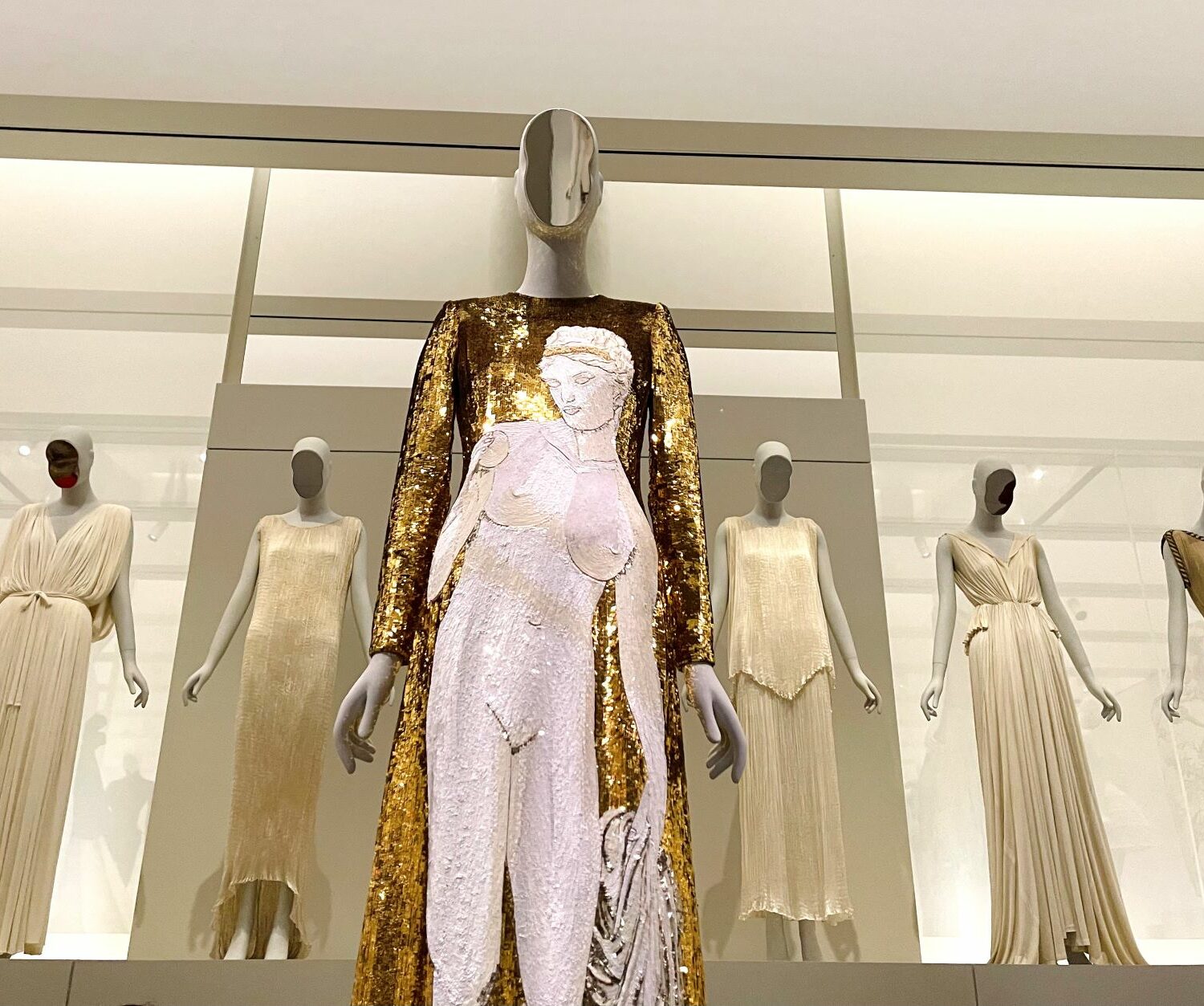
The first hymn is the Classical Body, rooted in the Greek-Roman heritage. Here the body is harmony, proportion, moral ideal translated into aesthetic form. This vision does not disappear, but continues to subdue the contemporary standards of beauty, affecting the formal language of fashion. In this section, the 5th century Nike terracotta statuette, with its dynamic tension and the ideal of physical perfection of antiquity, finds a reflection in the Delphos of Mariano Fortuny, made together with Adèle Henriette Elisabeth Nigrin. The smooth folds of the dress seem to transform the classic marble into fabric, evoking the Greek statue but reinterpreting it through a new idea of freedom of the female body. Delphos does not force the body, follows it, accompanies it, enhances its natural movement.
Also in the nineteenth century sculpture The Veiled Woman by Rafaello Monti, marble seems to be transformed into a veil, making the body visible at the moment when it conceals it. This tension between revelation and idealization finds a resonance in the dress of John Galliano for Maison Margiela, in which the sartorial construction assumes an almost sculptural quality: the body is modeled as plastic material, suspended between presence and abstraction, in a direct dialogue with the logic of the “velato” that also passes through the work of Monti. Dress and statue are not limited to resembling each other, but share a same idea of body: something that is revealed through what hides it.
Next to this ideal the Abstract Body develops, in which fashion moves away from anatomical veracity to transform the body into architecture. Corsets, crinolines, busts and rigid structures do not imitate the body, but redesign it according to artificial logic. This distance between the biological body and the body is not only aesthetic, it is a cultural tension that goes through centuries of representation and which makes evident how the body is always mediated by social and symbolic devices.
And this is where sociological thought becomes a key to reading. For Georg Simmel, fashion arises from the tension between imitation and distinction: the body dressed is simultaneously part of a social system and individual affirmation. The abstraction of the silhouette is not only aesthetic artifice, but also language of belonging and differentiation.
Similarly, Pierre Bourdieu reads these transformations as an expression of the habitat: the body is the place where social structures settle, and fashion becomes a tool through which these structures become visible, natural, almost inevitable. Even the most extreme or artificial forms are never neutral.
The decisive passage of the exhibition is that of the Reclaimed Body, where the body is no longer idealized or abstract, but recognized in its concrete plurality. The gravid body, the unconformed body, the vulnerable or disable body become central, through custom-made mannequins and shaped on real individuals. It is the case of Georgina Godley’s Pregnancy Dress that enters into dialogue with Harry Callahan’s Eleanor work. The gravid body, historically hidden or neutralized by fashion, becomes central presence and visible form.
The diversity of bodies is seen as a fundamental part of our common human condition: a condition that shows it not through differences, but through what all bodies have in common.
In Foucaultian terms, we could say that the body is no longer only governed by aesthetic norms, but it also becomes room for resistance and rewriting. Michel Foucault helps to read this passage as a transformation in the systems of visibility: what was excluded from the normative discourse finally enters the field of the visible.
Bolton then builds a narrative in which fashion does not simply illustrate art, but interprets it and extends it to the human body. Each dress seems to be born from an artistic image and, at the same time, return it to life through movement, matter and physical presence.
In this link between couture, photography, sculpture and sociology, the Costume Institute reveals the deepest nature of fashion, which is not limited to dressing the body. He interprets it, deforms it, disciplines it and finally returns it in its complexity; a cultural language through which society builds and tells the body. A body that changes over time, which reflects collective values, which absorbs norms and desires, but which through the dress also continues to reinvent itself continuously.
L’articolo “Corpo dress” on show at MET, where art and fashion meet proviene da IlNewyorkese.