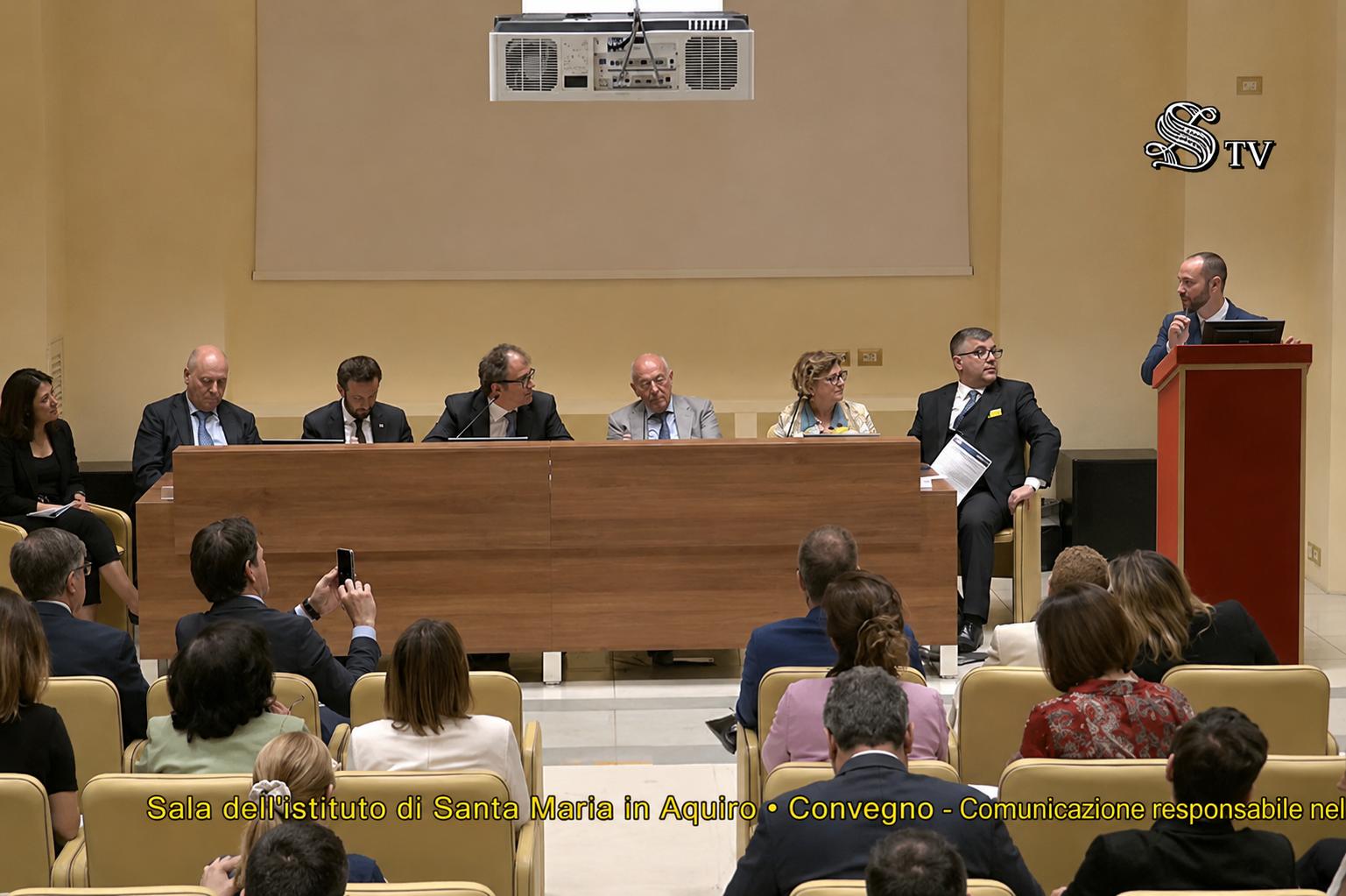
ROMA (ITALPRESS) – A Manifesto for responsible communication in and for health. He presented it yesterday, 27 May, at the Sala dell’Istituto di Santa Maria in Aquiro del Senato della Repubblica, the FERPI Life Sciences Group – Federation of Italian Public Relations, during the meeting “Communication responsible for health and health”, promoted at the initiative of Senator Daniela Sbrollini and realized in collaboration with the same FERPI.
The Manifesto “The role of communication for an ecosystem of ethical and responsible health” was drafted by the Life Sciences Group, born in FERPI in 2024, which brings together communication professionals from companies, institutions, universities, public and private health, scientific companies, agencies and third sector, and promotes ethical, responsible and transparent communication in the health and biomedical field, affirming itself as a reference point for those who work in the complexity of the health system.
Present in Rome the President of the Federation, Filippo Nani, who thanked Senator Sbrollini for promoting the meeting and in an institutional center, launching an important signal, because talking about communication of health means talking about public responsibility, trust, quality of information and, ultimately, protection of people. And the communicators take care of people.
“I am particularly proud – he said – of the work done by our Life Sciences Group. A serious work, competent, passionate, which arises from listening and comparison with different worlds. The Manifesto arrives at a time when communication can no longer be considered a simple activity of transmission of information, but rather contributes to creating culture, orienting perceptions, building trust. And even more when we talk about health, where each word can affect the way a person understands his own path of care, relates to the doctor, addresses a diagnosis or evaluates a therapeutic choice FERPI, as an intermediate organization, feels a particular responsibility: to be a space in which the argument counts more than the immediate reaction, in which the comparison even when complex between stakeholders is possible, and in which search of truth is recognized. The Life Sciences Group has best interpreted the role of the Federation: promoting ethical, competent communication, capable of generating trust and serving the common good.”.
The event has seen the cross presence of communication professionals, institutional representatives, scientific world, associations and stakeholders of the health system. A clear signal of how much the topic of health communication is taking on an increasingly strategic and structural role today.
To moderate the comparison Francesco Maria Avitto, in a slalom between different perspectives all confluent, however, on the need to build trust through a credible, responsible and interdisciplinary communication. Federico Serra (Capo Tecnica Intergroup Speaking on prevention and health emergencies in the internal areas), Roberto Grassi for the Italian Federation of Scientific Medical Societies (FISM), Pasquale Chiarelli for the Italian Society of Leadership and Management in Medicine (SIMM), Anna Lisa Mandorino for Cittadinanzattiva, Ruben Razzante dell’Università Cattolica di Milano and LUMSA di Roma on the theme of the deontological rules of the information In the interest of patients, health workers and the entire civil society.
To Alex Dell’Era, representing the Group “Scienze della Vita” of Ferpi, the pleasure of officially presenting the Manifesto for a responsible communication in and for health – “THE ROLE OF COMMUNICATION FOR A ECOSISTEMA OF ICT AND RESPONSABLE HEALTH” – the outcome of a discussion within the Study Group, which also involved different experiences. Health communication – said Dell’Era – can no longer be considered “an accessory theme” or a function that intervenes downstream of decision-making. On the contrary, communication is a structural component of the health ecosystem, able to influence confidence, adherence to prevention paths, relationship with institutions and quality of the relationship between citizens and the health system.
One of the central points of the Manifesto concerns the concept of corality: no actor of the health system – institutions, professionals, industry, media, associations or citizens – can face the complexity of contemporary communication alone. Hence the input to build a common culture of health communication, based on shared responsibility, dialogue and continuity of comparison. The Manifesto also identifies some fundamental principles that should guide communication in the health-system: authenticity, responsibility, collaboration and training. Principles that do not want to represent an abstract set of rules, but a concrete proposal to strengthen the credibility of the entire health communication ecosystem.
Particular attention has also been paid to the future prospects of the project. “The Manifesto presented today – said Filippo Nani – is not a point of arrival, but a point of departure. A proposal of method, professional ethics and shared responsibility. He wants to help us disarm words, subtracting them from simplification, polarization, fear and disinformation. At a time when people increasingly seek online answers, even through artificial intelligence tools, the quality of communication becomes an integral part of the ecosystem of care. For this reason we must ensure correct, understandable, contextual information, without ever replacing the irreplaceable value of the medical-patient relationship.”.
Among the objectives emerged, the will – which manifested a passionate adherence to all the participants in the panel – to create permanent spaces of comparison between the different actors of the system-health, in the awareness that the communication fragmentation – which is one of the criticalities identified in the delicate field of health – cannot be faced with isolated interventions, but only through stable relationships, shared responsibility and an interdisciplinary culture of communication. The Manifesto was born with the ambition to contribute to the construction of a more credible, transparent and trusted communication ecosystem.
Particular attention has also been paid to the future prospects of the project. “The Manifesto presented today – said Filippo Nani – is not a point of arrival, but a point of departure. A proposal of method, professional ethics and shared responsibility. He wants to help us disarm words, subtracting them from simplification, polarization, fear and disinformation. At a time when people increasingly seek online answers, even through artificial intelligence tools, the quality of communication becomes an integral part of the ecosystem of care. For this reason we must ensure correct, understandable, contextual information, without ever replacing the irreplaceable value of the medical-patient relationship.”.
Among the objectives emerged, the will – which manifested a passionate adherence to all the participants in the panel – to create permanent spaces of comparison between the different actors of the system-health, in the awareness that the communication fragmentation – which is one of the criticalities identified in the delicate field of health – cannot be faced with isolated interventions, but only through stable relationships, shared responsibility and an interdisciplinary culture of communication. The Manifesto was born with the ambition to contribute to the construction of a more credible, transparent and trusted communication ecosystem.
-Photos press office Ferpi-
(ITALPRESS).