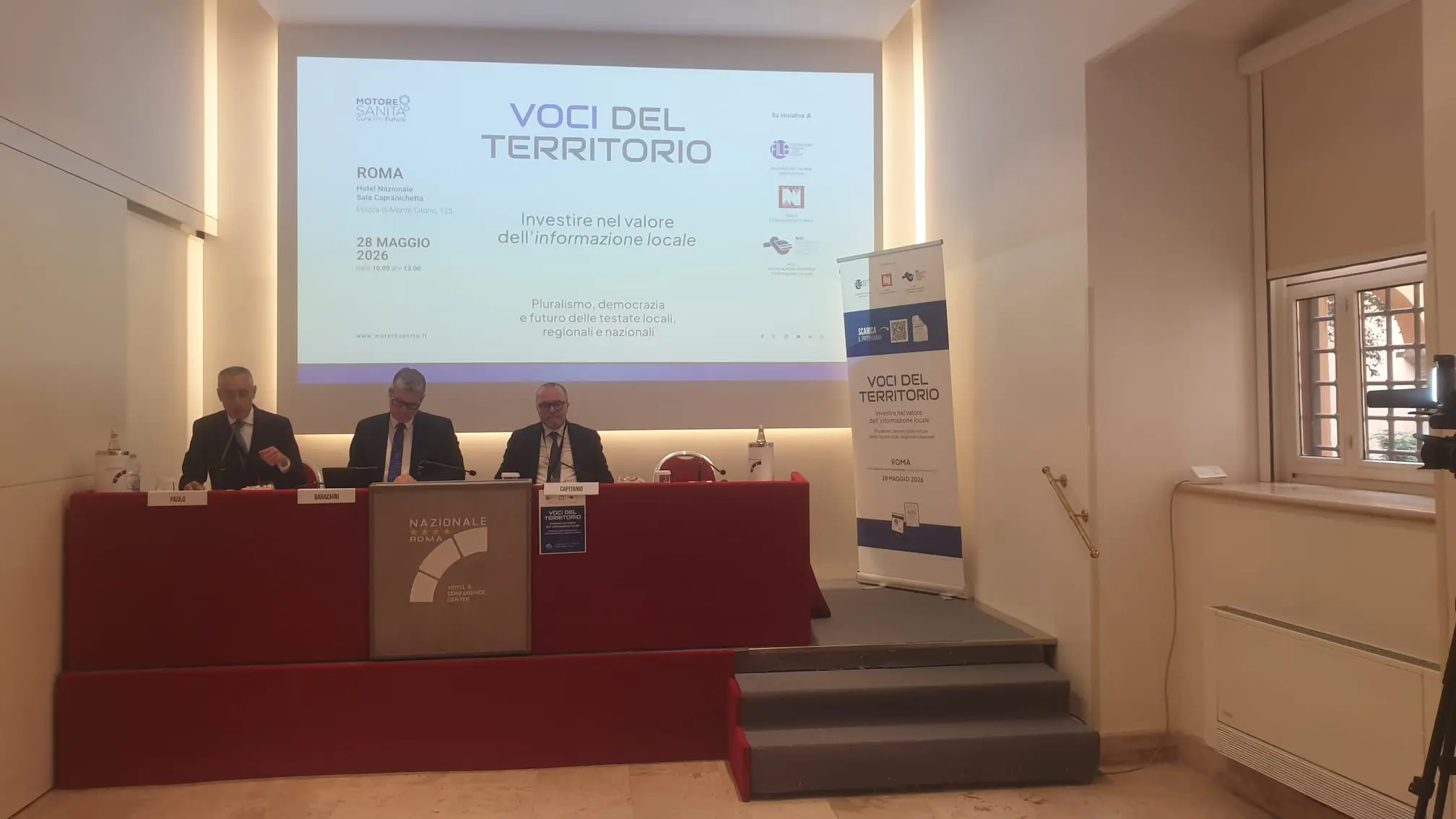
ROMA (ITALPRESS) – Investing in the value of local information as president of democracy, pluralism, civic control and participation of citizens: the File (Federation Italiana Liberi Editori), expresses full confidence in the words spoken by Alberto Barachini, Undersecretary to the Presidency of the Council of Ministers with delegation to the Information and Cooperative Editorial Office, intervened this morning in Rome to the national comparison on the future of information promoted by the.
Under the spotlight, therefore, the relationship between digital platforms and advertising market, the future of public support for publishing, the protection of editorial autonomy, the role of journalistic cooperatives, the implementation of the European Media Freedom Act and the need for new guarantees for proximity information. In fact, local information continues to ensure participation, widespread control, identity of communities and democratic qualities, a local and daily work to tell the territories and to give voice to local communities in the information supply chain.
Public support for information is essential for the undersecretary to ensure pluralism: “It is right to maintain current supports and avoid cuts – he said –, sharing the proposal to tax large online platforms that drain resources for more than 50% of the total advertising market and 75% of the digital one. There is the need to regulate the Over the Top (OTT) – he added referring to the companies that provide, through the Internet, services, content, video and absorb a significant share of the advertising market – so that they contribute to the production of quality content. We have to decide what the market is and what the game field is. Or artificial intelligence systems are publishers or not. From my point of view, I am. Then they must follow the same rules.”.
Called by Roberto Paolo, President FILE, transparency in the allocation of resources for institutional advertising orders ensuring compliance with the rules. Paul highlighted the importance of supporting local information to reach the whole population with in-depth news and thus avoiding a lowering of the level of attention and a danger to democracy.
To be noted the interventions of Massimiliano Catapanio, commissioner of the Authority for the Garanzie in the Communications, Federico Mollicone president of the VII Commission culture, science and education of the Chamber of Deputies, by Lorenzo Nicolosi managing director licensing and Miusic department Siae Claudio Verretto, President of FIPEG (Federazione Italiana Piccoli Salute Editori di Newspapers), Chiara Genisio, Vice-President of Piedmont FISC (Federazione Italiana.
All agreed to consider local and territorial publications an essential democratic presidium to be protected with a new balance between innovation, economic sustainability and pluralism. The concrete risk in the absence of targeted actions is editorial desertification and a serious democratic impoverishment of the country. Presidents of democracy also threatened by the Crimi amendment.
On this point the position of Nicola Calandrini (Fdi) president of the Fifth Permanent Commission Economic Planning and Senate Budget recalling the government’s work to make structural the funds that the Crimi amendment wanted to abolish: “Supporting territorial information means supporting democracy. The local newspapers and editorial cooperatives represent a fundamental democratic presidium, especially in the internal areas and in the most fragile territories. We chose to support the publishing sector in a historical phase marked by the crisis of the printed paper, the digital transformation and the radical change of the ways in which citizens are informed. With the Milleproroghe we have postponed the cuts previewed from the so-called Crimi amendment, which would have hit mainly journalistic cooperatives, non profit agencies, foundations and publishing associations – he added -. A clear choice: informational pluralism cannot be left exclusively to the logic of the market, especially in the most fragile territories and in the internal areas. The government is now at work to definitively overcome a logic of annual prorogues and structurally make the system of direct contributions provided by Legislative Decree 70/2017, that the Crimi amendment wanted to repeal, ensuring stability to editorial realities that every day ensure information of proximity and pluralism. With the 82 million of the DPCM 17 April 2025 we support paper, newsstands, distribution and sales points. Summarizing these measures to direct historical contributions for editorial pluralism, the overall public support for the sector between 2023 and 2025 largely exceeds 200 million euros.”.
– photo office printing File –
(ITALPRESS).