
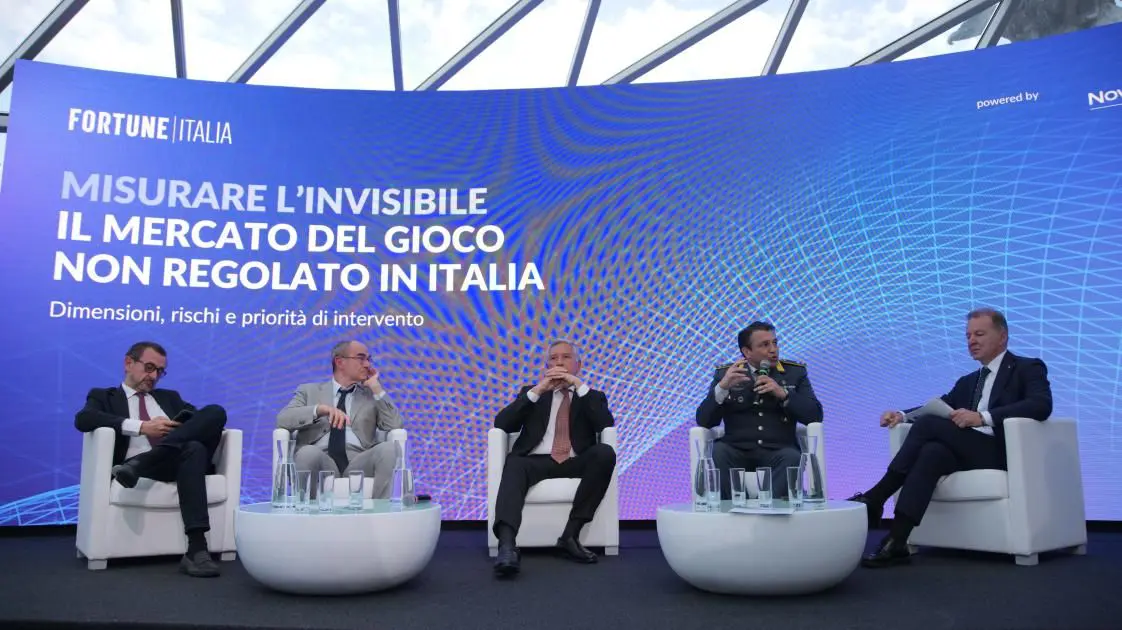
ROMA (ITALPRESS) – The illegal gaming market in Italy continues to pose a concrete threat not only for the herb, but also for the protection of consumers and for the overall seal of the system. It is the painting that emerged during the meeting “Measure the invisible. The game market not regulated in Italy”, with the participation of Renato Loiero, Economic Councillor Presidency of the Council of Ministers, and Marco Osnato, President Finance Commission, Chamber of Deputies.
On this occasion, the results of the LUISS and Prisma research were presented to measure the unregulated game market in Italy, within a comparison that involved academic worlds, institutions, control authorities and operators.
“The path of the tax delegation has strengthened the state’s granting system, focusing on clearer rules, greater transparency, digitization and qualification of operators – said Osnato –. The priority is consumer protection, along with the defence of legality and public revenue. Once this perimeter is defined, the contrast to illegality must be increasingly effective and co-ordinatedly involve institutions, supervisory authorities and investigative forces.”
From the analysis it emerged that Italy maintains a channelling rate of 92% of actual expenditure in the legal gaming market, one of the highest levels in the world. A fact that confirms the solidity of the Italian system and the role played, over time, by a normative, technological and operational framework that allowed the large majority of the application to the regulated circuit. This result, however, makes even more evident the risk represented by the residual share that continues to escape controls.
According to the LUISS-Prisma reports, in 2024 the overall collection of the sector reached 187.2 billion euros, but 29.8 billion are subtracted to the regulated circuit and intercepted by the illegal market. This is a significant share of 16% of the total, which clearly describes the economic dimension of the phenomenon and its ability to affect the balances of the sector.
The central point emerged from the meeting is that the illegal game does not produce only one negative effect, but it acts on multiple levels. On the one hand, it exposes consumers to an offer without guarantees, without traceability, without limits, without reliable mechanisms of self-exclusion or containment of problematic behaviour. On the other hand it determines a direct impact on public revenue, removing tax resources and feeding opaque circuits that often intersect with the criminal economy. Finally, it weakens the legal system, because it restricts the competitiveness of authorized operators and puts pressure on the perimeter granted, which constitutes the main presidium of legality, transparency and protection.
The research has evidenced that more than 85% of the illegal volume is now generated by offshore digital platforms, capable of operating out of licenses, tax obligations, anti-money laundering rules and consumer protection standards. In this segment also include crypto casino, bot Telegram and other digital tools that allow anonymous access, absence of deposit limits and complete opacity of flows. The competitive advantage of the illegal is based on this asymmetry: higher payouts, aggressive bonuses and total absence of constraints, in the face of a regulated market instead held to comply with rules, controls and stringent obligations.
One of the clearest messages in comparison concerns the protection of the player. Only the regulated circuit is able to offer concrete instruments of protection, from traceability of payments to deposit limits, from identification systems to self-exclusion mechanisms and links with support services. When the player migrates to the submerged,these guarantees are less. The apparent convenience of the illegal offer thus results in an increase in real risks for those who play.
Another point emerges from the work presented in Rome: the contrast to the illegal market cannot be separated from the ability of the legal sector to remain competitive. A regulated offer must continue to invest in technological innovation, anti-fraud systems, early identification tools of problematic behaviour and advanced protection measures. If the authorized circuit is progressively weakened by unsustainable conditions, a paradox effect is created: the player moves where no rules exist, and the system loses simultaneously effectiveness, control and protection ability.
“The legal game is not only a regulated sector, but an instrument of protection – said Mauro D’Attis, Vice-President of the Parliamentary Commission of Inquiry on the Mafia phenomenon –. It means offering citizens a controlled perimeter, transparent and subjected to the rules of the State, subtracting room for illegality. The illegal game, especially on the web, feeds opaque circuits that can interweave with organized crime, recycling and other illicit trafficking, as well as produce significant tax damage. For this reason both repressive tools, entrusted to the institutional and investigative network, and prevention action based on coherent norms and the strengthening of the legal system, because removing the player from illegal channels means protecting the person and the state together.”
“The contrast to the illegal game today requires increasingly effective tools, analysis skills, cooperation between institutions and a constant updating of intervention measures – explained Mario Lollobrigida, Director of Adm Games – The phenomenon has different characteristics between physical and digital, but in both cases the central point remains the protection of the player and the defense of a perimeter of legality that also protects the state. The legal circuit guarantees the identification of the user, limits of expense, self-exclusion, traceability of flows and prevention tools of behaviour at risk: you are sure that in unauthorized channels simply do not exist. This is why the strengthening of contrast action, on the operational, regulatory and cooperation between authorities, remains an essential priority.”
The meeting put the theme of illegal play within a wider framework of public policy. Defending the granting system does not mean protecting a part of interest, but preserving a tool that, over time, allowed to govern the public game sector, keep channelling, guarantee public revenue and build a perimeter of community protection controls. In this perspective, the contrast to illegality and the maintenance of an economically vital legal market appeared as two sides of the same strategy.
The studies presented offered a quantitative and methodological basis to read the phenomenon, through an econometric analysis built on regional dataset 2015-2024 and multivariate models validated for robustness.
The conclusions converge on one point: the Italian system works, but must be protected. Every regulatory intervention that affects the sector should therefore be evaluated also for its impact on channelling, on the competitive capacity of legal gaming and, consequently, on the concrete possibility of keeping players away from the illegal. Existing data are significant: the channelling rate is 92%; the overall collection is 187.2 billion euros, while the estimated illegal collection of 29.8 billion euros. The seizure from the legal market amounted to €10.5 billion, with a total damage to the illegal market of €1.4 billion per year.
“The illegal market alters deepnte the competition, because authorized operators support costs, compliance obligations, technological investments and taxation that the submerged simply does not – it has evidenced Markus Buechele, CEO Novomatic Italia – If the legal sector loses competitiveness, the risk is to move a part of the demand towards offers without rules, safeguards and controls. For this legality, taxation, anti-money laundering are the common guidelines, while innovation and protection of the player must be the guarantee for the user”.
The meeting “Measure the invisible. The game market not regulated in Italy”, organized by Novomatic Italia, was held in Rome, at La Lanterna, and gathered representatives of the academic world, institutions, supervisory authorities and
of the sector.
The closing round table, moderated by Massimo Maria Amorosini of Fortune Italia, has been dedicated to the relationship between the illegal market and the regulated system, intervened Markus Buechele, CEO of Novomatic Italia, Michele Esposito, General of Brigade and Commander of the Special Nucleo Tutela Entrate and Repressione Frodi Fiscali della Guardia di Finanza, Mario Lollobrigida, Director of the Agency of Customs and the Singles.
– Diessecom press office photos –
(ITALPRESS).