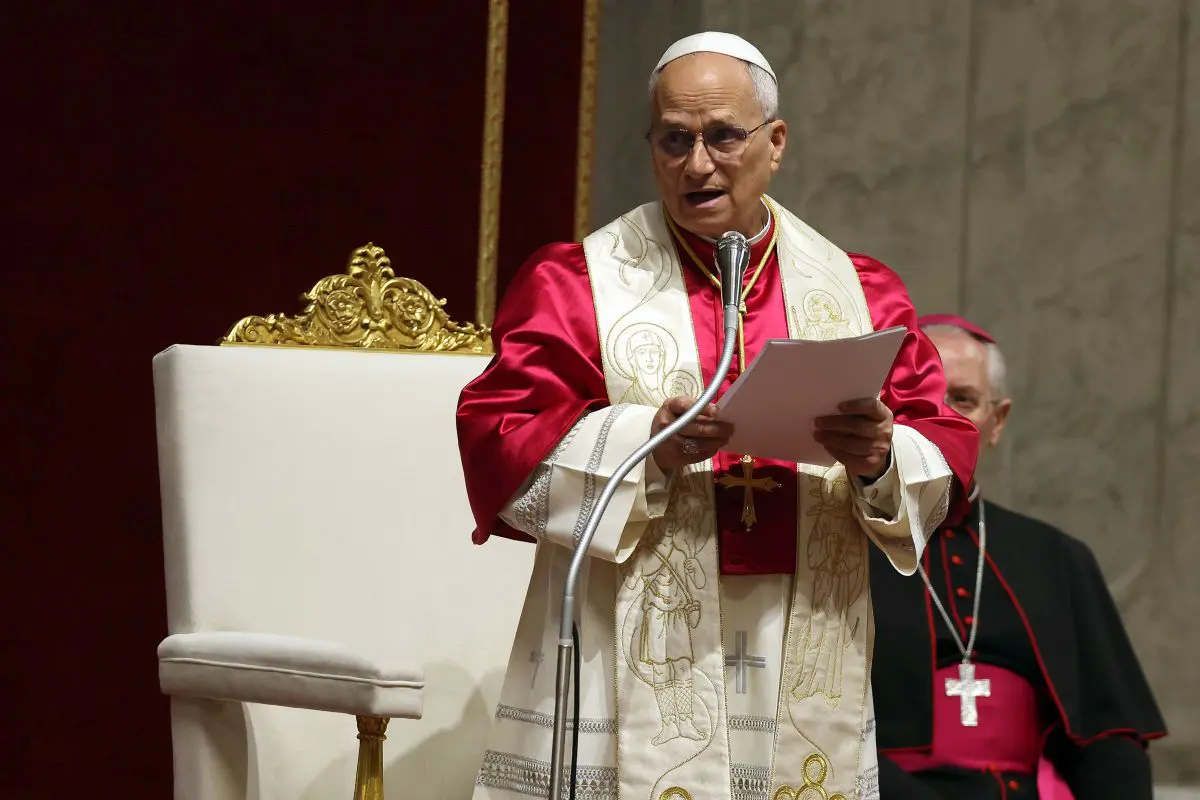
ROMA (ITALPRESS) – “Today we see a real paradigm shift in public discourse and rearmament choices, with a worrying rehabilitation of war as an instrument of international politics, while the ethical criteria that had limited its use are eroded.” This is what we read in the first encyclical letter of Pope Leo XIV “Magnifica humanitas”, presented in the Synod Hall. “Regional conflicts that drag themselves over time, escalation of tensions and crossed threats become almost habitual, and forms of conflict emerge for territorial expansion which they believed were overcome,” the Pope wrote. “The public opinion is progressively oriented and assumed by polarizing media narratives, often amplified by algorithms that enhance conflict and contrast,” he adds.
“A decisive test for social justice today is the condition of migrants, refugees and those who are forced to move due to poverty, violence, climate change and environmental disasters. The way a society treats them shows whether its idea of justice is guided by fear or fraternity. Social justice, in this field, implies at least two complementary commitments: on the one hand, safeguard the right to the hope of those who are forced to leave, guaranteeing safe and legal ways, dignified welcome conditions, real paths of integration. On the other hand, it also promotes the right to remain in your land in peace and security, addressing the deep causes that force to migrate, including those related to economic injustice and climate crisis. When these rights are respected, migration can become an opportunity for mutual encounter and enrichment among peoples,” he adds.
“Today, automation, robotics and artificial intelligence are rapidly transforming the very structure of work. This will bring, it is said, great improvements for all. In reality, the ‘new ways’ of working are not necessarily better, because while the Ia promises to boost productivity by taking charge of ordinary tasks, workers are often forced to adapt to the speed and demands of machines, rather than being designed to help those who work.” This is what we read in the first encyclical of Pope Leo XIV “Magnifica humanitas”, presented in the Synod Hall. “This is why, contrary to the benefits of the Ia that are advertised, the current approaches to technology can paradoxically disqualify workers, undergo automated surveillance and relegate them to rigid and repetitive functions,” the Pope writes.
“The need to keep pace with technology can erode the sense of its ability to act on the part of the workers and suffocate the innovative skills that these are called to deep into their work. We need to design systems centred on the person and not only on the performance,” says Leo XIV.
“A significant part of the operation of the digital economy is based on the silent work of millions of human beings, employed in unseen but essential activities. In many cases it is young people, mostly women, who work hard for minimal compensation. To this invisible effort is added that, even more brutal, of the extraction of the resources necessary for the production of the devices and the microprocessors on which the Ia rests”, writes the Pope. “In some regions of the world, adolescents and children work in dangerous conditions in shattering materials from which rare lands are produced. Corps marked, mutilated, consumed because the flow of the calculation does not stop,” he adds.
The Pontiff recalls that in “some contexts it is realistic to fear a significant and rapid contraction of the available places, with a chain effect that affects in depth families, young people and local economies”.
“In many sectors this already results in new forms of precariousness and inequality, with very high remuneration for a highly specialized minority and increasingly reduced wages for a large part of the active population.” For Pope Leo XIV “it is desirable that technology raises man from particularly heavy, repetitive or dangerous jobs and that it offers intelligent support to human activity, but the general rule must remain the protection of jobs and the irreplaceable role of the person. The objective of greater profits cannot justify choices that systematically sacrifice employment, because the human person is fine and not half, and the economic order must remain subject to his dignity and to the common good.”.
– Photo of repertoire IPA Agency –
(ITALPRESS).