There is one day in New York, where time seems to slow down and the city changes pace. It happens at the end of June, when the sun remains taller and, between the green overlooking the Hudson, the Midsummer Festival takes place in the large space of Battery Park that widens its view over the Statue of Liberty. It is a very ancient Nordic tradition, linked to the summer solstice, the moment when light reaches its peak, already celebrated in pre-Christian times with rituals related to fertility, nature and the cycle of seasons. It is celebrated on the weekend closest to June 24, and also New York keeps intact that same light and collective energy (the next appointment is scheduled for June 20 from 16.00 to 21.00). Here, in the heart of Battery Park, the celebration takes shape surprisingly authentic and incredibly engaging. Thousands of people dressed in white clothes, find themselves to participate in a party that is both simple and deeply symbolic.
At the centre of the scene is the Maypole, the pole decorated with leaves and flowers, around which it dances in circle following movements handed down over time. Around, wreaths of hand-woven flowers, live folk music, tables with improvised picnics and traditional dishes. It is not a folklore reconstruction for tourists, but a celebration carried out for decades by the Scandinavian community in the city and, especially in recent years, became a fixed appointment of the New York summer. The difference, compared to Scandinavia, is all in the context: if there is often celebrated in nature, between friends and family, here the Midsummer becomes an open, shared moment, almost suspended between different cultures. For a few hours, New York stops being hectic and lets itself cross from a sense of slowness, light and community that seems to come from far away.
From here you can start discovering New York’s Scandinavia that has no precise neighborhood, never having developed a mass immigration from northern Europe in New York, but there is a discreet, authentic, hidden between places and rituals to look for. In the late 19th century and early 20th century, many Scandinavians established themselves in the American Midwest, while New York remained more an entrance door and a pass point than a final destination. Precisely for this reason their presence in the city has remained more widespread than territorial, made not only of IKEA but also of churches, cultural associations, institutions and small places of identity, more than a real district recognizable on the map.
One of the most authentic places to understand how this Nordic presence is interwoven with the city is the Church of Sweden. On the 48th street between 5th and Madison Avenue in Manhattan, it appears almost discreet, with its sober facade that fits without noise in the ordered rhythm of the neighborhood. But just cross the threshold (from Wednesday to Sunday between noon and 16.00) to change completely register. You are not only entering a place of worship but in a hybrid space, suspended between spirituality, culture and everyday life. Born to serve the Swedish community in New York, the Church of Sweden over time has become a real meeting point. Traditional holidays are celebrated here, seasonal events, markets, expat meetings and moments open to the city.
But the real surprise is located on the ground floor, where a small coffee opens which seems to be transported directly from Stockholm. It is here that you can eat fast meals based on smoked salmon, and snacks that reflect one of the deepest rituals of Swedish culture (FIKA in Scandinavian terminology): not a simple coffee break, but a way to inhabit time, sit down, slow down, share something sweet, without haste or distractions. Among homemade cakes, cinnamon rolls among the most soft of all New York and coffee served with almost domestic simplicity, you create an atmosphere that contrasts clearly with the rhythm of the city just outside. Along the walls of the coffee furnished in light wood, they sell chocolate and typical candy, books in language and decorated soprammobili that contribute to make the atmosphere home and extremely welcoming, even more in the Christmas period when the space between the tables turns into a real colorful market.
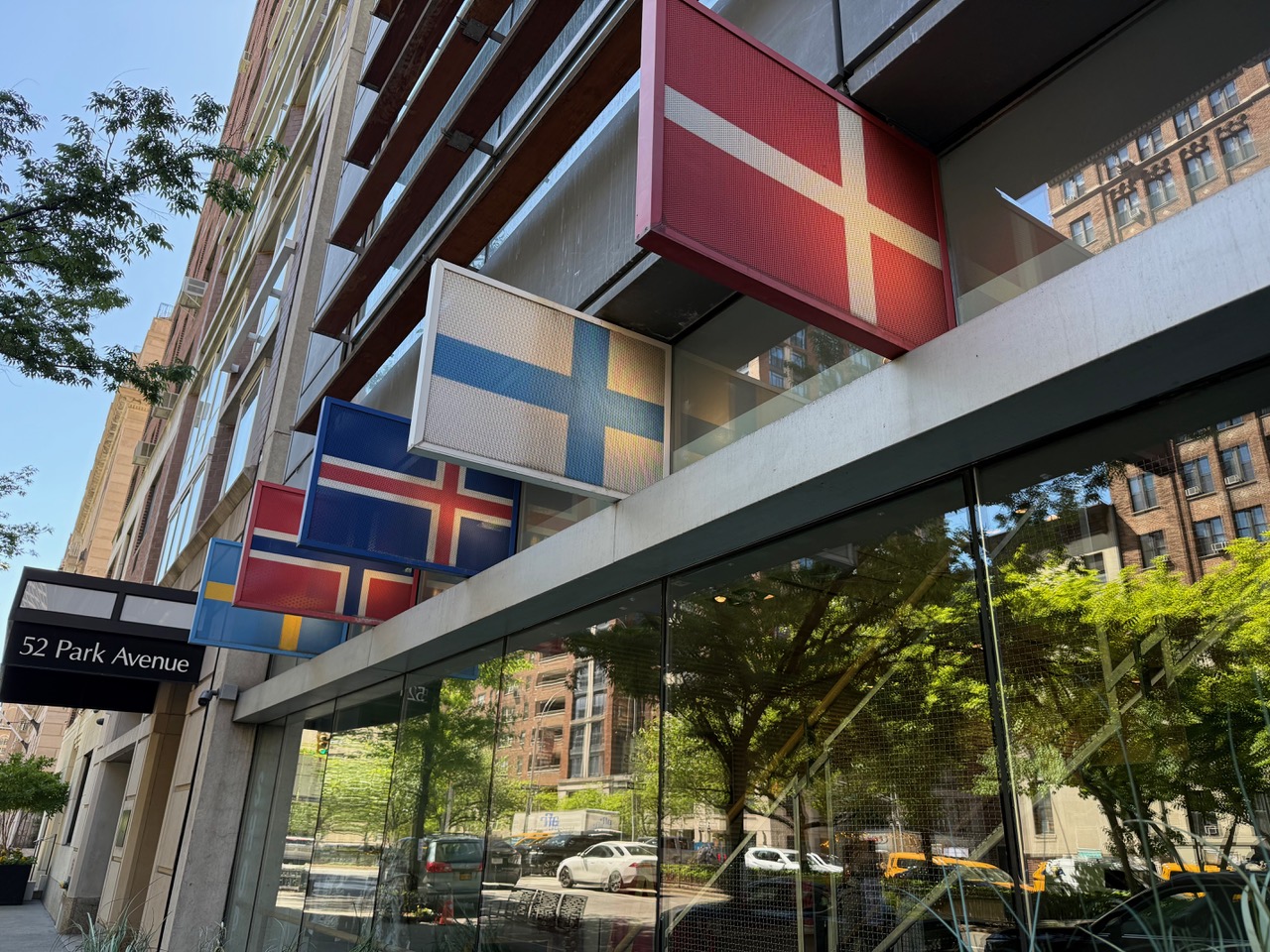
Another fundamental point to read this Nordic presence in New York is Scandinavia House, at 58 Park Avenue. Unlike the most intimate size and collection of the Swedish church, although with the same multifunctional ambition, here you enter a more contemporary, bright, essential space where Scandinavia is told through culture, design and images. The structure is the official center of the American-Scandinavian Foundation and works as a real window on Northern Europe where art and photography exhibitions are organized within the beautiful gallery on the third floor, cinema shows, book presentations, meetings with artists and designers. The shop on the ground floor exhibits brand objects known as Marimekko but also local producers all to discover. It is a place that does not seek the nostalgic effect, but that of the representation of the present Scandinavia between minimalist aesthetics and cultural reflection. But as always it is in the kitchen that every culture is best expressed and Björk Cafe & Bistrot, always within this structure is a first address to mark!
Widening research in New York, however, the most historical reference of Scandinavian cuisine is Aquavit, opened in 1987. It was one of the first restaurants to bring Manhattan a modern view of the Nordic tradition, long before the “Nordic cuisine” became a global trend. Here the Swedish cuisine is reinterpreted with almost architectural precision: essential dishes, clean techniques and ingredients that focus more on quality than on effect. Very different, but equally significant, is the experience of Aska, in Brooklyn. Here the kitchen is no longer just reinterpreted tradition, but I tell. The tasting route is built as a journey that recalls landscapes and raw materials of Northern Europe: fermentations, ancient techniques, often unexpected ingredients for the New York context. It is one of the most radical and contemporary expressions of Nordic cuisine in the city, and represents the most experimental side of this presence.
Next to the most structured catering, a fundamental part of Scandinavian presence in New York is then located in the bakery, where the Nordic language becomes immediately recognizable in the details: cardamom buns, cinnamon rolls, rye bread and a simplicity that is almost aesthetical before gastronomic.
The most authentic and consolidated reference is Fabrique Bakery, a Swedish bakery born in Stockholm and arrived in New York with different locations. Here the approach remained very faithful to the original: long leavening dough, essential sweets and a production that closely recalls the model of contemporary Scandinavian bakery. The cardamom bun, in particular, has become one of the most recognizable symbols of this presence in the city. Along with fine dining restaurants, these bakery represent perhaps the most daily side of Nordic culture in New York: places where Scandinavia becomes something you can really taste, in a city where everything changes quickly but some flavors remain surprisingly stable.
In a mid-summer party, a church became a meeting point and some restaurants loyal to traditions we explored another culture that every day contributes to the magical melting pot of New York! And this is the meaning of the World Tour in New York: discover that the city never lets you read all together, but only for fragments, communities, details that emerge between one neighborhood and the other.
If you liked this trip in New York Scandinavia, you can find the other stages of the column already published and continue to explore the different souls of the city. And the appointment is next month, when we move back to another culture, another community, another piece of world hidden in the streets of New York.
L’articolo There is also some Scandinavia in New York proviene da IlNewyorkese.